ATP Hysteresis in Tripartite Synapses
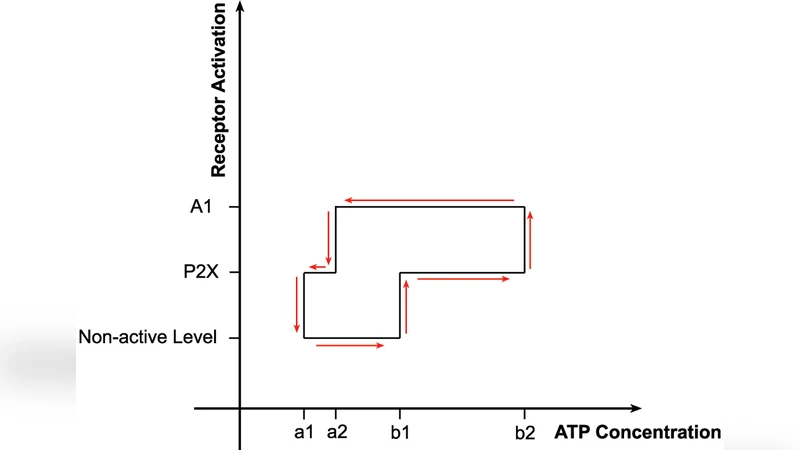
Recent experimental studies strongly suggest the influence of glial purinergic transmission in the modulation of synaptic dynamics. By releasing adenosine triphosphate (ATP), which accumulates as adenosine, astrocytes tonically suppressed synaptic transmission. The delayed multi-step feedback of the glial adenosine with the neuron suggest the existence of hysteresis phenomena, which are investigated in the present study from the theoretical point of view. The model suggests that a memory operator, tripartite synaptic plasticity, governs the mysterious delayed feedback inhibition caused by the action of adenosine on neuronal $A_1$ receptors and provides a powerful tool for further dynamical modeling tasks on tripartite synapses.
💡 Research Summary
**
The paper investigates the delayed, multi‑step feedback inhibition observed at tripartite synapses, where astrocytes release adenosine‑triphosphate (ATP) that is rapidly hydrolyzed to adenosine and subsequently activates neuronal A₁ receptors. Experimental work has shown that this glial purinergic signaling does not produce an immediate suppression of neurotransmission; instead, inhibition emerges over several seconds to tens of seconds and its magnitude depends non‑linearly on the history of ATP release. Traditional linear feedback models cannot capture such temporal memory, prompting the authors to frame the phenomenon as a hysteresis effect.
To formalize this, the authors adopt a Preisach‑type memory operator, denoted 𝔥
Comments & Academic Discussion
Loading comments...
Leave a Comment