LISA technology and instrumentation
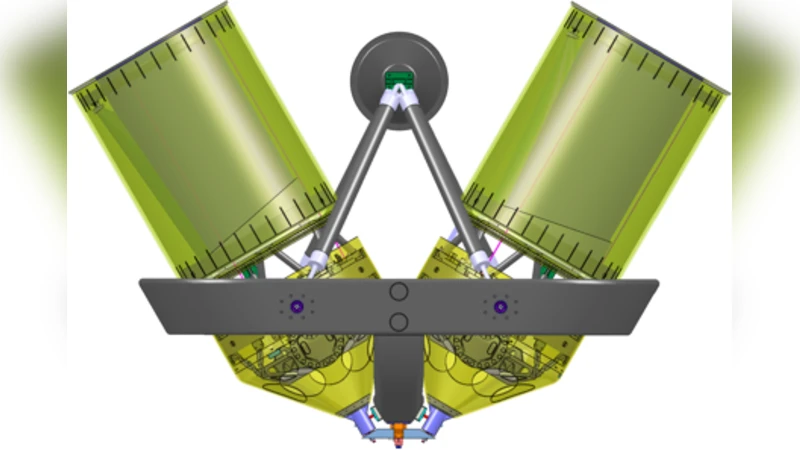
This article reviews the present status of the technology and instrumentation for the joint ESA/NASA gravitational wave detector LISA. It briefly describes the measurement principle and the mission architecture including the resulting sensitivity before focussing on a description of the main payload items, such as the interferomtric measurement system, comprising the optical system with the optical bench and the telescope, the laser system, and the phase measurement system; and the disturbance reduction system with the inertial sensor, the charge control system, and the micropropulsion system. The article touches upon the requirements for the different subsystems that need to be fulfilled to obtain the overall sensitivity.
💡 Research Summary
The paper provides a comprehensive review of the current status of the technology and instrumentation that will enable the joint ESA‑NASA space‑based gravitational‑wave observatory LISA (Laser Interferometer Space Antenna). It begins by outlining the fundamental measurement principle: three spacecraft form an almost equilateral triangle with arm lengths of 2.5 million km, and laser beams are exchanged between the free‑falling test masses (TMs) on each spacecraft. A passing gravitational wave induces picometer‑scale changes in the inter‑spacecraft distances, which are sensed by a heterodyne laser interferometer. Because the TMs must remain in pure geodesic motion, a Disturbance Reduction System (DRS) is required to suppress all non‑gravitational forces.
The mission architecture is described next, together with the target sensitivity curve (≈10⁻²⁰ /√Hz at 1 mHz, covering 0.1 mHz–1 Hz). The authors present a noise‑budget allocation that distributes the total allowable noise among the various subsystems.
The payload is divided into two major blocks. The Interferometric Measurement System (IMS) comprises the optical system (optical bench and 30 cm aperture telescope), the laser system, and the Phase Measurement System (PMS). The optical bench is fabricated from ultra‑low‑expansion carbon‑composite material and is thermally stabilized to keep path‑length fluctuations below 10 pm. The telescope delivers the laser beam to the distant spacecraft and includes active pointing control. The laser is a 1064 nm Nd:YAG source delivering several watts; its power and frequency are stabilized by electronic feedback loops and temperature control, achieving frequency noise below 1 Hz/√Hz in the critical band. The PMS uses high‑speed photodiodes and digital signal‑processing electronics (sampling at 10 MHz) to achieve a phase‑noise floor of ~1 µrad/√Hz. The measured phases are processed with Time‑Delay Interferometry (TDI) to cancel laser frequency noise and arm‑length mismatches.
The Disturbance Reduction System (DRS) consists of the inertial sensor, the charge‑control system, and the micro‑propulsion system. The inertial sensor levitates the TM electrostatically, achieving acceleration noise ≤10⁻¹⁵ m/s²/√Hz. Charge accumulation from the solar wind is mitigated by UV‑LED‑based photo‑discharge, keeping the TM charge below 10⁻¹³ C. The micro‑propulsion system, based on field‑emission electric propulsion (FEEP) or colloid thrusters, provides thrust on the order of 0.1 µN with thrust‑noise ≤10⁻⁸ N/√Hz, enabling precise drag‑free control.
Each subsystem’s technical requirements are compared with the current Technology Readiness Level (TRL). The optical bench, telescope, and laser frequency stabilization have already demonstrated performance exceeding the LISA specifications in laboratory tests (TRL 6‑7). The inertial sensor and charge‑control hardware are at TRL 6, while the long‑duration reliability of the micro‑thrusters and the in‑flight performance of the charge‑control system remain at TRL 5‑6, representing the principal risk areas.
The authors conclude by identifying the remaining development challenges: long‑term micro‑thruster lifetime, efficient charge management in the space environment, real‑time implementation of TDI algorithms, and full system integration testing. They propose a roadmap that leverages results from the LISA Pathfinder mission, extensive ground‑test facilities, and extended environmental qualification campaigns. Successful mitigation of these risks will allow LISA, slated for launch in the early 2030s, to achieve its unprecedented low‑frequency sensitivity and open a new window on the gravitational‑wave universe.
Comments & Academic Discussion
Loading comments...
Leave a Comment