Matrix Completion from a Few Entries
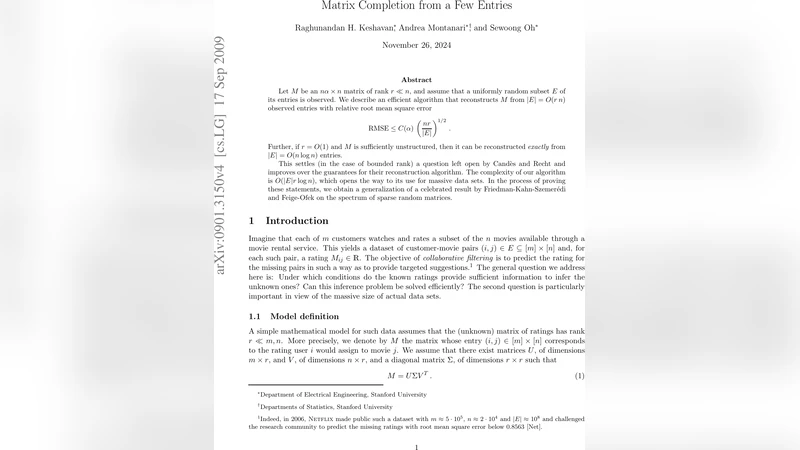
Let M be a random (alpha n) x n matrix of rank r«n, and assume that a uniformly random subset E of its entries is observed. We describe an efficient algorithm that reconstructs M from |E| = O(rn) observed entries with relative root mean square error RMSE <= C(rn/|E|)^0.5 . Further, if r=O(1), M can be reconstructed exactly from |E| = O(n log(n)) entries. These results apply beyond random matrices to general low-rank incoherent matrices. This settles (in the case of bounded rank) a question left open by Candes and Recht and improves over the guarantees for their reconstruction algorithm. The complexity of our algorithm is O(|E|r log(n)), which opens the way to its use for massive data sets. In the process of proving these statements, we obtain a generalization of a celebrated result by Friedman-Kahn-Szemeredi and Feige-Ofek on the spectrum of sparse random matrices.
💡 Research Summary
The paper addresses the fundamental problem of low‑rank matrix completion: given a matrix M of size α n × n (α is a constant, typically 1) with rank r ≪ n, recover M from a randomly sampled subset E of its entries. The authors propose an algorithm that works with only |E| = O(r n) observations, achieving a relative root‑mean‑square error (RMSE) bounded by C·√(r n/|E|). When the rank r is constant, the method even guarantees exact recovery with |E| = O(n log n) samples. The algorithm runs in O(|E| r log n) time, making it suitable for massive data sets. The results hold for any incoherent low‑rank matrix, extending beyond purely random constructions, and they settle an open question left by Candès and Recht regarding the optimal sample complexity for bounded rank.
Problem Setting and Assumptions
M ∈ ℝ^{αn×n} is assumed to be μ‑incoherent: the left and right singular vectors have bounded inner products with the standard basis, ensuring that the information in M is spread uniformly across its entries. A sampling mask Ω ⊂
Comments & Academic Discussion
Loading comments...
Leave a Comment