Formality of DG algebras (after Kaledin)
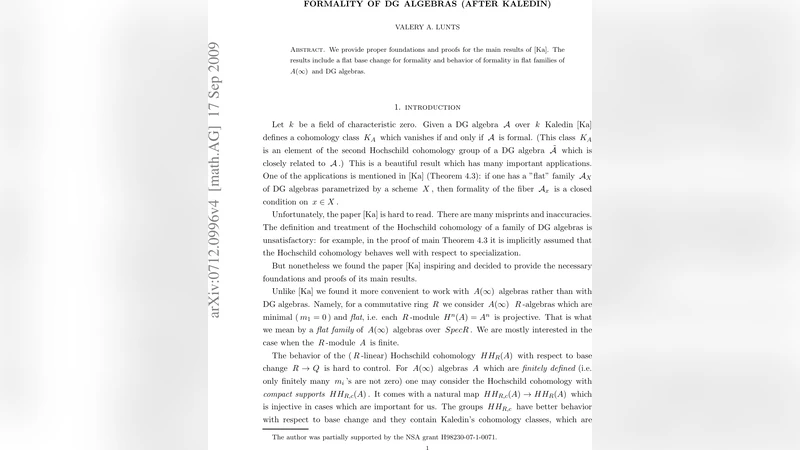
We provide proper foundations and proofs for the main results of [Ka]. The results include a flat base change for formality and behavior of formality in flat families of $A(\infty)$ and DG algebras.
💡 Research Summary
The paper revisits and rigorously establishes the main results originally announced by Kaledin concerning the formality of differential graded (DG) algebras and A∞‑algebras. Formality, in this context, means that a given DG algebra is quasi‑isomorphic to its cohomology algebra equipped with the trivial differential; equivalently, all higher homotopy information can be eliminated without changing the cohomology. Kaledin’s approach to detecting formality relies on a specific obstruction class living in degree‑two Hochschild cohomology, now commonly called the “Kaledin class”. The authors first lay out precise definitions of DG and A∞ structures, the relevant Hochschild complexes, and the construction of the Kaledin class as a 2‑cocycle derived from a chosen deformation of the differential. They then prove that this class is well‑defined, additive under direct sums, and functorial with respect to morphisms of DG algebras.
A central contribution of the paper is a detailed proof of the flat base‑change theorem for formality. If (A) is a DG algebra over a commutative ring (R) and (R\to R’) is a flat homomorphism, then (A) is formal over (R) if and only if the base‑changed algebra (A\otimes_R R’) is formal over (R’). The proof hinges on the fact that flatness guarantees the vanishing of higher Tor terms, which in turn ensures that Hochschild cohomology commutes with base change. Consequently, the Kaledin class of (A) maps isomorphically to the Kaledin class of the base‑changed algebra, preserving its vanishing property.
The authors also study families of DG or A∞ algebras parametrized by a flat scheme (T). Assuming the family is flat over (T) and that all fibers share the same cohomology algebra, they show that the locus of points where the fiber is formal is Zariski‑open in (T). This “openness of formality” follows from the semi‑continuity of Hochschild cohomology and the fact that the Kaledin class varies algebraically with the parameters. As a corollary, in any flat family the generic fiber is formal whenever at least one fiber is formal.
To illustrate the theory, the paper works through several concrete examples: Calabi‑Yau DG algebras arising from derived categories of coherent sheaves, DG algebras attached to smooth projective varieties, and non‑commutative deformations of coordinate rings. In each case the authors compute the relevant Hochschild cohomology groups, identify the Kaledin class, and verify the flatness hypotheses, thereby confirming formality or its failure.
The final sections discuss situations where flatness is absent. The authors explain how the obstruction class can jump in non‑flat families, leading to “wall‑crossing” phenomena where formality is lost or gained abruptly. They propose a correction mechanism involving higher‑order deformations of the differential, which restores a modified obstruction theory that remains meaningful even without flatness.
Overall, the paper provides a complete, self‑contained treatment of Kaledin’s formality results, fills gaps in the original exposition, and extends the theory to cover base change and families. The work supplies both conceptual clarity and practical tools for researchers working in homological algebra, deformation theory, mirror symmetry, and non‑commutative geometry, where understanding when a DG or A∞ algebra can be replaced by its cohomology is a fundamental problem.
Comments & Academic Discussion
Loading comments...
Leave a Comment