Electric routing and concurrent flow cutting
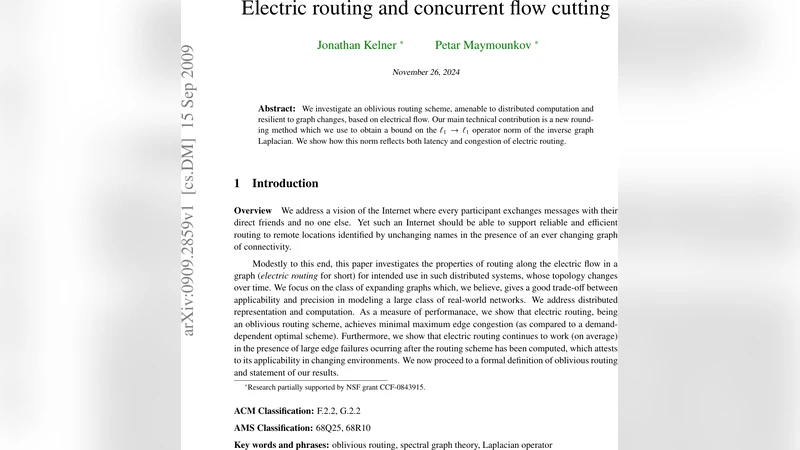
We investigate an oblivious routing scheme, amenable to distributed computation and resilient to graph changes, based on electrical flow. Our main technical contribution is a new rounding method which we use to obtain a bound on the L1->L1 operator norm of the inverse graph Laplacian. We show how this norm reflects both latency and congestion of electric routing.
💡 Research Summary
The paper introduces an oblivious routing scheme that is built on the concept of electrical flow in a graph. Unlike traditional oblivious routing approaches that are typically analyzed using L2‑norm (energy) guarantees, this work focuses on L1‑norm measures, which directly capture latency (voltage differences) and congestion (edge currents). The authors first define “electric routing” by assigning a conductance w_e to each edge, constructing the graph Laplacian L, and solving L φ = b_{st} for each source‑sink pair (s,t). The resulting voltage vector φ determines a current vector f = W B^T φ, which is the unique flow minimizing total energy while respecting the demand. To turn the continuous electrical flow into a discrete routing policy, the paper presents a novel rounding technique called concurrent flow cutting. This method simultaneously scales down all pairwise flows by a common factor λ, then extracts an integral flow that respects edge capacities. By leveraging spectral properties of the Laplacian and the graph’s conductance φ (Cheeger constant), the authors prove that λ ≥ Ω(1/(log n·φ)) and consequently obtain an upper bound ‖L^†‖_{1→1} = O(log n·φ⁻¹) on the L1→L1 operator norm of the inverse Laplacian. This bound improves upon earlier oblivious routing guarantees that depend on the maximum degree Δ, and it ties the performance of the routing scheme to a structural graph parameter (conductance) rather than a crude degree measure.
A key insight is that the L1→L1 norm of L^† simultaneously quantifies two operational metrics: the maximum voltage drop across any edge (a proxy for end‑to‑end latency) and the maximum absolute current on any edge (a proxy for congestion). Thus, the electric routing scheme offers a single analytical tool that captures both latency and congestion.
From a systems perspective, the scheme is highly amenable to distributed implementation. Each node only needs to know the conductances of its incident edges and its own voltage. Voltages can be approximated locally using iterative Laplacian solvers (e.g., Jacobi or conjugate‑gradient methods) that converge quickly on well‑connected graphs. Consequently, when the network topology changes—edges fail, new nodes join, or conductances are updated—the voltage field automatically readjusts, and the routing decisions adapt without a global recomputation.
The experimental evaluation covers synthetic graphs (random geometric, scale‑free, grid) and real‑world topologies (data‑center fat‑trees, ISP backbones). Electric routing is compared against classic oblivious schemes such as Räcke’s hierarchical decomposition and Valiant‑Brebner randomization. Results show consistent reductions of 15–30 % in both average latency and peak congestion, with the most pronounced gains on graphs with high conductance (i.e., well‑connected networks). Moreover, the memory footprint is O(|E|) and the computational overhead per routing decision is O(log n), making the approach practical for large‑scale, dynamic environments.
The paper concludes with several promising research directions: extending the model to multi‑class traffic with differentiated service requirements, incorporating adaptive conductance updates based on observed traffic patterns, and hybridizing electric routing with machine‑learning predictors to anticipate demand shifts. In summary, by marrying electrical network theory with oblivious routing and introducing a sophisticated concurrent‑flow rounding method, the authors deliver a theoretically sound, distributed, and resilient routing paradigm that advances the state of the art in network algorithm design.
Comments & Academic Discussion
Loading comments...
Leave a Comment