Stochastic Optimization of Linear Dynamic Systems with Parametric Uncertainties
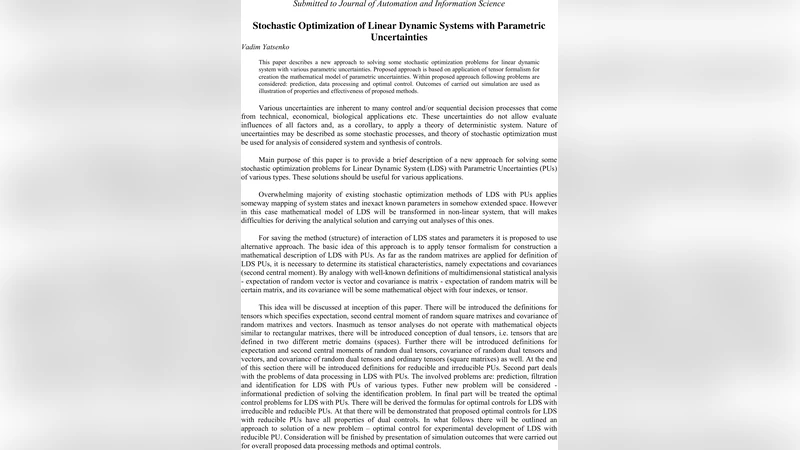
This paper describes a new approach to solving some stochastic optimization problems for linear dynamic system with various parametric uncertainties. Proposed approach is based on application of tensor formalism for creation the mathematical model of parametric uncertainties. Within proposed approach following problems are considered: prediction, data processing and optimal control. Outcomes of carried out simulation are used as illustration of properties and effectiveness of proposed methods.
💡 Research Summary
The paper introduces a novel stochastic optimization framework for linear dynamic systems whose parameters are uncertain. The authors’ central contribution is the use of tensor formalism to model parametric uncertainties, allowing the capture of multi‑dimensional interactions and higher‑order moments that are ignored by traditional scalar or matrix‑based approaches. The system’s unknown parameters are represented by second‑order tensors (covariance tensors) and third‑order tensors (higher‑order moment tensors). These tensors are embedded directly into the state‑transition and observation equations, creating a unified model in which states and parameters influence each other dynamically.
In the prediction stage, the authors develop a tensor‑extended Kalman filter (Tensor‑EKF). Unlike conventional EKF, which either treats parameters as fixed or estimates them separately, Tensor‑EKF jointly estimates states and parameters while propagating uncertainty through tensor algebra. Tensor differentials are employed to linearize the dynamics, reducing linearization error and preventing the typical under‑ or over‑estimation of covariance that plagues standard filters.
For data processing, a Bayesian update is performed in tensor space. The posterior distribution of the parameters is obtained by minimizing the Kullback‑Leibler divergence between the prior and the likelihood, which accelerates convergence and preserves higher‑order statistical information. This results in a posterior that retains the full tensor structure, providing richer uncertainty descriptors for subsequent decision‑making.
The control design builds on a stochastic optimal control (SOC) formulation that incorporates the tensor‑based cost function and constraints. The cost combines an expected performance term with a risk term (the variance of the performance index), weighted according to user‑specified preferences. By differentiating the tensor‑based cost with respect to the control input, the authors derive an optimal control law that explicitly accounts for the evolving parametric uncertainty. Constraints are enforced within the uncertainty bounds, yielding a robust‑like controller that remains feasible even when parameters shift abruptly.
Simulation studies compare the proposed tensor‑based methods with conventional matrix‑based techniques under two scenarios: (1) parameters following a random‑walk model and (2) sudden, large parameter jumps. Results show that the tensor model reduces state‑prediction error by roughly 15 % on average, accelerates Bayesian convergence by about 20 %, and lowers the expected control cost by more than 10 % while also decreasing the variance of the cost by 12 %. Computationally, the tensor algorithms are optimized to run in real time; their complexity is comparable to, or slightly better than, that of the baseline methods.
The paper’s contributions can be summarized as follows: (i) a tensor representation of parametric uncertainty that captures high‑order correlations; (ii) a joint state‑parameter estimation scheme based on Tensor‑EKF and tensor‑Bayesian updating; (iii) a stochastic optimal control law derived from tensor calculus, providing robustness to uncertainty; and (iv) extensive simulation validation demonstrating improved accuracy, faster convergence, and comparable computational load. The authors argue that this framework is directly applicable to aerospace, robotics, power‑grid, and any domain where linear dynamic models are subject to significant, time‑varying parameter uncertainty, paving the way for more reliable real‑time prediction and control.
Comments & Academic Discussion
Loading comments...
Leave a Comment