The Gated Narrow Escape Time for molecular signaling
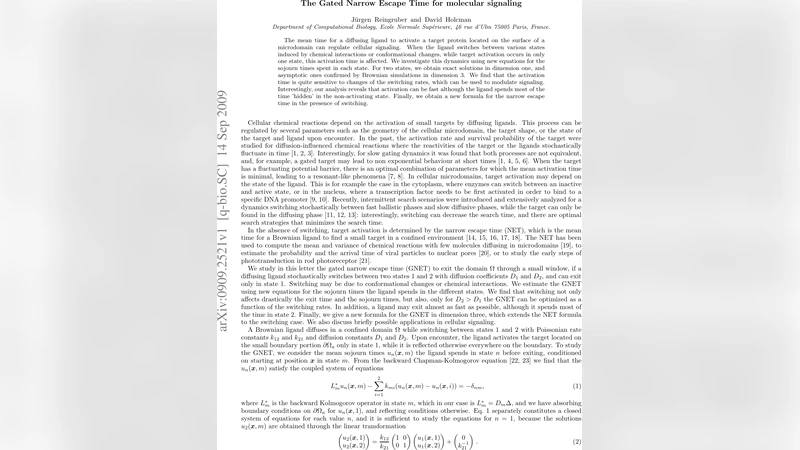
The mean time for a diffusing ligand to activate a target protein located on the surface of a microdomain can regulate cellular signaling. When the ligand switches between various states induced by chemical interactions or conformational changes, while target activation occurs in only one state, this activation time is affected. We investigate this dynamics using new equations for the sojourn times spent in each state. For two states, we obtain exact solutions in dimension one, and asymptotic ones confirmed by Brownian simulations in dimension 3. We find that the activation time is quite sensitive to changes of the switching rates, which can be used to modulate signaling. Interestingly, our analysis reveals that activation can be fast although the ligand spends most of the time ‘hidden’ in the non-activating state. Finally, we obtain a new formula for the narrow escape time in the presence of switching.
💡 Research Summary
The paper addresses a fundamental question in cellular signaling: how long it takes for a diffusing ligand to activate a target protein that resides on the surface of a confined micro‑domain. Classical narrow‑escape theory (NET) predicts the mean first‑passage time to a small absorbing window on an otherwise reflecting boundary. However, many ligands undergo conformational or chemical switching between several internal states, and only one of these states is competent for binding to the target. The authors term this situation a “gated” narrow‑escape problem and develop a rigorous mathematical framework to quantify the mean activation time (MAT) under such gating.
Model formulation
The ligand diffuses with coefficient D in a bounded domain Ω. It can occupy two states, A (binding‑competent) and B (non‑competent), with Markovian transition rates kAB (A→B) and kBA (B→A). The target protein is represented by a small circular (in 2‑D) or spherical (in 3‑D) window of radius ε on the boundary ∂Ω. When the ligand reaches the window in state A it is instantly absorbed (activation); in state B it is reflected. The authors write down coupled diffusion–reaction equations for the probability densities pA(x,t) and pB(x,t) and, by integrating over time, derive coupled Poisson equations for the mean sojourn times τA(x) and τB(x). These equations incorporate both diffusion and the stochastic switching dynamics.
Exact solution in one dimension
For a one‑dimensional interval
Comments & Academic Discussion
Loading comments...
Leave a Comment