Excel Modelling - Transparency, Auditing and Business Use
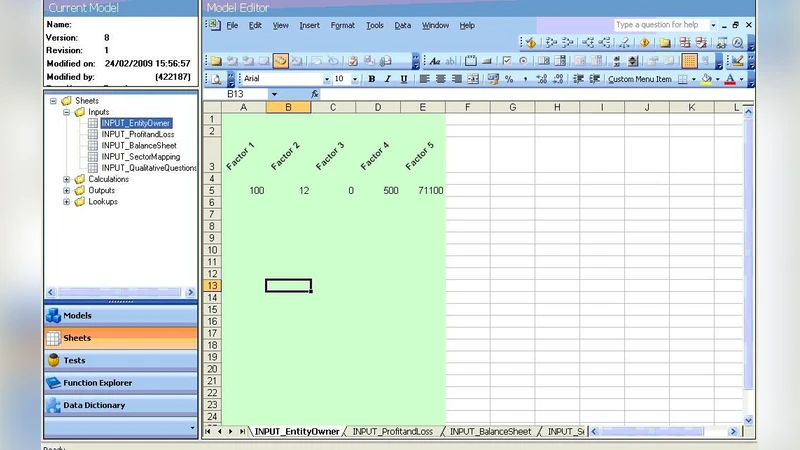
Within Lloyds Banking Group the heritage HBOS Corporate division deals with Corporate loans, and is required to assess these loans for risk in accordance with the Basle Accord regulations. Statistical Risk Rating models are developed by the risk analysts to assess the obligors credit worthiness. It is necessary then to provide the bankers who originated the loan (‘Relationship Managers’ or RMs) with an assessment tool to generate the loan rating upon which they base their lending decisions. Heritage HBoS Corporate required a new model build system for holding its Risk Rating models in 2006 as a result of more complex models being created to comply with the Basle Accord. The use of Excel was promoted by the IT department for a number of reasons; the Excel solution now in use is reviewed in this paper.
💡 Research Summary
The paper presents a case study of how the HBOS Corporate division of Lloyds Banking Group replaced its legacy risk‑rating model management platform with an Excel‑based system in 2006 to meet the increasingly complex requirements of the Basel Accord. The authors begin by outlining the regulatory pressure that forced the organization to develop more sophisticated statistical models for assessing corporate loan risk and the need to provide Relationship Managers (RMs) with a fast, user‑friendly tool for generating credit ratings.
Excel was chosen by the IT department for several strategic reasons: low acquisition cost, rapid development cycles, and the fact that RMs were already proficient with the spreadsheet environment. The solution is organized into four logical layers. The “Model Repository” layer stores metadata, version identifiers, and audit information on a central file server. The “Input Sheet” layer provides a structured interface where RMs enter borrower financials; cell‑level validation rules (range checks, data type enforcement, logical consistency) are embedded to minimise entry errors. The “Calculation Engine” layer implements the statistical rating algorithms using a combination of native Excel formulas and VBA‑driven user‑defined functions. Wherever possible, the core logic is expressed as cell formulas to maximise transparency, while VBA macros automate version stamping, snapshot creation, and audit‑log generation. Finally, the “Report Sheet” layer visualises the rating output, offers scenario‑analysis charts, and produces printable summaries for loan‑approval committees.
Version control and auditability are treated as first‑class concerns. Each time a model file is saved, an automated naming convention appends a version number and timestamp; VBA routines copy the pre‑change file to a secure archive folder, thereby preserving a complete history of model states. User identity is captured through Active Directory authentication, and all change events are logged to a central audit database, satisfying regulator demands for traceability and reproducibility.
From an operational perspective, the Excel tool dramatically reduces the time RMs spend generating risk scores. By entering borrower data, the RM instantly receives a Basel‑compliant rating and can immediately run “what‑if” scenarios, enabling more informed lending decisions and faster turnaround for customers. The paper also documents the governance framework that was instituted: a cross‑functional steering committee reviews model changes, a formal testing protocol validates VBA functions, and a change‑management workflow ensures that any modification undergoes peer review before deployment.
Nevertheless, the authors acknowledge inherent limitations of an Excel‑centric approach. Large data sets strain Excel’s memory limits, making batch processing of thousands of loan records cumbersome. Simultaneous access by multiple users can lead to file‑locking conflicts, and VBA macros present a surface for potential security vulnerabilities. To mitigate these issues, the organization implemented a centralized file‑server with strict access controls, introduced a file‑locking service to coordinate concurrent edits, and instituted regular code‑review cycles to detect malicious or poorly written scripts. For future scalability, the paper proposes migrating the computational core to a .NET‑based web service while retaining Excel as a front‑end data‑entry and reporting layer.
In conclusion, the study demonstrates that, when combined with rigorous versioning, audit trails, and governance processes, Excel can serve as an effective, low‑cost platform for complex regulatory modelling in a banking environment. The authors argue that the key to success lies in leveraging Excel’s rapid prototyping and user familiarity while compensating for its technical shortcomings through disciplined controls and a clear migration roadmap. This case provides a practical blueprint for other financial institutions seeking to balance regulatory compliance, operational efficiency, and business agility.
Comments & Academic Discussion
Loading comments...
Leave a Comment