Transseries: Ratios, Grids, and Witnesses
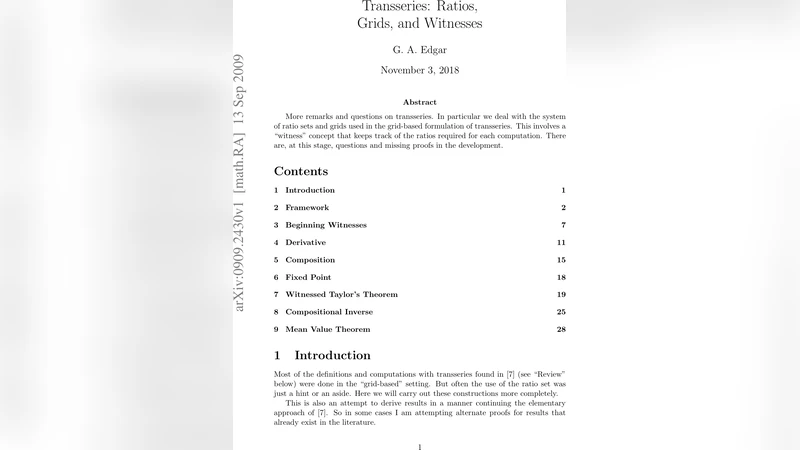
More remarks and questions on transseries. In particular we deal with the system of ratio sets and grids used in the grid-based formulation of transseries. This involves a “witness” concept that keeps track of the ratios required for each computation. There are, at this stage, questions and missing proofs in the development.
💡 Research Summary
The paper “Transseries: Ratios, Grids, and Witnesses” revisits the grid‑based formulation of transseries and introduces a systematic way to handle the ratios that arise during algebraic operations. Transseries are formal objects that combine infinite powers and infinite exponentials, and their terms are organized into a discrete hierarchy called a grid. Each grid level encodes a specific asymptotic size, and the inclusion relations between grids determine the overall ordering of the series.
The authors observe that traditional treatments of grids lack a precise mechanism for tracking the relative sizes of terms, which leads to ambiguities when performing complex operations such as differentiation of sums, products, or integrals. To address this, they define a “ratio set” – a finite collection of ratios that capture the relative magnitude of any two terms that need to be compared. A ratio (a/b) belongs to the ratio set if the two terms (a) and (b) lie on compatible grid levels; the set therefore serves as a common denominator for all comparisons required in a given computation.
The central innovation is the introduction of a “witness” (or “witness object”). A witness records, at each step of a computation, which ratios from the ratio set have been used. When a new term is generated, the algorithm checks whether the needed ratio already exists in the witness; if it does, the existing entry is reused, otherwise the witness is extended with the new ratio. This bookkeeping prevents the uncontrolled proliferation of ratios, guarantees that the ratio set remains finite, and ensures that the grid structure stays stable throughout the computation. The authors call this property “grid stability”: any sequence of allowed operations on transseries that respects the witness mechanism yields a result whose terms still belong to a well‑defined grid and whose ratio set is still finite.
The paper provides several concrete examples. For instance, when multiplying (f = x^{-1}e^{x}) by (g = x^{-2}e^{2x}), the witness initially records the ratio (e^{x}/e^{2x}=e^{-x}). Subsequent differentiation or integration steps reuse this ratio, illustrating how the witness eliminates redundant calculations. The authors also discuss how the witness interacts with the construction of logarithmic and exponential extensions, showing that the same finite ratio set can control even more elaborate transseries.
Despite these advances, the authors acknowledge several open problems. First, it is not yet proved that every possible transseries operation can be captured by a finite ratio set; the question remains open for transseries whose grid has non‑countable depth. Second, the efficiency of the witness mechanism in the presence of infinitely nested operations (e.g., iterated exponentials) has not been formally analyzed. Third, the choice of ratios influences the “optimality” of the final representation, but a quantitative measure of this effect is missing. Finally, the paper does not provide a concrete algorithmic complexity analysis for implementing witnesses in computer algebra systems, leaving the practical scalability of the approach uncertain.
In summary, the work makes a significant conceptual contribution by formalizing ratio sets and witnesses, thereby providing a robust framework for consistent, finite‑ratio computations on transseries. It clarifies how grid stability can be maintained and opens a research agenda that includes extending the theory to non‑countable grids, optimizing witness management, and integrating the methodology into automated symbolic computation platforms.