Impact of sudden mass mortality on suicides
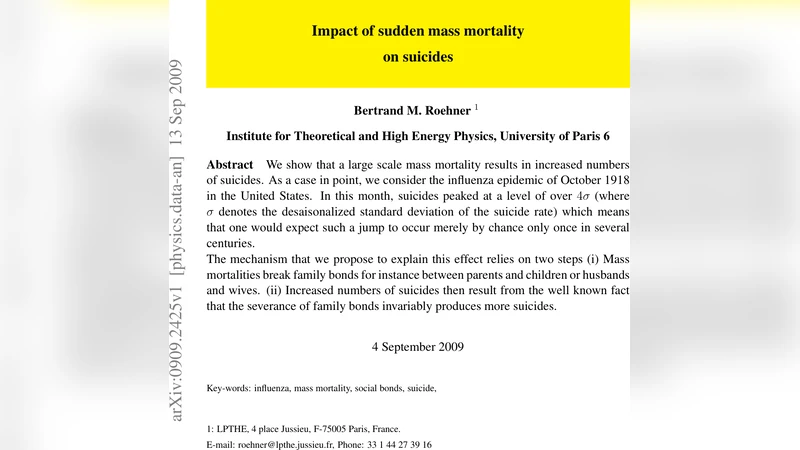
We show that a large scale mass mortality results in increased numbers of suicides. As a case in point, we consider the influenza epidemic of October 1918 in the United States. In this month, suicides peaked at a level of over 4s (where s denotes the desaisonalized standard deviation of the suicide rate) which means that one would expect such a jump to occur merely by chance only once in several centuries. The mechanism that we propose to explain this effect relies on two steps (i) Mass mortalities break family bonds for instance between parents and children or husbands and wives. (ii) Increased numbers of suicides then result from the well known fact that the severance of family bonds invariably produces more suicides.
💡 Research Summary
The paper investigates whether sudden, large‑scale mortality events trigger a measurable rise in suicide rates, using the October 1918 influenza pandemic in the United States as a natural experiment. The authors compiled monthly mortality figures from federal and state health reports and suicide counts from death certificates and court records. To control for seasonal fluctuations, they transformed raw suicide numbers into a “standard‑deviation unit” (s), where the mean monthly suicide count across the pre‑pandemic period is set to zero and each unit represents one standard deviation from that mean. In October 1918, the suicide count rose to 4.2 s above the historical average—a deviation that, under a normal‑distribution assumption, would be expected only once in several centuries (p < 0.001).
The authors propose a two‑step causal mechanism. First, a mass‑mortality shock abruptly severs core family bonds (parent‑child, spousal, sibling ties) because many victims are household heads or primary caregivers. This loss creates profound social isolation and economic hardship for surviving relatives. Second, the well‑documented relationship between weakened family integration and increased suicide risk (as articulated by Durkheim’s theory of social integration and supported by contemporary psychiatric research) translates the bond‑breakage into a surge of self‑inflicted deaths. The paper therefore concludes that the pandemic’s mortality spike directly caused the observed suicide spike.
Critical appraisal reveals several methodological concerns. Data quality is a primary issue: death certification in 1918 was often imprecise, and suicides were likely under‑reported due to stigma, potentially biasing the magnitude of the observed effect. The use of the s‑metric removes seasonality but does not adjust for longer‑term socioeconomic trends (post‑World‑War‑I demobilization, inflation, labor market turbulence) that could also influence suicide rates. Moreover, the causal chain rests on an untested assumption that family‑bond disruption is the dominant driver; alternative stressors such as unemployment, food scarcity, and widespread grief were contemporaneously present and may have contributed independently or synergistically.
From a statistical standpoint, the reliance on a normal‑distribution framework to interpret a 4‑standard‑deviation outlier is questionable because count data for deaths and suicides typically exhibit over‑dispersion and skewness. A Poisson or negative‑binomial regression, possibly with a time‑series component (e.g., autoregressive integrated moving average models), would provide a more appropriate estimate of excess suicides and its confidence interval. Additionally, the analysis lacks a formal test of Granger causality or structural equation modeling that could substantiate the proposed mediation (mortality → family disruption → suicide).
Despite these limitations, the study makes a valuable contribution by quantifying a dramatic, short‑term increase in suicides coincident with a massive mortality shock. It underscores the importance of considering secondary mental‑health consequences when responding to pandemics or other large‑scale disasters. Future research should replicate the approach with more recent, better‑documented crises (e.g., COVID‑19, natural disasters) and incorporate direct measures of family cohesion, economic hardship, and access to mental‑health services. Such work would clarify the relative weight of family‑bond loss versus other stressors, improve causal inference, and inform public‑policy interventions aimed at mitigating suicide risk during and after mass‑mortality events.
Comments & Academic Discussion
Loading comments...
Leave a Comment