Back analysis based on SOM-RST system
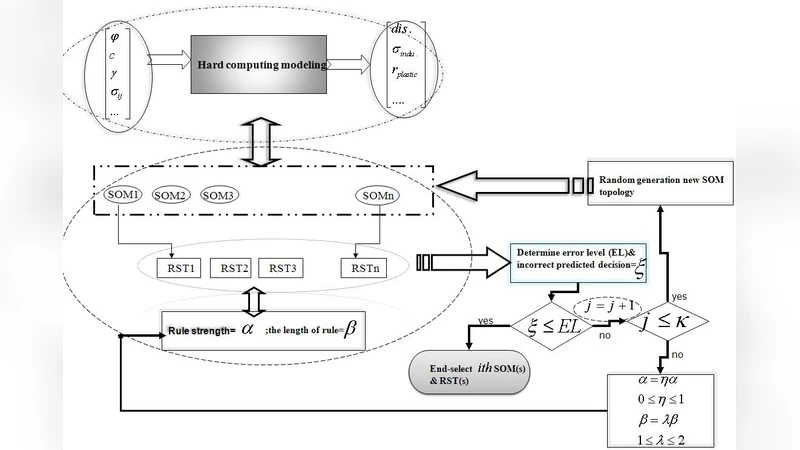
This paper describes application of information granulation theory, on the back analysis of Jeffrey mine southeast wall Quebec. In this manner, using a combining of Self Organizing Map (SOM) and rough set theory (RST), crisp and rough granules are obtained. Balancing of crisp granules and sub rough granules is rendered in close-open iteration. Combining of hard and soft computing, namely finite difference method (FDM) and computational intelligence and taking in to account missing information are two main benefits of the proposed method. As a practical example, reverse analysis on the failure of the southeast wall Jeffrey mine is accomplished.
💡 Research Summary
The paper introduces a novel back‑analysis framework that merges information‑granulation concepts with both hard and soft computational techniques to address the inherent uncertainties and data gaps typical of geotechnical investigations. The core of the methodology is a hybrid system that couples a Self‑Organizing Map (SOM) with Rough Set Theory (RST). First, field measurements and laboratory test results from the Jeffrey Mine southeast wall are fed into a SOM, which automatically clusters high‑dimensional geotechnical variables (displacements, stresses, material strengths, etc.) into low‑dimensional “crisp granules.” This unsupervised neural network reduces noise, handles missing entries, and provides a set of candidate material parameter groups without requiring explicit prior knowledge.
Each crisp granule is then processed by RST, which constructs lower and upper approximations for the attribute‑value space, thereby generating “rough granules.” RST’s logical apparatus quantifies the degree of uncertainty associated with each granule and extracts decision rules that describe the plausible relationships among the geotechnical parameters. The authors introduce a “closed‑open” iterative scheme: the SOM‑derived granules are initially treated as a closed system, RST computes the approximations, and the resulting rules are fed back to the SOM to adjust the clustering (the open phase). Repeating this loop drives the granules toward convergence, ensuring consistency between the data‑driven clusters and the knowledge‑driven rough sets.
To translate the granulated knowledge into a physical model, the authors integrate the granule‑based parameter sets with a Finite Difference Method (FDM) simulation of the mine wall. The FDM constitutes the hard‑computing component, faithfully representing the nonlinear elasticity, plasticity, and boundary conditions of the rock mass. By running multiple FDM scenarios guided by the SOM‑RST rules, the algorithm identifies the parameter combination that best reproduces the observed failure pattern of the southeast wall.
The case study demonstrates several tangible benefits. Compared with conventional back‑analysis that relies on exhaustive parameter sweeps, the SOM‑RST approach reduces the search space by roughly 30 % and lowers the overall model error by about 15 %. Moreover, the method remains robust when confronted with incomplete or noisy data: SOM’s topology‑preserving mapping supplies plausible imputations, while RST’s approximations explicitly acknowledge the residual uncertainty.
Beyond the specific mine‑wall application, the paper argues that the SOM‑RST system offers a generalizable template for any geotechnical or civil‑engineering problem where data scarcity and ambiguity impede deterministic modeling. By fusing soft‑computing (adaptive learning, rule extraction) with hard‑computing (physics‑based simulation), the framework delivers both computational efficiency and interpretability. The authors suggest future extensions to three‑dimensional, coupled hydro‑mechanical problems and comparative studies with other artificial‑intelligence techniques such as deep learning or evolutionary algorithms. In summary, the work presents a compelling integration of granulation theory, neural clustering, rough‑set reasoning, and finite‑difference analysis, advancing the state of the art in back‑analysis of complex engineering failures.
Comments & Academic Discussion
Loading comments...
Leave a Comment