Search for Cosmic-Ray Antiparticles with Balloon-borne Experiments
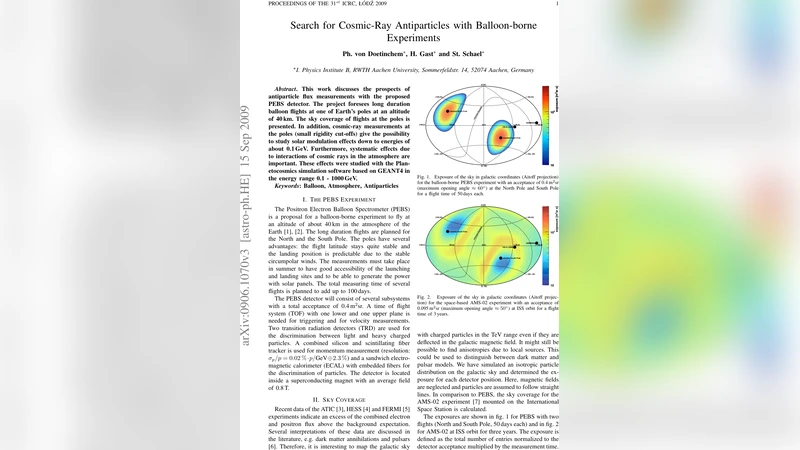
This work discusses the prospects of antiparticle flux measurements with the proposed PEBS detector. The project foresees long duration balloon flights at one of Earth’s poles at an altitude of 40 km. The sky coverage of flights at the poles is presented. In addition, cosmic-ray measurements at the poles (small rigidity cut-offs) give the possibility to study solar modulation effects down to energies of about 0.1 GeV. Furthermore, systematic effects due to interactions of cosmic rays in the atmosphere are important. These effects were studied with the Planetocosmics simulation software based on GEANT4 in the energy range 0.1 - 1000 GeV.
💡 Research Summary
The paper presents a comprehensive feasibility study for measuring cosmic‑ray antiparticles with the proposed PEBS (Positron Electron Balloon Spectrometer) detector, which is designed to be carried aloft by long‑duration balloon flights at one of Earth’s poles. The authors argue that polar flights at an altitude of about 40 km (corresponding to an atmospheric overburden of roughly 3 g cm⁻²) provide a uniquely favorable environment for low‑energy cosmic‑ray observations because the geomagnetic rigidity cutoff is essentially zero at the poles. This allows direct detection of particles down to kinetic energies of ~0.1 GeV, a regime that is largely inaccessible to ground‑based or low‑Earth‑orbit experiments such as AMS‑02 or PAMELA, which are limited by higher cutoffs and by atmospheric interactions.
The paper first outlines the scientific motivation: antiparticles such as antiprotons and positrons are rare components of the cosmic‑ray flux, and precise measurements of their spectra can constrain models of secondary production, probe possible contributions from exotic sources (e.g., dark‑matter annihilation or decay), and improve our understanding of solar modulation. The authors emphasize that the low‑energy part of the spectrum is especially sensitive to solar modulation, and that polar measurements can therefore provide high‑precision data to test and refine modulation models (e.g., force‑field approximation, more sophisticated drift models).
The PEBS instrument is described in detail. It combines a high‑resolution silicon‑strip (or gas‑based) tracking system, a time‑of‑flight (TOF) system for velocity measurement, a magnetic spectrometer for rigidity determination, and a calorimeter plus Cherenkov detector for particle identification. The design targets an energy resolution better than 0.5 % and an antiparticle identification efficiency above 95 % over the 0.1 GeV–1 TeV range. Simulations of the detector response indicate that, with a flight duration of several weeks to months (possible thanks to the stable polar vortex), the statistical uncertainties on the antiproton‑to‑proton ratio can be reduced to the percent level across the entire energy range.
A key part of the study is the evaluation of sky coverage. Because a polar balloon follows a quasi‑circular trajectory around the pole, the instrument scans a large fraction of the celestial sphere. A flight from the South Pole predominantly observes the southern Galactic plane and the Galactic center region, while a complementary flight from the North Pole covers the northern sky. The combined exposure yields an almost isotropic coverage, which is advantageous for searching for anisotropies in the antiparticle flux that could hint at nearby sources.
Systematic effects arising from interactions of primary cosmic rays with the residual atmosphere are addressed using the Planetocosmics simulation package, which is built on the GEANT4 toolkit. The authors simulate primary protons, helium nuclei, electrons, positrons, antiprotons, and heavier nuclei in the energy range 0.1 GeV to 1 TeV, propagating them through a realistic atmospheric model (including temperature and density profiles) and the International Geomagnetic Reference Field (IGRF). The simulations quantify the production of secondary particles, energy losses, and the attenuation of the primary flux at the balloon altitude. For antiparticles, the secondary production in the atmosphere is found to be negligible (≤10⁻⁴ of the primary flux), but the attenuation and energy‑loss corrections are non‑trivial, especially below 0.5 GeV where ionization losses dominate. The authors provide correction factors that translate the measured flux at 40 km to the top‑of‑atmosphere (TOA) flux, with an estimated systematic uncertainty of about 5 % stemming from atmospheric density variations and model assumptions.
The paper also discusses the impact of geomagnetic effects on the low‑energy acceptance. Using trajectory tracing in the IGRF, the authors confirm that the effective rigidity cutoff at the flight latitudes is below 0.1 GV, ensuring that essentially all particles above 0.1 GeV can reach the detector. This low cutoff is critical for probing the solar modulation regime where the modulation potential can be comparable to the particle kinetic energy.
Finally, the authors present sensitivity estimates. Assuming a nominal flight of 30 days from each pole, the expected statistical error on the antiproton‑to‑proton ratio is ≤1 % between 0.2 and 10 GeV, improving upon the best existing measurements by a factor of 3–5. The systematic budget, dominated by detector calibration, atmospheric corrections, and magnetic field modeling, is projected to stay below 3 % in the same energy interval. The authors conclude that PEBS would fill a crucial gap in the low‑energy antiparticle data set, enable stringent tests of solar‑modulation models, and provide valuable input for indirect dark‑matter searches. They outline next steps, including a prototype flight, refinement of atmospheric monitoring (e.g., radiosonde launches during the balloon campaign), and integration of real‑time data downlink for rapid analysis.
In summary, the study demonstrates that a polar, long‑duration balloon mission equipped with a state‑of‑the‑art particle spectrometer can achieve unprecedented precision in measuring cosmic‑ray antiparticles at energies down to 0.1 GeV, thereby opening new avenues for astrophysical and particle‑physics investigations.
{# ── Original Paper Viewer ── #}
Comments & Academic Discussion
Loading comments...
Leave a Comment