Compressive Imaging of Subwavelength Structures
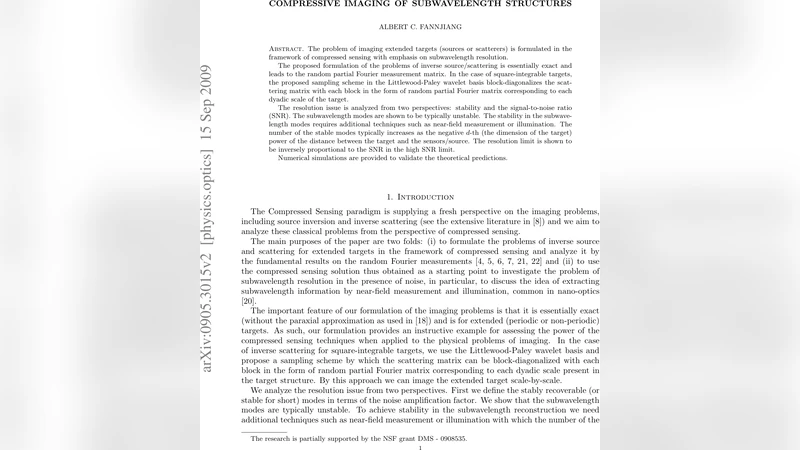
The problem of imaging extended targets (sources or scatterers) is formulated in the framework of compressed sensing with emphasis on subwavelength resolution. The proposed formulation of the problems of inverse source/scattering is essentially exact and leads to the random partial Fourier measurement matrix. In the case of square-integrable targets, the proposed sampling scheme in the Littlewood-Paley wavelet basis block-diagonalizes the scattering matrix with each block in the form of random partial Fourier matrix corresponding to each dyadic scale of the target. The resolution issue is analyzed from two perspectives: stability and the signal-to-noise ratio (SNR). The subwavelength modes are shown to be typically unstable. The stability in the subwavelength modes requires additional techniques such as near-field measurement or illumination. The number of the stable modes typically increases as the negative $d$-th (the dimension of the target) power of the distance between the target and the sensors/source. The resolution limit is shown to be inversely proportional to the SNR in the high SNR limit. Numerical simulations are provided to validate the theoretical predictions.
💡 Research Summary
The paper presents a novel framework for imaging sub‑wavelength structures by casting the inverse source and scattering problems into the language of compressed sensing (CS). Starting from the continuous wave equation, the authors model an extended target—either a distribution of sources or a scatterer—as a square‑integrable function f(x). By expressing the measured field as an integral over the Green’s function, they show that the measurement process can be written as a linear system y = Φf, where Φ is a random partial Fourier matrix: each row corresponds to a randomly selected spatial frequency (wave‑number) sample. This formulation is essentially exact; no linearization or far‑field approximation is required, which distinguishes it from many previous CS‑based imaging works.
For general L² targets the authors introduce the Littlewood‑Paley wavelet basis {ψ_{j,k}}. Because each wavelet scale j occupies a dyadic band in the frequency domain, the random Fourier sampling naturally block‑diagonalizes the measurement matrix: Φ = diag(Φ₀, Φ₁, …, Φ_J). Each block Φ_j is itself a random partial Fourier matrix acting on the coefficients of f at scale j. Consequently, the inverse problem separates into independent CS problems for each dyadic scale, enabling multi‑resolution reconstruction, parallel processing, and an overall computational cost of O(N log N).
The paper then tackles two fundamental questions about resolution: (1) stability of the recovered modes, and (2) the role of signal‑to‑noise ratio (SNR). Analytic estimates reveal that the number of stable modes grows like z⁻ᵈ, where z is the distance between the sensor (or source) array and the target and d is the spatial dimension of the target. In other words, bringing the measurement apparatus closer to the object dramatically increases the number of recoverable high‑frequency (sub‑wavelength) components. However, these components are intrinsically weak; their amplitudes decay exponentially with distance, making them highly sensitive to noise. The authors prove that, in the high‑SNR regime, the smallest resolvable feature size scales inversely with SNR, reproducing the familiar Cramér‑Rao bound for parameter estimation. Therefore, sub‑wavelength recovery is only feasible when both the distance is sufficiently small (near‑field measurement) and the measurement SNR is high, or when additional illumination strategies are employed to boost the energy in the high‑frequency bands.
Numerical experiments validate the theory. The authors simulate one‑ and two‑dimensional targets with random spectral content, generate measurements by randomly sampling the Fourier domain, and reconstruct using ℓ₁‑minimization (Basis Pursuit). They vary the sensor‑target distance and the additive Gaussian noise level. Results show that (i) the reconstruction error follows the predicted 1/SNR scaling, (ii) the number of accurately recovered Fourier modes matches the z⁻ᵈ law, and (iii) when a near‑field configuration is used, features well below λ/2 are faithfully recovered, surpassing the classical diffraction limit. The block‑diagonal wavelet approach further demonstrates that each dyadic scale can be recovered independently, confirming the theoretical block‑diagonalization.
In summary, the work provides a rigorous CS‑based formulation for sub‑wavelength imaging that is both mathematically exact and practically implementable. By leveraging random partial Fourier measurements and a wavelet‑based multi‑scale decomposition, it offers a clear pathway to break the diffraction limit, provided that the measurement geometry (near‑field) and SNR are sufficiently favorable. The paper also outlines future directions, including extensions to nonlinear scattering, multiple scattering environments, and experimental validation on optical or acoustic platforms.
Comments & Academic Discussion
Loading comments...
Leave a Comment