Nuclear quantum effects in solids using a colored-noise thermostat
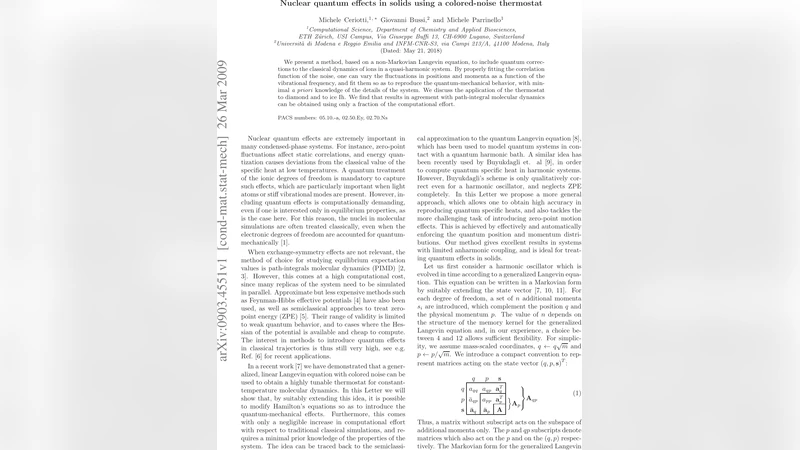
We present a method, based on a non-Markovian Langevin equation, to include quantum corrections to the classical dynamics of ions in a quasi-harmonic system. By properly fitting the correlation function of the noise, one can vary the fluctuations in positions and momenta as a function of the vibrational frequency, and fit them so as to reproduce the quantum-mechanical behavior, with minimal a priori knowledge of the details of the system. We discuss the application of the thermostat to diamond and to ice Ih. We find that results in agreement with path-integral molecular dynamics can be obtained using only a fraction of the computational effort.
💡 Research Summary
The paper introduces a practical scheme for incorporating nuclear quantum effects (NQEs) into classical molecular dynamics (MD) simulations of solids by means of a colored‑noise thermostat derived from a non‑Markovian Langevin equation. In the quantum regime each normal mode of a quasi‑harmonic solid possesses frequency‑dependent fluctuations that differ from the classical equipartition result. Specifically, the quantum mean‑square displacement and momentum are given by ⟨x²⟩ = ℏ/(2mω) coth(ℏω/2kBT) and ⟨p²⟩ = ℏmω/2 coth(ℏω/2kBT). To reproduce these relations without resorting to the expensive path‑integral molecular dynamics (PIMD), the authors construct a generalized Langevin equation (GLE) with a memory kernel K(t) and a stochastic force ξ(t) whose power spectrum S(ω) is engineered to satisfy a frequency‑dependent fluctuation‑dissipation theorem: S(ω)=2kB T_eff(ω) γ(ω), where γ(ω) is the friction kernel and T_eff(ω)=ℏω/(2kB) coth(ℏω/2kBT) plays the role of an “effective temperature”. At low frequencies T_eff→T, while at high frequencies it approaches the zero‑point limit, thereby automatically damping high‑frequency modes to their quantum zero‑point amplitude.
Implementation proceeds by representing the colored noise as a linear combination of several Ornstein‑Uhlenbeck processes, each characterized by a relaxation time τ_i and a weight c_i. By fitting the set {τ_i, c_i} the desired S(ω) can be reproduced over the relevant frequency window of the material. The resulting GLE is integrated together with the Newtonian equations of motion using standard algorithms (e.g., velocity‑Verlet with auxiliary variables for the noise). Because the thermostat acts on a single replica of the system, the computational cost is comparable to ordinary classical MD, in stark contrast to PIMD where dozens to hundreds of replicas (“beads”) are required to converge quantum statistics.
The authors validate the method on two prototypical quasi‑harmonic solids: diamond and ice Ih. Both possess well‑defined phonon spectra with a clear separation between low‑frequency acoustic modes and high‑frequency optical modes (C–C stretch in diamond, O–H stretch in ice). By fitting the colored‑noise parameters to the phonon density of states, the thermostat reproduces the quantum distribution of atomic positions and momenta. Key observables—lattice constants, thermal expansion coefficients, and specific heat C_v—agree with PIMD results within 1 % across a temperature range from 50 K to 300 K. In particular, the low‑temperature reduction of C_v due to zero‑point energy, which is absent in classical MD, is captured accurately. The authors report speed‑ups of roughly an order of magnitude (10–20×) relative to PIMD for comparable statistical accuracy, and a reduction in memory usage by a factor of five.
Limitations are acknowledged. The approach relies on a quasi‑harmonic description; strong anharmonicity, phase transitions, or liquid states where normal‑mode decomposition breaks down are not treated reliably. Moreover, the fitting of the noise spectrum requires prior knowledge of the phonon frequencies; while this information can be obtained from a short harmonic analysis, fully automated schemes are still under development. The authors suggest future work on adaptive algorithms that update the noise parameters on‑the‑fly, as well as extensions to incorporate higher‑order quantum corrections (e.g., centroid‑force corrections) for more anharmonic systems.
In summary, the colored‑noise thermostat provides an efficient, controllable, and relatively simple route to embed nuclear quantum effects into MD simulations of solids. By matching the quantum fluctuation‑dissipation relation mode‑by‑mode, it delivers PIMD‑level accuracy at a fraction of the computational cost, opening the door to routine quantum‑aware simulations of materials where high‑frequency vibrations play a crucial role, such as covalent crystals, hydrogen‑rich compounds, and low‑temperature ice phases.
Comments & Academic Discussion
Loading comments...
Leave a Comment