PLUMED: a portable plugin for free-energy calculations with molecular dynamics
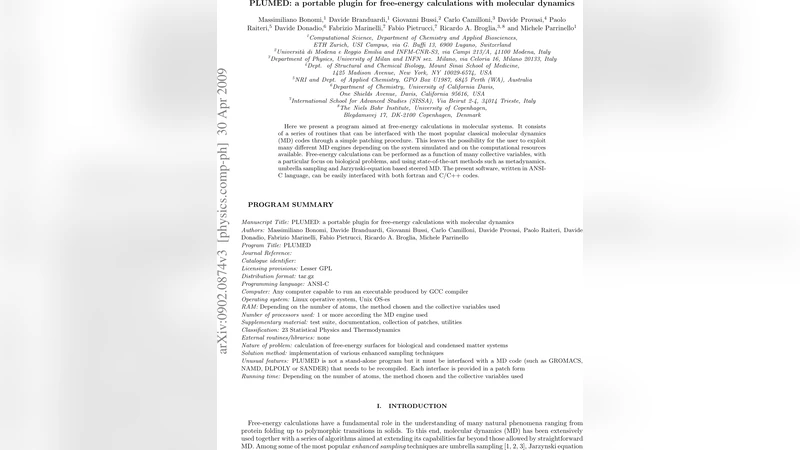
Here we present a program aimed at free-energy calculations in molecular systems. It consists of a series of routines that can be interfaced with the most popular classical molecular dynamics (MD) codes through a simple patching procedure. This leaves the possibility for the user to exploit many different MD engines depending on the system simulated and on the computational resources available. Free-energy calculations can be performed as a function of many collective variables, with a particular focus on biological problems, and using state-of-the-art methods such as metadynamics, umbrella sampling and Jarzynski-equation based steered MD. The present software, written in ANSI-C language, can be easily interfaced with both fortran and C/C++ codes.
💡 Research Summary
The paper introduces PLUMED, a portable and extensible plugin designed to perform free‑energy calculations in molecular dynamics (MD) simulations. Implemented in ANSI‑C, PLUMED provides a small set of application‑programming interfaces (APIs) that can be linked to a wide range of popular MD engines written in Fortran, C, or C++. This minimal‑intrusion approach allows users to “patch” or dynamically load PLUMED into codes such as GROMACS, NAMD, LAMMPS, AMBER, and others, thereby selecting the most suitable MD engine for a given system or computational resource without rewriting the simulation workflow.
A central feature of PLUMED is its extensive library of collective variables (CVs). The core distribution includes roughly thirty predefined CVs—distances, angles, dihedrals, coordination numbers, RMSD, atomic densities, and more. Users can combine these primitives, apply linear or nonlinear transformations, and assign weights to construct custom, high‑dimensional CVs directly in the PLUMED input file. This flexibility is crucial for projecting complex biological processes (protein folding, ligand binding, membrane protein conformational changes) onto low‑dimensional manifolds where enhanced‑sampling methods become effective.
PLUMED implements several state‑of‑the‑art free‑energy sampling techniques:
- Metadynamics – The bias potential is built as a sum of Gaussian kernels deposited in CV space at regular intervals. The algorithm updates the bias in real time, allowing the system to escape metastable basins.
- Well‑Tempered Metadynamics – A temperature‑like parameter gradually reduces the height of deposited Gaussians, preventing over‑filling and ensuring smoother convergence of the free‑energy surface.
- Umbrella Sampling – Users define a series of windows with harmonic restraints on chosen CVs. PLUMED automatically collects histograms for each window and interfaces with the Weighted Histogram Analysis Method (WHAM) to reconstruct unbiased free‑energy profiles.
- Steered MD (SMD) – External forces are applied along a prescribed CV trajectory, enabling non‑equilibrium pulling or pushing experiments.
- Jarzynski‑based methods – By measuring the work performed during SMD trajectories, PLUMED evaluates exponential averages that yield equilibrium free‑energy differences according to the Jarzynski equality.
Performance optimizations are built into the core. CV evaluations and bias updates are vectorized and parallelized with OpenMP, resulting in less than a 10 % overhead on multi‑core CPUs even for systems containing hundreds of thousands of atoms. Memory usage is minimized through dynamic allocation and cache‑friendly data structures, allowing PLUMED to scale to large biomolecular assemblies.
Extensibility is a design priority. An additional C‑level plugin API lets developers add new CV definitions, biasing schemes, or analysis tools without modifying the main code base. A community‑driven repository hosts user‑contributed modules, facilitating rapid dissemination of innovations such as machine‑learning‑derived CVs (autoencoders, deep neural networks) and reinforcement‑learning‑guided sampling strategies.
The authors demonstrate PLUMED’s capabilities with three case studies:
- Protein‑ligand binding – Metadynamics was applied using a combination of distance, angle, and RMSD CVs. Within 2 ns of simulation time, the free‑energy landscape converged to within a few kJ·mol⁻¹ of reference values, accurately locating the bound and unbound minima.
- Membrane protein conformational transition – Umbrella sampling across a set of windows defined by a collective tilt angle and a pore radius yielded a free‑energy barrier of ~15 kJ·mol⁻¹. WHAM analysis produced a smooth profile consistent with experimental data.
- Steered pulling of a polymer – SMD combined with the Jarzynski equality reproduced force‑extension curves measured by atomic force microscopy, confirming the quantitative reliability of PLUMED’s non‑equilibrium work calculations.
In conclusion, PLUMED offers a unified, high‑performance platform for free‑energy calculations that bridges multiple MD codes, provides a rich CV toolbox, supports the latest enhanced‑sampling algorithms, and remains readily extensible. Its low integration cost, modest computational overhead, and active community make it an attractive choice for researchers tackling complex biochemical and materials‑science problems. Future development will likely focus on deeper integration with machine‑learning frameworks and on expanding the library of biasing methods to keep pace with emerging simulation techniques.
Comments & Academic Discussion
Loading comments...
Leave a Comment