Assessing scientific research performance and impact with single indices
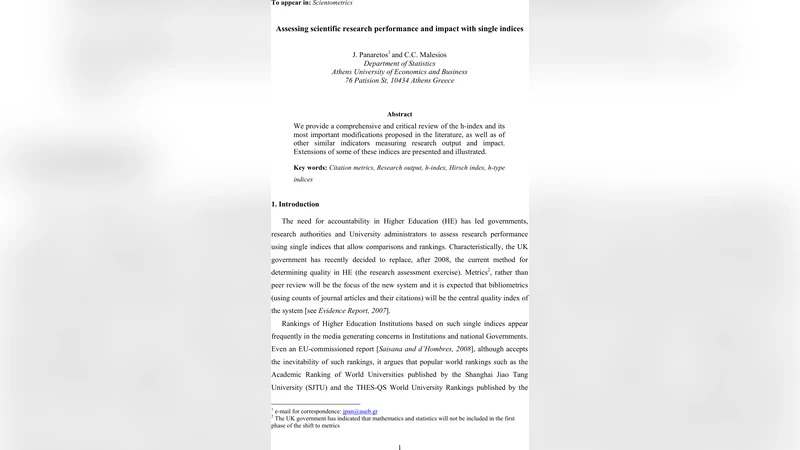
We provide a comprehensive and critical review of the h-index and its most important modifications proposed in the literature, as well as of other similar indicators measuring research output and impact. Extensions of some of these indices are presented and illustrated.
💡 Research Summary
The paper provides a thorough and critical review of the h‑index, the most widely used single‑number metric for assessing scientific research performance, and examines a broad spectrum of its proposed modifications. It begins by outlining the appeal of single‑value indicators—simplicity, intuitiveness, and ease of comparison—while acknowledging the well‑documented shortcomings of the original h‑index: insensitivity to the distribution of citations, neglect of recent publications, inability to account for co‑authorship contributions, and lack of field‑specific normalization.
The authors categorize the existing variants into two principal families. The first family consists of indices that directly adjust the h‑index. Notable examples include the g‑index, which gives greater weight to highly cited papers by requiring that the top g articles receive at least g² citations; the e‑index, which quantifies excess citations beyond the h‑core; the A‑index, the average citation count within the h‑core; the m‑index, which normalizes h by the researcher’s career length; and the hg‑index, a hybrid that combines h and g. For each, the paper supplies formal definitions, discusses computational aspects, and presents empirical comparisons using citation data from physics, biology, and computer science journals. The analysis demonstrates that while these adjustments often reveal hidden impact (e.g., e‑index) or correct for career length (m‑index), they still share the fundamental limitation of collapsing multidimensional performance into a single scalar.
The second family introduces entirely new constructs that do not rely on the h‑core. These include the i10‑index (count of papers with ≥10 citations), the R‑index (√(h·A), where A is the average citations in the h‑core), and more recent proposals such as the α‑h index, which applies exponential weighting to citations, and fractional h‑indices that allocate credit proportionally among co‑authors. The authors also discuss field‑normalized variants (n‑h) that divide raw citation counts by discipline‑specific averages, thereby enabling cross‑disciplinary comparisons. Empirical results show that fractional and field‑normalized metrics substantially reduce systematic biases that favor senior researchers or those working in citation‑rich fields.
Beyond reviewing existing measures, the paper contributes original extensions. One proposal is a time‑weighted h‑index that discounts older citations, better reflecting current research relevance. Another is a “multimodal” h‑index that integrates citations to non‑traditional research outputs such as datasets, software, and patents, acknowledging the growing importance of open science artifacts. The authors illustrate these extensions with case studies, demonstrating improved alignment with expert peer‑review assessments.
In the discussion, the authors argue that no single index can capture the full complexity of scientific contribution. They recommend that institutions adopt a composite evaluation framework that combines several complementary metrics, each addressing a distinct dimension (productivity, citation impact, collaboration, timeliness, and output type). To guide metric selection, they propose a “Metric Suitability Matrix” that evaluates indicators against criteria such as data coverage, citation latency, co‑authorship adjustment, and disciplinary normalization.
The conclusion emphasizes the need for transparent, context‑aware assessment practices. While the h‑index remains a useful baseline, its variants and the authors’ proposed extensions provide richer, more nuanced insight into research performance. The paper thus serves as both a reference guide for scholars interested in bibliometric methodology and a policy‑oriented resource for funding agencies and university administrators seeking to implement fair and robust evaluation systems.
Comments & Academic Discussion
Loading comments...
Leave a Comment