Street Hierarchies: A Minority of Streets Account for a Majority of Traffic Flow
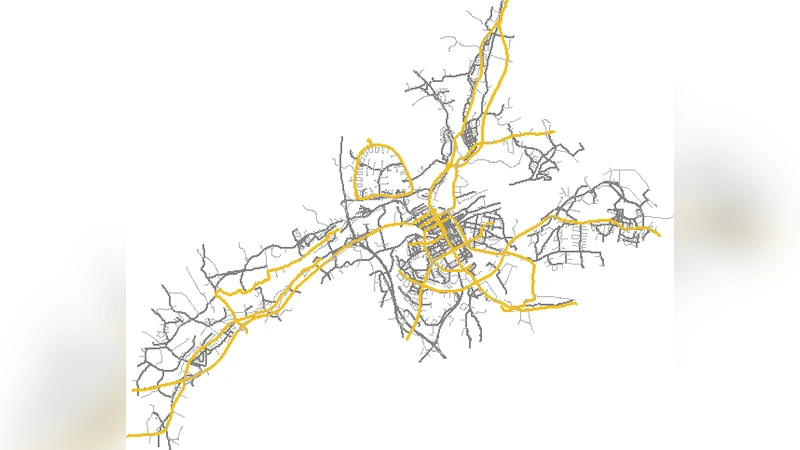
Urban streets are hierarchically organized in the sense that a majority of streets are trivial, while a minority of streets is vital. This hierarchy can be simply, but elegantly, characterized by the 80/20 principle, i.e. 80 percent of streets are less connected (below the average), while 20 percent of streets are well connected (above the average); out of the 20 percent, there is 1 percent of streets that are extremely well connected. This paper, using a European city as an example, examined, at a much more detailed level, such street hierarchies from the perspective of geometric and topological properties. Based on an empirical study, we further proved a previous conjecture that a minority of streets accounts for a majority of traffic flow; more accurately, the 20 percent of top streets accommodate 80 percent of traffic flow (20/80), and the 1 percent of top streets account for more than 20 percent of traffic flow (1/20). Our study provides new evidence as to how a city is (self-)organized, contributing to the understanding of cities and their evolution using increasingly available mobility geographic information.
💡 Research Summary
The paper investigates the hierarchical organization of urban streets and its impact on traffic distribution, using a detailed case study of a European city. The authors first reconstruct the road network at the street level rather than the conventional link (segment) level by aggregating contiguous road segments that share the same name into single street entities. This approach captures the full geometric and topological characteristics of each street, allowing a more realistic assessment of connectivity and flow. Street connectivity is quantified by node degree, and streets are classified relative to the network’s average degree: roughly 80 % of streets fall below the average, 20 % exceed it, and within that upper tier about 1 % exhibit exceptionally high degree values, several times the mean. Traffic flow is measured using a combination of ground‑based vehicle counts and mobile positioning data, from which origin‑destination (OD) matrices are derived and allocated to individual streets.
The empirical analysis reveals two strikingly parallel hierarchies. First, the degree distribution follows a power‑law pattern, confirming that a small subset of streets functions as hubs in the topological network. Second, traffic volume mirrors this distribution: the top 20 % of streets carry approximately 80 % of total traffic (the classic 20/80 rule), and the top 1 % alone accounts for more than 20 % of the flow (the 1/20 rule). These findings substantiate a long‑standing conjecture that a minority of streets dominates urban mobility.
Beyond confirming the Pareto principle, the study discusses practical implications. High‑connectivity streets and the associated traffic concentration become natural focal points for congestion mitigation strategies, such as adaptive signal control, priority lanes for public transport, and enhanced pedestrian and cycling infrastructure. By targeting these critical arteries, planners can achieve disproportionate improvements in overall network performance.
The authors acknowledge several limitations. Street‑name inconsistencies and data cleaning challenges may introduce classification errors. Temporal variability in traffic patterns is only partially captured, and non‑motorized modes (walking, cycling) are excluded from the flow analysis. Consequently, the reported hierarchies represent a snapshot rather than a fully dynamic picture.
Future research directions include integrating multimodal mobility data, extending the analysis to multiple cities for cross‑regional validation, and employing longitudinal datasets to examine how street hierarchies evolve over time, especially under interventions such as congestion pricing or infrastructure upgrades.
In sum, the paper provides robust quantitative evidence that urban street networks are self‑organized into a pronounced hierarchy, where a tiny fraction of highly connected streets carries the bulk of vehicular movement. This insight deepens our theoretical understanding of city structure and offers concrete guidance for more efficient, resilient, and sustainable urban transportation planning.
Comments & Academic Discussion
Loading comments...
Leave a Comment