More is the Same; Phase Transitions and Mean Field Theories
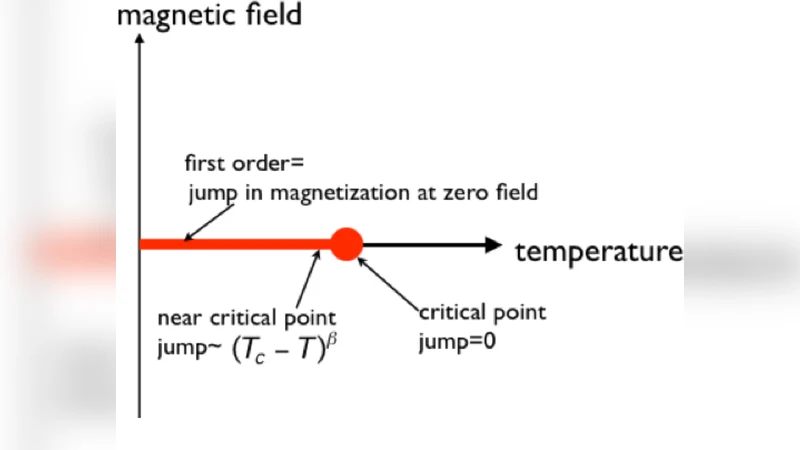
This paper looks at the early theory of phase transitions. It considers a group of related concepts derived from condensed matter and statistical physics. The key technical ideas here go under the names of “singularity”, “order parameter”, “mean field theory”, and “variational method”. In a less technical vein, the question here is how can matter, ordinary matter, support a diversity of forms. We see this diversity each time we observe ice in contact with liquid water or see water vapor, “steam”, come up from a pot of heated water. Different phases can be qualitatively different in that walking on ice is well within human capacity, but walking on liquid water is proverbially forbidden to ordinary humans. These differences have been apparent to humankind for millennia, but only brought within the domain of scientific understanding since the 1880s. A phase transition is a change from one behavior to another. A first order phase transition involves a discontinuous jump in a some statistical variable of the system. The discontinuous property is called the order parameter. Each phase transitions has its own order parameter that range over a tremendous variety of physical properties. These properties include the density of a liquid gas transition, the magnetization in a ferromagnet, the size of a connected cluster in a percolation transition, and a condensate wave function in a superfluid or superconductor. A continuous transition occurs when that jump approaches zero. This note is about statistical mechanics and the development of mean field theory as a basis for a partial understanding of this phenomenon.
💡 Research Summary
The paper provides a historical and conceptual overview of the early theoretical framework that describes phase transitions in condensed matter and statistical physics. It begins by noting that everyday observations—ice melting into water, water boiling into steam—are manifestations of distinct thermodynamic phases, each characterized by different macroscopic properties. While humanity has long recognized these phenomena, a scientific description only emerged in the late 19th century with the development of statistical mechanics.
A phase transition is defined as a qualitative change in the collective behavior of a many‑particle system. The authors distinguish two broad classes. In a first‑order transition the order parameter—a macroscopic quantity that differentiates the two phases—exhibits a discontinuous jump. Classic examples include the density jump at a liquid–gas transition or the magnetization jump in a ferromagnet. In a continuous (second‑order) transition the jump shrinks to zero; the order parameter varies smoothly, but its susceptibility or specific heat diverges, signalling a singularity in higher derivatives of the free energy.
The concept of a singularity is introduced as the mathematical hallmark of a transition: a point where the free‑energy landscape becomes non‑analytic. The paper emphasizes that the order parameter is the physical embodiment of this singularity, and it can take many forms—density, magnetization, cluster size in percolation, or the complex condensate wavefunction in superfluids and superconductors.
The core technical development is the mean‑field theory (MFT). By replacing the true many‑body interaction with an average “field” generated by the surrounding particles, the problem reduces to a single‑particle variational problem. The authors illustrate this with the Ising model: the pairwise coupling Jσ_iσ_j is approximated by JzMσ_i, where M is the average magnetization and z the coordination number. Minimizing the resulting variational free energy yields the self‑consistency equation M = tanh
Comments & Academic Discussion
Loading comments...
Leave a Comment