Problems in application of LDPC codes to information reconciliation in quantum key distribution protocols
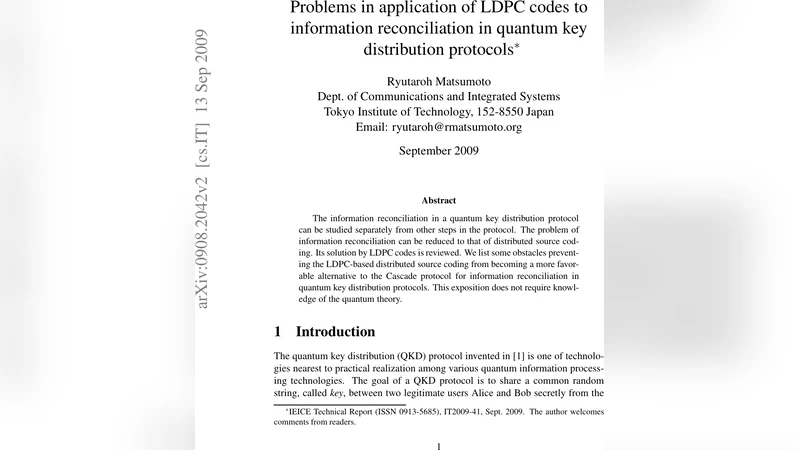
The information reconciliation in a quantum key distribution protocol can be studied separately from other steps in the protocol. The problem of information reconciliation can be reduced to that of distributed source coding. Its solution by LDPC codes is reviewed. We list some obstacles preventing the LDPC-based distributed source coding from becoming a more favorable alternative to the Cascade protocol for information reconciliation in quantum key distribution protocols. This exposition does not require knowledge of the quantum theory.
💡 Research Summary
**
The paper isolates the information‑reconciliation step of a quantum key distribution (QKD) protocol and treats it as an independent problem that can be mapped onto distributed source coding. In this formulation, two legitimate parties each possess a noisy version of a binary string (the raw key) and must agree on an identical string while leaking as little information as possible over a public authenticated channel. Classical information theory tells us that the minimum amount of public communication required is dictated by the conditional entropy of the strings, which in turn depends on the quantum bit error rate (QBER) of the underlying quantum channel.
The authors review the use of low‑density parity‑check (LDPC) codes for this purpose. LDPC codes are linear block codes defined by a sparse parity‑check matrix; they can be decoded efficiently by iterative belief‑propagation algorithms that approach Shannon‑limit performance when the channel statistics are known. In a QKD setting, one party (Alice) computes the syndrome of her raw key with respect to a chosen LDPC parity‑check matrix and sends this syndrome to the other party (Bob). Bob then runs the belief‑propagation decoder using his own raw key, the received syndrome, and an estimate of the channel error probability (p) (derived from the measured QBER). If the decoder converges, Bob’s corrected key matches Alice’s, and the amount of information disclosed equals the length of the syndrome, which can be made arbitrarily close to the theoretical minimum by selecting an appropriate code rate.
Despite these attractive theoretical properties, the paper identifies several practical obstacles that have prevented LDPC‑based reconciliation from supplanting the widely used Cascade protocol. The obstacles fall into five broad categories:
-
Code design and parameter tuning complexity – QKD systems experience time‑varying QBER due to changes in photon loss, detector noise, and environmental conditions. LDPC codes must be tailored to a specific error probability; therefore, a system that must adapt to a moving target error rate either needs a large library of pre‑designed codes or an on‑the‑fly code‑generation mechanism. Both approaches demand sophisticated automation and add latency.
-
Imprecise error‑rate estimation – The belief‑propagation decoder requires an accurate estimate of the channel crossover probability. In practice, QBER is estimated from a limited sample of disclosed bits, leading to statistical uncertainty. Over‑ or under‑estimation degrades convergence speed, increases the number of required iterations, or forces the decoder to fail, which in turn forces the protocol to fall back to additional public communication.
-
Non‑ideal quantum channel characteristics – Real quantum channels exhibit loss, dark counts, after‑pulsing, and phase noise that cannot be captured by a simple binary symmetric channel model. These effects introduce asymmetries and correlations that standard LDPC designs (which assume independent, identically distributed bit flips) do not address, reducing the effective performance of the code.
-
Real‑time computational burden – Iterative LDPC decoding typically requires hundreds to thousands of message‑passing rounds, especially for long block lengths (tens of thousands of bits) needed to achieve low leakage. Implementations on general‑purpose CPUs or modest FPGAs may not meet the throughput and latency requirements of high‑rate QKD systems, and the associated power and memory demands become prohibitive.
-
Cost‑effectiveness relative to Cascade – Cascade is an interactive, multi‑pass protocol that, while not optimal in terms of leaked bits, is extremely simple to implement, robust to QBER estimation errors, and well‑suited to low‑error‑rate regimes (QBER < 5 %). The overhead of developing, testing, and maintaining an LDPC‑based system often outweighs the modest gains in efficiency, especially when the QKD deployment is constrained by hardware resources.
To overcome these barriers, the authors propose several research directions. Adaptive LDPC schemes could maintain a pool of codes with different rates and switch among them as the measured QBER drifts, or they could employ on‑the‑fly matrix transformations that preserve sparsity while adjusting the effective code rate. Bayesian or sequential estimation techniques could provide more reliable QBER estimates and quantify their uncertainty, allowing the decoder to incorporate this information directly into its belief updates. Designing asymmetric or non‑binary LDPC codes that reflect the actual statistics of the quantum channel (e.g., incorporating detector dark‑count probabilities) would improve robustness. Hardware acceleration—through ASICs or high‑performance FPGA architectures—could dramatically reduce decoding latency and power consumption, making LDPC viable for real‑time QKD. Finally, hybrid protocols that combine the strengths of Cascade (fast, coarse error removal) with LDPC (fine‑grained, low‑leakage correction) may offer a pragmatic path forward.
In conclusion, the paper makes clear that LDPC‑based information reconciliation is theoretically compelling but faces a suite of engineering challenges before it can replace Cascade in practical QKD deployments. Addressing code adaptability, accurate channel estimation, realistic channel modeling, and high‑speed hardware implementation are essential steps. Successful resolution of these issues would enable QKD systems to operate closer to the Shannon limit, increase secret‑key throughput, and reduce the amount of information exposed to a potential eavesdropper, thereby strengthening the overall security guarantees of quantum cryptography.
Comments & Academic Discussion
Loading comments...
Leave a Comment