Asymptotic behavior of growth functions of D0L-systems
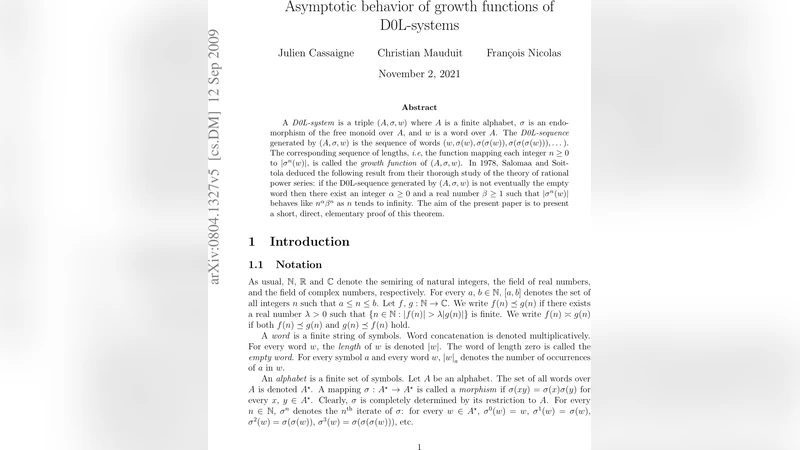
A D0L-system is a triple (A, f, w) where A is a finite alphabet, f is an endomorphism of the free monoid over A, and w is a word over A. The D0L-sequence generated by (A, f, w) is the sequence of words (w, f(w), f(f(w)), f(f(f(w))), …). The corresponding sequence of lengths, that is the function mapping each non-negative integer n to |f^n(w)|, is called the growth function of (A, f, w). In 1978, Salomaa and Soittola deduced the following result from their thorough study of the theory of rational power series: if the D0L-sequence generated by (A, f, w) is not eventually the empty word then there exist a non-negative integer d and a real number b greater than or equal to one such that |f^n(w)| behaves like n^d b^n as n tends to infinity. The aim of the present paper is to present a short, direct, elementary proof of this theorem.
💡 Research Summary
The paper addresses the asymptotic growth of the length function associated with a D0L‑system, a formal model consisting of a finite alphabet A, a morphism σ : A* → A*, and an initial word w. The D0L‑sequence is the infinite list (w, σ(w), σ²(w), …) and the growth function is n ↦ |σⁿ(w)|. In 1978 Salomaa and Soittola proved, using the theory of rational power series, that if the sequence never becomes the empty word then there exist a non‑negative integer α and a real number β ≥ 1 such that |σⁿ(w)| is asymptotically equivalent to n^α βⁿ. Their proof relies on deep results about Schützenberger’s representation theorem and the location of minimal‑modulus poles of rational series.
The present work offers a short, elementary proof that avoids the heavy machinery of rational series. The authors first reduce the system to a “reduced” one, meaning every alphabet symbol eventually appears in some σ^m(w). In this setting Lemma 1 shows that if a word x appears in σ^{n₀}(w) then |σⁿ(x)| is Θ(|σⁿ(w)|). Lemma 2 then yields the equivalence |σⁿ(w)| ≈ ∑_{a∈A}|σⁿ(a)|.
The key observation is that the vector of symbol counts after n iterations can be expressed as the product of a d × d non‑negative integer matrix M (d = |A|) with its n‑th power. Specifically, M_{ij} = |σ(a_j)|{a_i} counts how many copies of a_i appear in σ(a_j). Consequently, ∑{a∈A}|σⁿ(a)| = ‖Mⁿ‖₁, the 1‑norm of Mⁿ.
The central technical contribution is Proposition 1, which states that for any non‑nilpotent complex matrix M there exist an integer α∈
Comments & Academic Discussion
Loading comments...
Leave a Comment