Deterministic approximation for the cover time of trees
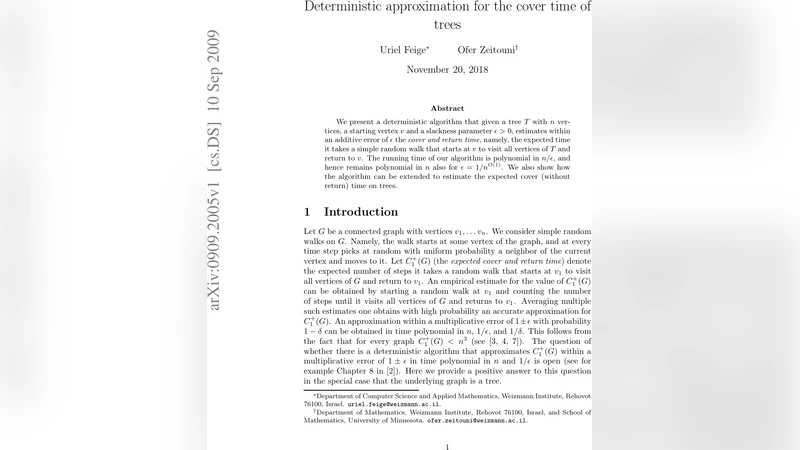
We present a deterministic algorithm that given a tree T with n vertices, a starting vertex v and a slackness parameter epsilon > 0, estimates within an additive error of epsilon the cover and return time, namely, the expected time it takes a simple random walk that starts at v to visit all vertices of T and return to v. The running time of our algorithm is polynomial in n/epsilon, and hence remains polynomial in n also for epsilon = 1/n^{O(1)}. We also show how the algorithm can be extended to estimate the expected cover (without return) time on trees.
💡 Research Summary
The paper tackles the classic problem of estimating the cover‑and‑return time of a simple random walk on a tree — the expected number of steps required for a walk that starts at a designated vertex v to visit every vertex of the tree T and then return to v. While the exact value can be expressed in terms of the inverse of the transition matrix of the underlying Markov chain, computing it directly is #P‑hard for general graphs, and even for trees the naïve approach requires solving a large linear system. Existing approximation methods therefore rely on Monte‑Carlo simulations or spectral bounds, both of which need a number of samples that grows at least as 1/ε² to guarantee an additive error ε, making them impractical for high‑precision demands.
The authors present a deterministic algorithm that, given a tree T with n vertices, a start vertex v, and a slackness parameter ε > 0, produces an estimate (\widehat{C}(v)) such that
\
Comments & Academic Discussion
Loading comments...
Leave a Comment