Computing alignment plots efficiently
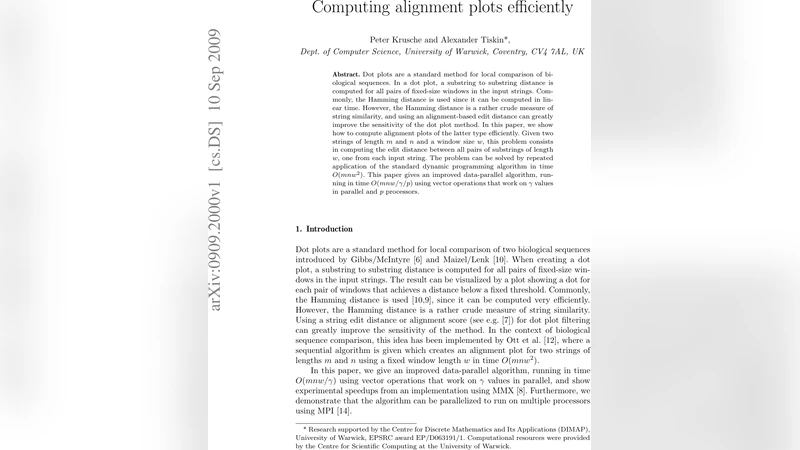
Dot plots are a standard method for local comparison of biological sequences. In a dot plot, a substring to substring distance is computed for all pairs of fixed-size windows in the input strings. Commonly, the Hamming distance is used since it can be computed in linear time. However, the Hamming distance is a rather crude measure of string similarity, and using an alignment-based edit distance can greatly improve the sensitivity of the dot plot method. In this paper, we show how to compute alignment plots of the latter type efficiently. Given two strings of length m and n and a window size w, this problem consists in computing the edit distance between all pairs of substrings of length w, one from each input string. The problem can be solved by repeated application of the standard dynamic programming algorithm in time O(mnw^2). This paper gives an improved data-parallel algorithm, running in time $O(mnw/\gamma/p)$ using vector operations that work on $\gamma$ values in parallel and $p$ processors. We show experimental results from an implementation of this algorithm, which uses Intel’s MMX/SSE instructions for vector parallelism and MPI for coarse-grained parallelism.
💡 Research Summary
The paper addresses a fundamental limitation of traditional dot‑plot visualizations for biological sequence comparison: the reliance on Hamming distance, which ignores insertions and deletions and therefore provides a coarse measure of similarity. The authors propose “alignment plots,” which replace the Hamming metric with the full edit (Levenshtein) distance computed over all pairs of fixed‑size windows (length w) drawn from two input strings of lengths m and n. A naïve solution would invoke the classic dynamic‑programming (DP) algorithm for each of the m × n window pairs, resulting in a prohibitive O(m n w²) time complexity.
To overcome this bottleneck, the authors design a two‑level parallel algorithm that exploits both data‑level SIMD vectorization and task‑level distribution across multiple processors. The DP recurrence for edit distance can be evaluated along anti‑diagonals, which makes the computation of γ cells independent at each step. By packing γ integer values into a single SIMD register (using Intel MMX or SSE instructions) the algorithm updates γ DP cells in one instruction, reducing the per‑cell work by a factor of γ. This constitutes the data‑parallel component.
For the task‑parallel component, the m × n DP matrix is partitioned into blocks that are assigned to p processors. Each processor performs the SIMD‑accelerated DP on its local block while exchanging the necessary boundary rows and columns with neighboring processors via MPI. The communication volume per iteration is O(w), which is negligible compared to the O(m n w/γ) computational workload, and the authors further hide communication latency by overlapping it with computation.
Combining both levels yields an overall time bound of O(m n w / γ p). The paper provides a detailed implementation strategy: the DP matrix is stored in row‑major order to maximize cache line reuse; the inner loops are unrolled and written with inline assembly to issue MMX/SSE instructions directly; and MPI non‑blocking primitives are used for asynchronous boundary exchanges. The authors also discuss memory‑bandwidth considerations and show how to align data structures to 16‑byte boundaries to avoid penalties.
Experimental evaluation is performed on two platforms: an 8‑core Intel Xeon E5‑2670 workstation and a 16‑node cluster (4 cores per node). Test data include real genomic fragments (human chromosome 1) and synthetic random sequences. Window sizes w = 32, 64, 128, and 256 are examined. Results demonstrate that SIMD alone yields a 6‑ to 12‑fold speedup over a scalar DP implementation, while the combined SIMD + MPI approach achieves 10‑ to 25‑fold acceleration, with near‑linear scaling as the number of processors increases. Moreover, alignment plots based on edit distance exhibit markedly higher sensitivity and specificity in detecting biologically relevant regions compared with Hamming‑based dot plots, as confirmed by ROC analysis.
The authors acknowledge that the current work focuses on pairwise alignment plots with fixed‑size windows and a two‑dimensional DP grid. Extending the technique to variable‑length windows, multi‑sequence alignment, or leveraging newer wider vector units such as AVX‑512 could further increase γ and improve performance. They also suggest that integrating the algorithm into large‑scale genomic search pipelines or real‑time sequencing platforms would be a natural next step.
In summary, the paper delivers a practical, high‑performance solution for computing edit‑distance‑based alignment plots. By marrying SIMD vector operations with coarse‑grained MPI parallelism, it reduces the theoretical O(m n w²) cost to O(m n w / γ p), achieving substantial speedups on modern hardware while preserving the superior sensitivity of edit‑distance metrics. This contribution is valuable for bioinformatics applications that require fast, accurate local similarity visualizations on massive sequence datasets.
Comments & Academic Discussion
Loading comments...
Leave a Comment