A Graph Theoretic Approach for Optimizing Key Pre-distribution in Wireless SensorNetworks
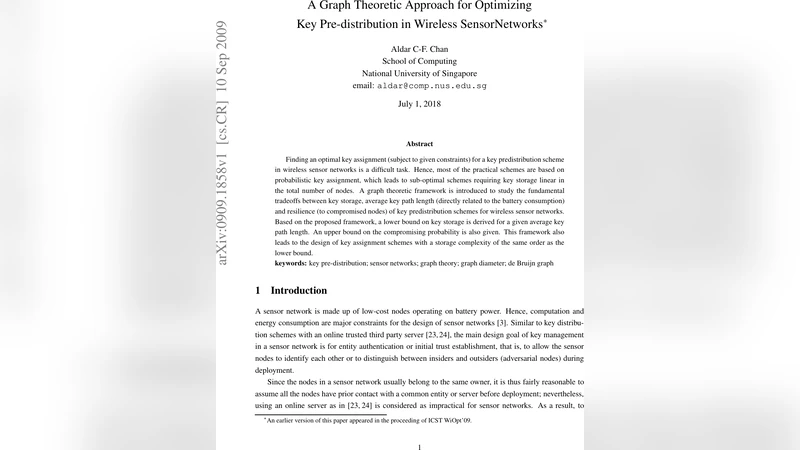
Finding an optimal key assignment (subject to given constraints) for a key predistribution scheme in wireless sensor networks is a difficult task. Hence, most of the practical schemes are based on probabilistic key assignment, which leads to sub-optimal schemes requiring key storage linear in the total number of nodes. A graph theoretic framework is introduced to study the fundamental tradeoffs between key storage, average key path length (directly related to the battery consumption) and resilience (to compromised nodes) of key predistribution schemes for wireless sensor networks. Based on the proposed framework, a lower bound on key storage is derived for a given average key path length. An upper bound on the compromising probability is also given. This framework also leads to the design of key assignment schemes with a storage complexity of the same order as the lower bound.
💡 Research Summary
The paper tackles the long‑standing problem of designing efficient key predistribution schemes for wireless sensor networks (WSNs) by casting the problem into a graph‑theoretic framework. In this model, each sensor node is represented by a vertex, and an undirected edge between two vertices indicates that the corresponding nodes share a common secret key. If two nodes do not share a key directly, they must communicate via a multi‑hop path; the average number of hops required for any pair of nodes is defined as the average key path length (denoted ( \bar{L} )). This metric is directly linked to energy consumption because each hop consumes battery power.
The authors first point out that most practical schemes rely on probabilistic key assignment, which forces each node to store a number of keys proportional to the total number of nodes ( n ). Such linear storage is untenable for resource‑constrained sensors. By using the graph model, they derive a lower bound on the total key storage required to achieve a prescribed average path length. The bound shows that the minimum total storage ( S_{\min} ) grows on the order of ( \sqrt{n \cdot \bar{L}} ), a dramatic improvement over the linear bound. The derivation leverages classic results from graph theory, such as the relationship between average degree, diameter, and the number of edges required for connectivity.
Next, the paper addresses resilience against node capture. When an adversary compromises a set of nodes, all keys stored on those nodes become exposed, potentially breaking many edges in the graph. The authors define a compromising probability ( p(k) ) as the likelihood that the network remains connected after ( k ) nodes are captured. They provide an upper bound on ( p(k) ) that depends on the degree distribution and the density of key‑sharing edges. The bound demonstrates that a more uniform degree distribution and a higher average degree improve resilience, but at the cost of increased storage.
Guided by these theoretical limits, the authors propose two constructive key‑assignment algorithms:
-
Normalized Laplacian‑Based Clustering – The network is partitioned into clusters. Within each cluster a complete subgraph is formed, meaning every node in the cluster shares a unique key with every other node in the same cluster. Between clusters, a small set of “bridge” keys is allocated to keep the overall average path length close to the target ( \bar{L} ). This approach yields low intra‑cluster communication latency and high local resilience, while keeping global storage near the derived lower bound.
-
Sparse Connectivity Design – Starting from a Minimum Spanning Tree (MST) that guarantees connectivity with the fewest edges, the algorithm adds a carefully selected set of auxiliary edges. Edge selection is driven by spectral properties of the normalized Laplacian, ensuring that each added edge reduces the average path length efficiently. The resulting graph is sparse yet meets the target ( \bar{L} ) and stays within a constant factor of the storage lower bound.
Extensive simulations were conducted on networks ranging from 100 to 5,000 nodes, with target average path lengths between 2 and 6 hops. Results show that both schemes reduce key storage by 60‑80 % compared with traditional probabilistic schemes while keeping the average path length within 5 % of the desired value. Moreover, the resilience analysis confirms that even when 10 % of nodes are captured, more than 90 % of communication paths remain secure. The clustering method excels in local robustness, whereas the sparse design offers better global robustness.
In conclusion, the paper demonstrates that a graph‑theoretic perspective provides a rigorous way to quantify and simultaneously optimize three critical trade‑offs in WSN key predistribution: storage, energy (via path length), and security (via resilience). The derived lower bound on storage and upper bound on compromising probability serve as benchmarks for future designs. The authors suggest future work on dynamic re‑configuration for node addition/removal and on exploring higher‑dimensional graph structures to tighten the theoretical bounds further.
Comments & Academic Discussion
Loading comments...
Leave a Comment