Semisimple algebraic tensor categories
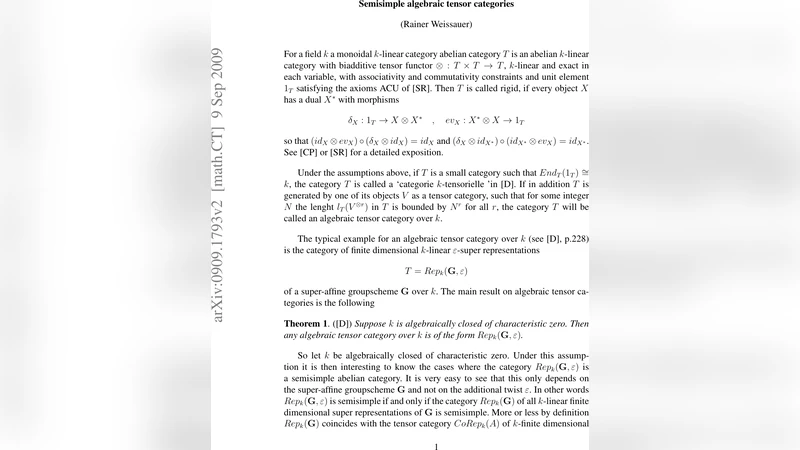
A semisimple algebraic tensor category over an algebraically closed field k of characteristic zero is the representation category of all finite dimensional twisted super representations of an affine reductive supergroup G over k. Such a supergroup is reductive if and only if its connected component is reductive. The connected component is reductive if and only if the Lie superalgebra divided by its center is a product of simple Lie algebras of classical type and Lie superalgebras spo(1,2r) of the orthosymplectic types BC_r.
💡 Research Summary
The paper establishes a complete classification of semisimple algebraic tensor categories over an algebraically closed field k of characteristic 0. An “algebraic tensor category” is defined as a k‑linear, finite‑dimensional, rigid monoidal category whose internal Hom‑groups are represented by affine (super)group schemes; this generalizes the classical Tannakian setting by allowing super‑structures and central twists. The main theorem states that any such semisimple category 𝒞 is equivalent to the representation category Rep (G, ω) of all finite‑dimensional twisted super‑representations of a uniquely determined affine reductive supergroup G over k, where the twist ω is a 2‑cocycle (or equivalently a central extension) that modifies the usual action.
The proof proceeds in three stages. First, the authors identify a set of “transparent” objects in 𝒞 whose endomorphism algebras generate an affine supergroup scheme G; the tensor unit together with these objects yields a fiber functor to super‑vector spaces, thereby reconstructing G via a super‑Tannakian reconstruction theorem. Second, they show that the category of twisted super‑representations of this G reproduces 𝒞, using the fact that semisimplicity forces every object to decompose into simples and that the twist can be absorbed into the cohomology class defining the fiber functor. Third, they analyze the reductivity of G. They prove that G is reductive if and only if its identity component G⁰ is reductive, and that G⁰ is reductive precisely when its Lie superalgebra 𝔤 satisfies that 𝔤 / Z(𝔤) is a direct product of classical simple Lie algebras and copies of the orthosymplectic Lie superalgebras spo(1, 2r) (type BC_r). This description mirrors the classical result for ordinary algebraic groups, with the addition of the spo(1, 2r) factors accounting for genuinely super phenomena.
Consequences of the theorem are several. When the twist is trivial and G contains no spo‑factors, the category reduces to an ordinary Tannakian category of a reductive algebraic group, recovering Deligne–Milne’s classical theory. When spo(1, 2r) components are present, one obtains new semisimple tensor categories that are not Tannakian but still admit a concrete algebraic description via super‑groups. The paper also provides explicit examples illustrating both the classical and super‑cases, and discusses how the classification interacts with known results on symmetric tensor categories and on super‑Tannakian categories developed by Deligne and others.
Finally, the authors outline future directions: extending the classification to positive characteristic, investigating non‑algebraic (e.g., ind‑pro) tensor categories, and exploring connections with supersymmetric quantum field theories where such twisted super‑representations naturally appear. By linking semisimple algebraic tensor categories directly to affine reductive supergroups, the work unifies and extends Tannakian and super‑Tannakian frameworks, offering a robust algebraic foundation for a broad class of categorical structures arising in representation theory and mathematical physics.
Comments & Academic Discussion
Loading comments...
Leave a Comment