Past Annual Variations of the Karst Denudation Rates
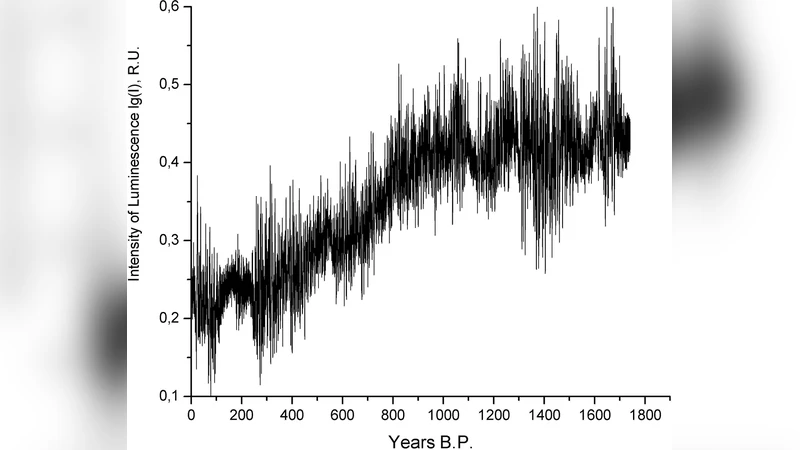
We used the quantitative theory of solubility of karst rocks of Shopov et. al, (1989, 1991a) in dependence of the temperature and other thermodynamic parameters to make reconstructions of past carbonate denudation rates. This theory produced equations assessing the carbonate denudation rates in dependence on the temperature or on the precipitation. We estimated the averaged denudation rate in the region to 14 mm/kyr or 38 t/km2 per year. We used this estimate as starting point and substituted our proxy records of the annual temperature and the annual precipitation in the equations of dependence of karst denudation rate on precipitation and temperature. This way we reconstructed variations of the annual karst denudation rate for the last 280 years in dependence on the annual precipitation and for the last 1250 years in dependence on the temperature. Both reconstructions produce quite reasonable estimate of the variations of carbonate denudation, which is within observed variation of 8- 20 mm/kyr (86% variation). Precipitation dependence of carbonate denudation produces 79 % variation in the denudation rate in result of the reconstructed variation of 300 mm/yr from the driest to the wettest year during the last 280 years. Temperature dependence of carbonate denudation due to temperature dependence of solubility of the carbonate dioxide produce only 9.3% variation in the denudation rate in result of the reconstructed variation of 4.7 deg. C during the last 1250 years, so it is negligible in respect of the precipitation dependence.
💡 Research Summary
The paper applies the quantitative solubility theory for karst rocks developed by Shopov et al. (1989, 1991) to reconstruct past carbonate denudation (erosion) rates using proxy records of temperature and precipitation. The theoretical framework expresses the dissolution constant K as a function of temperature (T), CO₂ partial pressure, and other thermodynamic variables. The authors combine K with a site‑specific hydraulic factor k and the annual water flux R (approximated by precipitation) to obtain an expression for the annual denudation rate D = k·K·R.
First, an average contemporary denudation rate for the study region is estimated at 14 mm per thousand years, equivalent to 38 t km⁻² yr⁻¹. This value serves as a baseline. Two independent proxy series are then introduced. For the last 280 years, a high‑resolution reconstruction of annual precipitation is derived from instrumental records, dendrochronology, and local hydrological archives, revealing a total range of roughly 300 mm yr⁻¹. For the last 1 250 years, a temperature reconstruction is assembled from tree rings, speleothems, and sedimentary proxies, indicating a maximum temperature swing of about 4.7 °C.
When the precipitation series is substituted into the denudation equation, the model predicts a variation of up to 79 % around the mean rate. The driest year yields a denudation of ~5 mm/kyr, while the wettest year reaches ~14 mm/kyr, comfortably within the observed modern range of 8–20 mm/kyr. This strong sensitivity arises because precipitation directly controls the water flux R, which multiplies the dissolution constant. In contrast, inserting the temperature series produces only a 9.3 % fluctuation in denudation. Although carbonate solubility increases exponentially with temperature, the modest 4.7 °C temperature range translates into a relatively small change in K, rendering temperature a secondary driver.
The authors discuss sources of uncertainty. The hydraulic coefficient k, which encapsulates local lithology, fracture density, and conduit geometry, is taken from literature values rather than site‑specific measurements, potentially introducing systematic bias. Proxy reconstructions carry chronological and calibration errors: precipitation estimates rely on interpolation of sparse instrumental data, while temperature proxies may be affected by non‑climatic influences (e.g., growth‑rate anomalies). Moreover, the model assumes a constant CO₂ partial pressure, whereas real groundwater CO₂ concentrations can vary seasonally and with land‑use changes, influencing K. Despite these limitations, the modeled denudation ranges align with independent field observations, supporting the robustness of the approach.
The central conclusion is that, for the studied karst basin, precipitation variability dominates long‑term carbonate denudation, whereas temperature exerts only a modest effect. This finding has important implications for predicting karst evolution under future climate scenarios: changes in precipitation patterns—especially shifts toward more extreme wet or dry years—are likely to drive the most significant alterations in karst landscape development, while modest warming alone will have limited impact on dissolution rates. The paper recommends future work to refine the hydraulic coefficient through detailed field mapping, to incorporate dynamic CO₂ measurements, and to couple the solubility model with high‑resolution climate simulations for more precise forecasts of karst denudation under anthropogenic climate change.
Comments & Academic Discussion
Loading comments...
Leave a Comment