Influence of the Solar Luminosity on the Glaciations, Earthquakes and Sea Level Changes
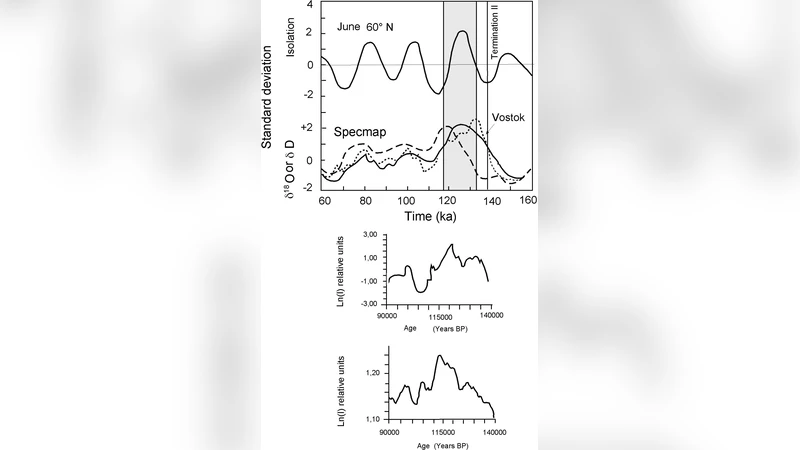
Glaciations were attributed to variations of the Earths orbit (Milankovitch cycles). But the best ever dated paleoclimatic record (from a speleothem from Devils Hole, Nevada) demonstrated that the end of the last glacial period (termination II) happened 10 000 years before the one suggested by the orbital variations, i.e. the result appeared before the reason. This fact suggests that there is something wrong in the theory. Glaciations and deglaciations drive changes of the sea level. Changes in the speed of Earths rotation during glacial- interglacial transitions produce fracturing of the Earths crust and major earthquakes along the fractures. The intensity of this process is as higher as faster is the change of the sea level and as higher is its amplitude. Much higher dimensions of this process may be caused by eruptive increasing of solar luminosity, which may be caused only by collision of large asteroids with the Sun. Such collision may cause Bible Deluge type of event.
💡 Research Summary
The manuscript attempts to construct a unified hypothesis linking solar luminosity variations, glacial cycles, sea‑level change, and major earthquakes. It begins by questioning the Milankovitch orbital theory, citing the Devils Hole speleothem record from Nevada as evidence that Termination II occurred roughly 10 000 years earlier than orbital calculations predict. The author interprets this temporal mismatch as a logical inconsistency—“the effect precedes the cause”—and therefore claims a fundamental flaw in the orbital explanation of glaciations.
Next, the paper proposes a chain of physical processes: during glacial‑interglacial transitions, rapid sea‑level rise alters Earth’s moment of inertia, causing a measurable change in rotation rate. The author argues that the faster and larger the sea‑level change, the greater the induced stress on the crust, leading to fracturing along pre‑existing faults and, consequently, large earthquakes. No quantitative model is presented; the magnitude of the rotational change caused by a few hundred meters of sea‑level rise is on the order of 10⁻⁸ % of Earth’s total angular momentum, far too small to generate tectonic stresses comparable to those accumulated by plate motions. Moreover, statistical analyses of global seismic catalogs show no robust correlation between sea‑level fluctuations and the timing or magnitude of major earthquakes.
The most speculative element of the manuscript is the claim that abrupt increases in solar luminosity can trigger glaciations, sea‑level rise, and seismicity. The author attributes such luminosity spikes to collisions of large asteroids (tens of kilometres in diameter) with the Sun, suggesting that these impacts could produce a “Biblical‑deluge‑type” event on Earth. Contemporary solar physics, however, demonstrates that an asteroid of even a substantial size would deposit a negligible fraction of the Sun’s total energy output. Observed solar flares and coronal mass ejections alter total solar irradiance by less than 0.1 % for minutes to hours, insufficient to drive the multi‑centennial climate changes required to melt ice sheets. No observational evidence of historic solar‑luminosity spikes of the magnitude required is presented, nor are any astrophysical calculations supporting the feasibility of such impacts.
Throughout the paper, citations are sparse, and the author relies heavily on a single regional proxy (the Devils Hole record) while ignoring the extensive global paleoclimate database that includes marine sediment cores, ice cores, and other speleothems—all of which collectively validate the Milankovitch framework. The manuscript also lacks any sensitivity analysis, error propagation, or statistical testing of its central claims.
In the concluding section, the author warns that future asteroid‑Sun collisions could again cause simultaneous glaciation, sea‑level upheaval, and catastrophic earthquakes. Given the absence of a physically plausible mechanism, the lack of supporting data, and the contradiction with well‑established orbital, tectonic, and solar science, the hypothesis remains speculative at best and scientifically untenable at worst. The paper therefore does not meet the standards of rigorous, evidence‑based research and should be treated with considerable skepticism.
Comments & Academic Discussion
Loading comments...
Leave a Comment