We experimentally demonstrate that the statistical properties of distances between pedestrians which are hindered from avoiding each other are described by the Gaussian Unitary Ensemble of random matrices. The same result has recently been obtained for an $n$-tuple of non-intersecting (one-dimensional, unidirectional) random walks. Thus, the observed behavior of autonomous walkers conditioned not to cross their trajectories (or, in other words, to stay in strict order at any time) resembles non-intersecting random walks.
Deep Dive into Walkers on the circle.
We experimentally demonstrate that the statistical properties of distances between pedestrians which are hindered from avoiding each other are described by the Gaussian Unitary Ensemble of random matrices. The same result has recently been obtained for an $n$-tuple of non-intersecting (one-dimensional, unidirectional) random walks. Thus, the observed behavior of autonomous walkers conditioned not to cross their trajectories (or, in other words, to stay in strict order at any time) resembles non-intersecting random walks.
The fact that non-intersecting one-dimensional random walks lead to universal system behavior has been known and discussed for at least 10 years [1], [2], [3]. It is also known that the results can be described in terms of random matrix theory -see for instance [4]. This fact is usually expressed in abstract mathematical theorems of universal validity, see for instance [5].
Our aim here is to use these abstract results in order to explain certain aspects of the observed behavior of pedestrians. A comprehensible application of the complicated mathematical theory is given e. g. in [6]. It analytically explains an experimental observation that the schedule of the city transport in Cuernavaca (Mexico) conforms to the predictions of the Gaussian Unitary Ensemble of random matrices (GUE). The reason for this interesting observation is the absence of a bus timetable, and primarily the fact that the buses do not overtake each other and hence their trajectories do not cross -see also [7] for the details. Our focus in this letter is pedestrians in a situation when they cannot avoid each other.
Pedestrian flow is a subject of intense study. This is understandable since the movement of large groups of people inevitably leads to injuries and deaths caused by trampling and by crowd-pressure. The consequences can be disastrous: for instance more than 1400 people were trampled to death during a stampede in Mecca in 1990. A proper understanding of the process how groups of people move is vital for taking effective precautions. The mathematical description is usually based on the pedestrian interactions denoted as “social forces” [8]. The exact character of these forces and of their cultural dependence remains unclear, however, and is a focus of recent discussions [9]. An evacuation dynamics of buildings is modeled in a similar way [10]. But not only panic situations are of importance. The comfortable and safe movement of people through corridors and on sidewalks is also of interest. Although people are autonomous individuals following their own destinations, they cannot move freely as soon as the pedestrian density exceeds a certain limit. For higher densities selforganizing phenomena occur. A typical example is the stratification of pavement walkers into layers for different direction [11].
We will discuss a unidirectional pedestrian motion in the range of intermediate density and in a narrow corridor that hinders mutual avoidance. Otherwise the people can move freely. Since to avoid another walker is not possible, the walker’s attention naturally focuses on the preceding fellow, in order not to collide with him. The situation resembles the assumptions of the model of vicious random walkers introduced by Fisher [12]. In a typical case, the vicious walkers move randomly on a one-dimensional discrete lattice. At each time step, that walker can move either to the left or to the right. The only constraint is that two walkers cannot occupy the same site at the same time. The model is easily modified to the situation when the motion is unidirectional (for instance right moving). In this case, the walkers are staying at the same site instead of moving to the left. The model has surprising relations with various fields of mathematics like combinatorics or random matrix theory [13]. The corresponding random matrix ensemble is, however, not fixed solely by the dynamics. It depends also on the particular initial and terminal conditions of the model [14].
Our measurement is inspired by the paper [15] where the fundamental diagram (i.e. the dependence of the pedestrian flow on the pedestrian density) has been measured experimentally with volunteers walking in a circle. Fundamental diagrams are one of the basic tools used in car flow modeling and traffic jam prediction. In highway traffic, its shape is influenced by many factors like the road topology, the existence of a near slip road, and so on. The interesting question of how cultural differences influence the flow-density relation for pedestrians has been discussed in [16]. Beside the fundamental diagram, the work also discusses density fluctuations which are of vital interest for the stampede dynamics. In a crowd, it is sudden density changes that lead to the abrupt release of the local pressure and finally cause people to fall and be trampled [17]. In a one-dimensional system, the local density is inversely proportional to the local distance among the walkers (the pedestrian clearance). So we will discuss the statistical properties of the experimentally measured pedestrian distances.
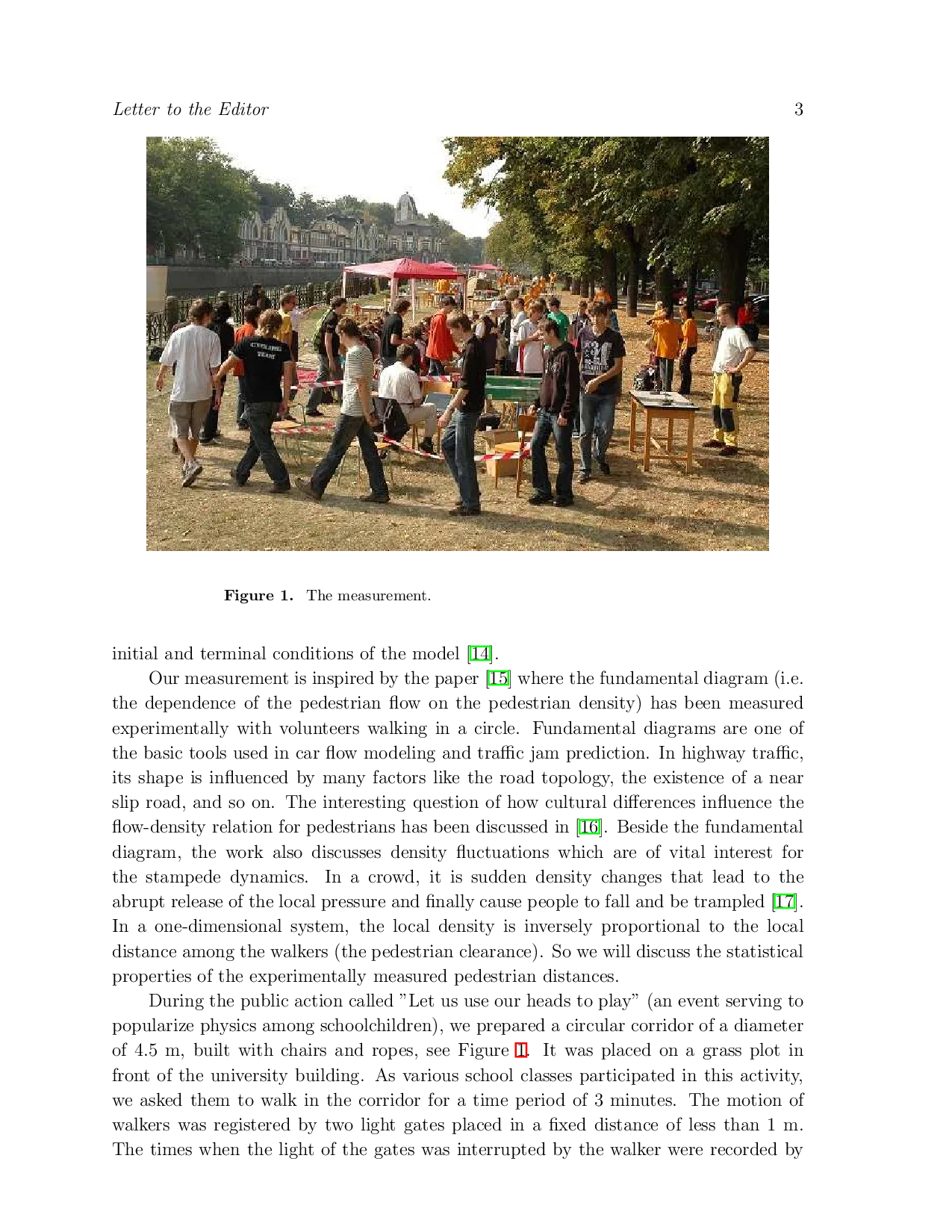
During the public action called “Let us use our heads to play” (an event serving to popularize physics among schoolchildren), we prepared a circular corridor of a diameter of 4.5 m, built with chairs and ropes, see Figure 1. It was placed on a grass plot in front of the university building. As various school classes participated in this activity, we asked them to walk in the corridor for a time p
…(Full text truncated)…
This content is AI-processed based on ArXiv data.