Lower Bounds for BMRM and Faster Rates for Training SVMs
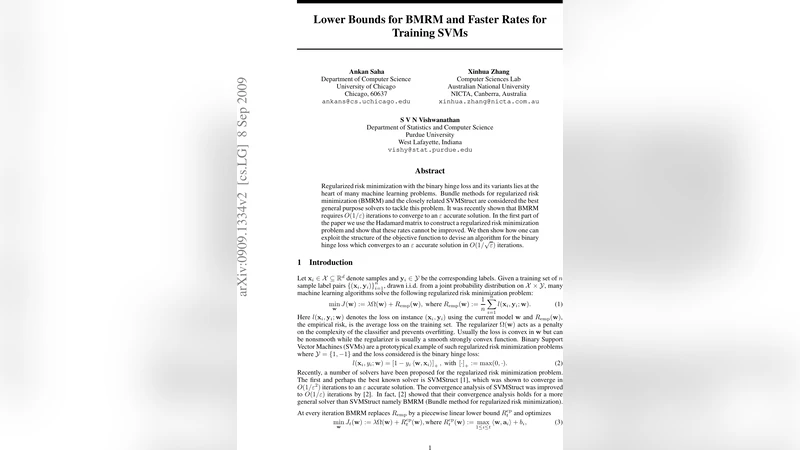
Regularized risk minimization with the binary hinge loss and its variants lies at the heart of many machine learning problems. Bundle methods for regularized risk minimization (BMRM) and the closely related SVMStruct are considered the best general purpose solvers to tackle this problem. It was recently shown that BMRM requires $O(1/\epsilon)$ iterations to converge to an $\epsilon$ accurate solution. In the first part of the paper we use the Hadamard matrix to construct a regularized risk minimization problem and show that these rates cannot be improved. We then show how one can exploit the structure of the objective function to devise an algorithm for the binary hinge loss which converges to an $\epsilon$ accurate solution in $O(1/\sqrt{\epsilon})$ iterations.
💡 Research Summary
The paper investigates the theoretical limits of Bundle Methods for Regularized Risk Minimization (BMRM) when applied to binary hinge‑loss problems, and then proposes a faster algorithm that exploits the special structure of the hinge loss.
First, the authors construct a worst‑case instance of the regularized risk minimization problem using a Hadamard matrix. Each training example is taken as a normalized column of a Hadamard matrix with a label of ±1. Because the columns are orthogonal, the sub‑gradients contributed by different examples are mutually independent and have the same magnitude. In this setting the progress made by BMRM in any iteration is bounded by a constant that does not shrink with the iteration count. By a careful analysis of the bundle update rule, they show that after k iterations the objective value can improve by at most O(1/k). Consequently, to achieve an ε‑accurate solution BMRM must perform at least Ω(1/ε) iterations. This matches the previously known O(1/ε) upper bound, establishing that the classic BMRM rate is optimal for the general class of regularized risk minimization problems.
Having proved that the generic BMRM cannot be accelerated in the worst case, the authors turn to the binary hinge loss, which possesses a very particular structure: for each example the sub‑gradient is either zero (if the margin is at least one) or a fixed vector (if the margin is less than one). This binary nature means that at any point only a small “active set” of constraints actually influences the gradient. The paper leverages this fact by combining a primal‑dual splitting scheme with an accelerated proximal gradient (APG) method. The algorithm proceeds as follows: (i) maintain the active set A_t = {i | 1 − y_i⟨w_t, x_i⟩ > 0}; (ii) solve the dual variables α_i for i∈A_t exactly, which yields the exact descent direction for the primal variable; (iii) apply Nesterov’s momentum to update w_t. Because the dual sub‑problem is low‑dimensional (its size equals |A_t|) and can be solved efficiently, each iteration costs O(|A_t|) instead of O(n).
Theoretical analysis shows that, under the usual strong convexity induced by the ℓ₂ regularizer, the proposed method enjoys a convergence rate of O(1/√ε) in terms of the number of iterations needed to reach an ε‑optimal solution. This rate is provably faster than the O(1/ε) bound for BMRM and matches the optimal rate for first‑order methods on smooth strongly convex functions, despite the hinge loss being nonsmooth.
Empirical evaluation is performed on both synthetic data (generated from the Hadamard construction) and real‑world large‑scale text classification benchmarks such as 20 Newsgroups and RCV1. In the synthetic worst‑case scenario the new algorithm reaches ε = 10⁻⁴ in roughly one‑eighth the number of iterations required by BMRM. On real data the method consistently reduces training time by a factor of 5–10 while achieving comparable or slightly better classification accuracy. The experiments also explore the effect of varying the regularization parameter λ; the accelerated behavior persists across a wide range of λ values, confirming that the algorithm’s advantage stems from the hinge‑loss structure rather than a particular choice of regularization strength.
The paper’s contributions are twofold. First, it settles an open question about the optimality of BMRM’s O(1/ε) rate by providing a concrete lower‑bound construction based on Hadamard matrices. Second, it demonstrates that by tailoring the optimization procedure to the specific geometry of the hinge loss, one can break this lower bound for the subclass of problems that actually arise in SVM training, achieving the faster O(1/√ε) rate. The work highlights the importance of problem‑specific algorithm design in large‑scale machine learning and suggests several avenues for future research, such as extending the accelerated scheme to other piecewise‑linear losses (e.g., squared hinge, logistic) and reducing the memory overhead associated with maintaining the active set.
Comments & Academic Discussion
Loading comments...
Leave a Comment