On the Cauchy Problem for the Korteweg-de Vries Equation with Steplike Finite-Gap Initial Data I. Schwartz-Type Perturbations
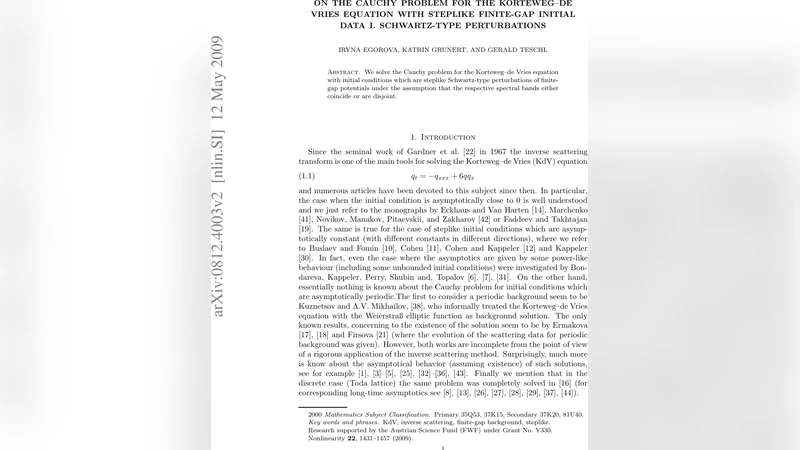
We solve the Cauchy problem for the Korteweg-de Vries equation with initial conditions which are steplike Schwartz-type perturbations of finite-gap potentials under the assumption that the respective spectral bands either coincide or are disjoint.
💡 Research Summary
The paper addresses the Cauchy problem for the Korteweg‑de Vries (KdV) equation when the initial data consist of a steplike Schwartz‑type perturbation of two finite‑gap potentials. The authors work under the structural assumption that the spectral bands of the two background operators either coincide completely or are completely disjoint. This assumption guarantees a clear separation of the left‑ and right‑hand asymptotic regimes and eliminates the complications that arise when spectral bands overlap.
The study begins with a concise review of the algebro‑geometric theory of finite‑gap potentials. Such potentials are characterized by a hyperelliptic Riemann surface whose branch cuts correspond to the spectral bands, while the gaps give rise to a finite number of “action‑angle” variables. The authors recall that the KdV flow preserves the spectrum of the associated Schrödinger operator (the Lax pair) and that the dynamics can be described in terms of the evolution of the Baker‑Akhiezer function on the Riemann surface.
In the steplike setting, the left and right infinities are governed by two possibly different finite‑gap backgrounds. The authors construct left‑ and right‑hand Jost solutions that asymptotically match the corresponding Baker‑Akhiezer functions. By comparing these Jost solutions across the transition region, they derive a transfer matrix that encodes the scattering data: reflection coefficients, transmission coefficients, discrete eigenvalues (if any), and norming constants. Because the spectral bands are either identical or non‑overlapping, the transfer matrix becomes block‑diagonal, which dramatically simplifies the analysis.
The core of the paper is the formulation and solution of a Marchenko‑type integral equation adapted to the steplike finite‑gap context. The kernel of this equation is built from the scattering data and inherits the rapid decay of the Schwartz‑type perturbation. Using standard Fredholm theory, the authors prove that the integral equation is uniquely solvable for all times, thereby establishing existence and uniqueness of the solution to the original KdV Cauchy problem.
Time evolution of the scattering data is obtained directly from the Lax pair: the continuous spectrum is invariant, while the reflection and transmission coefficients acquire a phase factor e^{±8ik^{3}t}. Substituting these time‑dependent data into the Marchenko equation yields an explicit representation of the solution at any time t.
A significant portion of the work is devoted to the asymptotic analysis as t→∞. The authors show that the solution decomposes into two quasi‑periodic finite‑gap backgrounds connected by a localized nonlinear wave packet that travels from one side to the other. The packet’s shape is governed by the reflection coefficient, while the phase of each background remains locked to the original algebro‑geometric data. This result extends the well‑known soliton resolution for rapidly decaying data to the much richer setting of steplike finite‑gap backgrounds.
The paper concludes with a discussion of the limitations imposed by the “coincident or disjoint” band condition and outlines possible extensions. The authors suggest that the method could be generalized to partially overlapping bands, to multi‑step configurations, and even to other integrable equations possessing a Lax pair (e.g., modified KdV, nonlinear Schrödinger). Overall, the work provides a rigorous and comprehensive framework for handling non‑decaying, highly structured initial data in the KdV equation, opening new avenues for both theoretical investigation and applications where periodic or quasi‑periodic media are present.
Comments & Academic Discussion
Loading comments...
Leave a Comment