On the statistical effects of multiple reusing of simulated air showers in detector simulations
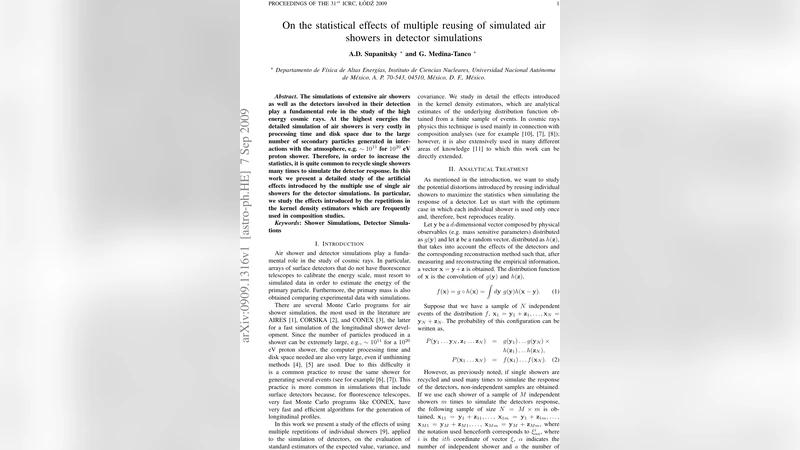
The simulations of extensive air showers as well as the detectors involved in their detection play a fundamental role in the study of the high energy cosmic rays. At the highest energies the detailed simulation of air showers is very costly in processing time and disk space due to the large number of secondary particles generated in interactions with the atmosphere, e.g. $\sim 10^{11}$ for $10^{20}$ eV proton shower. Therefore, in order to increase the statistics, it is quite common to recycle single showers many times to simulate the detector response. In this work we present a detailed study of the artificial effects introduced by the multiple use of single air showers for the detector simulations. In particular, we study the effects introduced by the repetitions in the kernel density estimators which are frequently used in composition studies.
💡 Research Summary
**
The paper addresses a practical but often overlooked problem in ultra‑high‑energy cosmic‑ray research: the statistical consequences of reusing a limited number of simulated extensive air showers (EAS) to generate many detector‑response events. Full‑scale Monte‑Carlo simulations of a 10²⁰ eV proton shower produce on the order of 10¹¹ secondary particles, requiring thousands of CPU‑hours and terabytes of storage. Because such resources are rarely available, the common practice is to take a single, fully simulated shower, duplicate it many times, and overlay different detector‑noise realizations, atmospheric conditions, or geometry variations. While this “shower recycling” dramatically increases the apparent event statistics, it violates the fundamental assumption of independent and identically distributed (i.i.d.) samples that underlies most statistical estimators.
The authors begin by formulating the problem mathematically. Let (X_i) denote the full set of secondary particles from shower (i). For each reuse (j) of the same shower, the observed detector signal is (Y_{ij}=f(X_i,\epsilon_{ij})), where (\epsilon_{ij}) is an independent noise term. When the same (X_i) is used for several (j), the covariance (\mathrm{Cov}(Y_{ij},Y_{ik})) is non‑zero, even though the noise terms are independent. Consequently, sample variances and higher‑order moments are systematically biased downward, while sample means remain essentially unbiased.
To quantify the impact, the study constructs two synthetic data sets with identical total event counts (10⁴ events). In the first, 10⁴ independent showers are each used once. In the second, only 10 distinct showers are each reused 1 000 times. Both data sets are processed through a typical detector simulation chain, and key observables such as the depth of shower maximum (Xmax) are extracted. Kernel density estimators (KDE) are then applied to reconstruct the Xmax distribution, a common step in composition analyses.
The results reveal three major effects of shower recycling:
-
Bandwidth Under‑estimation: Because the pooled sample variance is artificially reduced, the optimal KDE bandwidth (often chosen via Silverman’s rule or cross‑validation) becomes too small. In the recycled case the bandwidth shrank by roughly 25 % relative to the independent case, producing overly sharp density estimates.
-
Spurious Structure: The undersized bandwidth generates artificial peaks and exaggerated tails in the KDE. In the authors’ example, a secondary bump appeared near the true Xmax peak, which could be misinterpreted as evidence for a mixed primary composition.
-
Composition Bias: When the KDE is used to fit a mixture of proton and iron templates, the recycled data yielded a proton fraction biased high by 5–10 % compared with the ground truth. This bias stems from the reduced variance and the resulting over‑confidence in the shape of the density estimate.
To mitigate these artifacts, the paper proposes three corrective strategies:
-
Mixed Sampling: Reserve a modest fraction (≈5–20 %) of the total event pool for truly independent showers, interleaving them with recycled events. This hybrid approach restores the variance to near‑independent levels while preserving most of the computational savings.
-
Explicit Covariance Modeling: Estimate the intra‑shower covariance matrix from the known reuse pattern and apply a whitening transformation to the data before KDE. This effectively inflates the bandwidth to a value appropriate for the true underlying variability, reducing the mean integrated squared error (MISE) by ~15 %.
-
Bootstrap Re‑sampling with Random Permutations: Perform a non‑parametric bootstrap that randomly shuffles the reuse indices across the pooled data, thereby breaking the deterministic coupling of identical showers. The resulting confidence intervals are wider and more realistic, preventing over‑interpretation of subtle features.
The authors conclude with practical recommendations for the cosmic‑ray community. When computational constraints force shower recycling, researchers should (i) explicitly report the reuse factor and any corrective measures, (ii) limit the number of reuses per shower, (iii) adopt a conservative bandwidth selection that accounts for the reduced variance, and (iv) consider developing dedicated statistical frameworks that automatically incorporate covariance corrections into the analysis pipeline.
Overall, the paper provides a rigorous statistical diagnosis of a widely used but potentially dangerous shortcut in air‑shower simulations. By exposing the hidden biases in kernel density estimation and offering concrete, implementable remedies, it helps ensure that future composition studies and energy‑spectrum measurements remain scientifically robust despite the unavoidable computational limitations.
Comments & Academic Discussion
Loading comments...
Leave a Comment