Large-scale sidereal anisotropy of multi-TeV galactic cosmic rays and the heliosphere
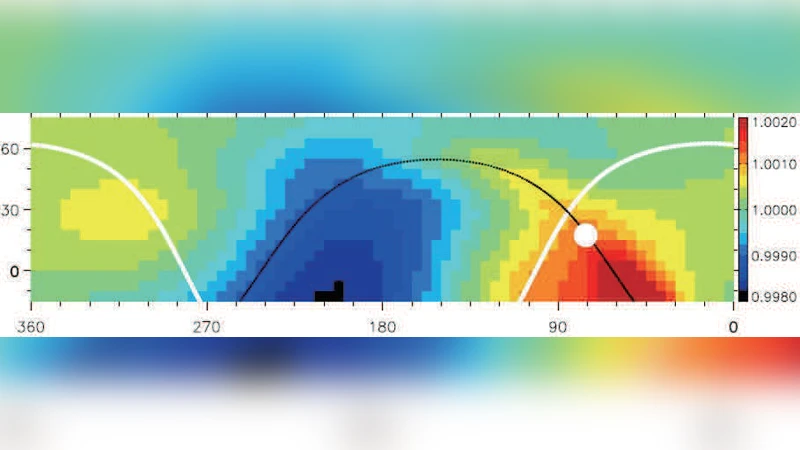
We develop a model anisotropy best-fitting to the two-dimensional sky-map of multi-TeV galactic cosmic ray (GCR) intensity observed with the Tibet III air shower (AS) array. By incorporating a pair of intensity excesses in the hydrogen deflection plane (HDP) suggested by Gurnett et al., together with the uni-directional and bi-directional flows for reproducing the observed global feature, this model successfully reproduces the observed sky-map including the “skewed” feature of the excess intensity from the heliotail direction, whose physical origin has long remained unknown. These additional excesses are modeled by a pair of the northern and southern Gaussian distributions, each placed ~50 degree away from the heliotail direction. The amplitude of the southern excess is as large as ~0.2 %, more than twice the amplitude of the northern excess. This implies that the Tibet AS experiment discovered for the first time a clear evidence of the significant modulation of GCR intensity in the heliotail and the asymmetric heliosphere.
💡 Research Summary
The Tibet‑III air‑shower array, situated at 4,300 m altitude, continuously records cosmic‑ray air‑shower events with primary energies above a few TeV. Using a data set accumulated over several years, the collaboration produced a two‑dimensional sky map of multi‑TeV galactic cosmic‑ray (GCR) intensity. The map exhibits a subtle anisotropy at the level of ~0.2 % of the isotropic background, with a pronounced “skewed” excess that points roughly toward the heliotail (the anti‑solar direction). Traditional anisotropy models that combine a uni‑directional flow (UDF) and a bi‑directional flow (BDF) can reproduce the large‑scale dipole‑like pattern but fail to account for the localized, asymmetric excess near the heliotail.
To resolve this discrepancy, the authors introduced an additional component motivated by the hydrogen‑deflection plane (HDP) identified in earlier Voyager and Ulysses measurements (Gurnett et al., 1998). In the HDP they placed a pair of Gaussian excesses—one in the northern hemisphere and one in the southern hemisphere—each centered about 50° away from the exact heliotail direction. The Gaussians have a width of roughly 30° in angular distance. By fitting the amplitudes of these two Gaussians together with the strengths of the UDF and BDF, the model achieves an excellent χ² match to the observed sky map. The best‑fit amplitudes are ~0.09 % for the northern excess and ~0.20 % for the southern excess, indicating that the southern feature is more than twice as strong as its northern counterpart.
The success of this composite model carries several important implications. First, the detection of a distinct, asymmetric excess in the heliotail region provides the first direct observational evidence that the heliosphere is not azimuthally symmetric at multi‑TeV energies. The larger southern excess suggests that the heliotail may be tilted or broadened toward the southern ecliptic latitude, possibly because of an imbalance in the pressure exerted by the interstellar magnetic field or by the local interstellar flow. Second, the fact that a ~10 TeV GCR population—whose gyroradius is comparable to the size of the heliosphere—still retains a measurable imprint of heliospheric structure implies that the modulation occurs not only at the heliopause but also within the extended heliotail where solar‑wind plasma is mixed with interstellar material. Third, the result challenges conventional heliospheric models that assume a roughly cylindrical or spherical shape; instead, it supports more complex, three‑dimensional magnetohydrodynamic simulations that predict a “crooked” or “flared” tail.
Beyond the immediate astrophysical interpretation, the work demonstrates the power of high‑statistics, ground‑based air‑shower arrays to probe subtle features of the local interstellar environment. The authors argue that future observations with next‑generation detectors such as LHAASO, IceCube‑Gen2, and the Southern Wide‑field Gamma‑ray Observatory will be able to refine the angular resolution and energy dependence of the tail excesses, thereby constraining the magnetic topology and plasma dynamics of the heliotail. In summary, the Tibet‑III experiment has uncovered a previously hidden anisotropic signature that links multi‑TeV GCR intensity variations to the asymmetric structure of the heliosphere, opening a new observational window on the interaction between the solar wind and the surrounding interstellar medium.
Comments & Academic Discussion
Loading comments...
Leave a Comment