Braided Categorical Quantum Mechanics I
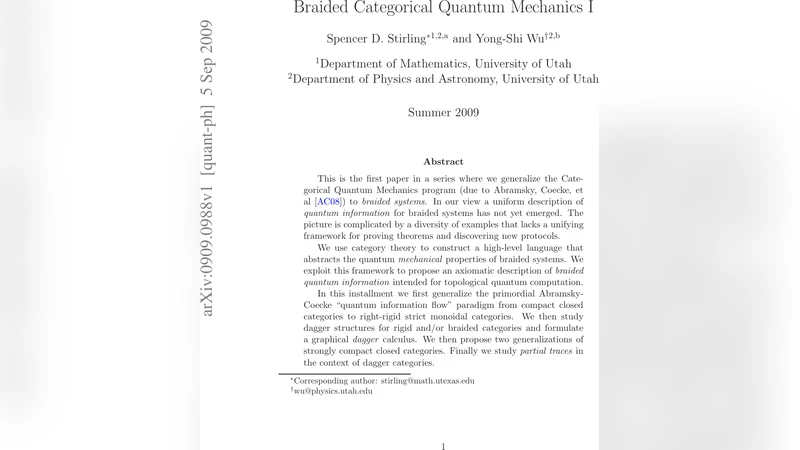
This is the first paper in a series where we generalize the Categorical Quantum Mechanics program (due to Abramsky, Coecke, et al) to braided systems. In our view a uniform description of quantum information for braided systems has not yet emerged. The picture is complicated by a diversity of examples that lacks a unifying framework for proving theorems and discovering new protocols. We use category theory to construct a high-level language that abstracts the quantum mechanical properties of braided systems. We exploit this framework to propose an axiomatic description of braided quantum information intended for topological quantum computation. In this installment we first generalize the primordial Abramsky-Coecke “quantum information flow” paradigm from compact closed categories to right-rigid strict monoidal categories. We then study dagger structures for rigid and/or braided categories and formulate a graphical dagger calculus. We then propose two generalizations of strongly compact closed categories. Finally we study partial traces in the context of dagger categories.
💡 Research Summary
The paper “Braided Categorical Quantum Mechanics I” sets out to extend the categorical quantum mechanics (CQM) program—originally built on compact‑closed, symmetric monoidal categories—so that it can faithfully model braided quantum systems such as those encountered in topological quantum computation. The authors begin by replacing the symmetric compact‑closed setting with a right‑rigid strict monoidal category. In a right‑rigid category each object A possesses a right dual A* together with unit and counit morphisms ηA : I → A*⊗A and εA : A⊗A* → I, but no left‑dual or symmetry is required. This asymmetry mirrors the non‑trivial braiding of anyons, where exchanging particles does not simply swap tensor factors.
Having established a one‑sided duality, the authors introduce a dagger structure compatible with both the rigid and braided aspects. Traditional daggers are defined on symmetric monoidal categories as a contravariant involution that acts like complex conjugate transpose on morphisms. Here the dagger is defined graphically: reversing the direction of arrows in the string diagram while preserving the braiding crossings. The resulting “graphical dagger calculus’’ respects the triangular identities of the right‑rigid structure and interacts coherently with the braid isomorphisms. This provides a categorical notion of reversible quantum processes even in a non‑symmetric setting.
The paper then proposes two generalisations of strongly compact‑closed categories. The first, a strong right‑rigid dagger category, retains a single-sided dual together with a dagger, and reconstructs the inner‑product‑like features of strongly compact‑closed categories (e.g., the existence of a scalar involution) in this asymmetric context. The second, a braided‑dagger rigid category, demands that the braid and dagger commute, yielding a setting where braiding is unitary with respect to the dagger. Both structures are shown to support a rich diagrammatic language that can express topological quantum gates, entanglement, and measurement in a way that is faithful to the underlying physics of anyonic systems.
A major technical contribution is the definition of a partial trace for dagger‑rigid categories. In compact‑closed categories the trace is defined via the cup‑cap (η and ε) morphisms; here the authors adapt this construction using the right‑dual and the dagger, producing a “dagger‑rigid trace’’ that discards a subsystem while preserving the dagger structure on the remaining part. This trace satisfies the usual cyclicity and naturality properties and enables the authors to model information flow, decoherence, and error‑correction procedures diagrammatically.
To illustrate the framework, the authors present several examples. They encode the braiding of Fibonacci anyons as morphisms in a right‑rigid dagger category, showing how the non‑trivial phase acquired under exchange appears as a scalar attached to a braid crossing. They also demonstrate how a topological quantum circuit can be simplified using the dagger‑rigid trace, effectively “tracing out’’ ancillary anyons after a measurement. These examples highlight that many familiar quantum‑information protocols (teleportation, entanglement swapping, measurement‑based computation) have natural analogues in the braided setting when expressed in the authors’ language.
In summary, the paper delivers a comprehensive categorical toolkit for braided quantum mechanics: (1) a shift from symmetric compact‑closed to right‑rigid monoidal categories, (2) a compatible dagger calculus, (3) two robust extensions of strong compactness to the braided world, and (4) a well‑behaved partial trace. Together these results lay the groundwork for a unified, high‑level description of topological quantum computation and open the door to systematic theorem‑proving and protocol discovery in braided quantum information theory.
Comments & Academic Discussion
Loading comments...
Leave a Comment