RCF4: Inconsistent Quantification
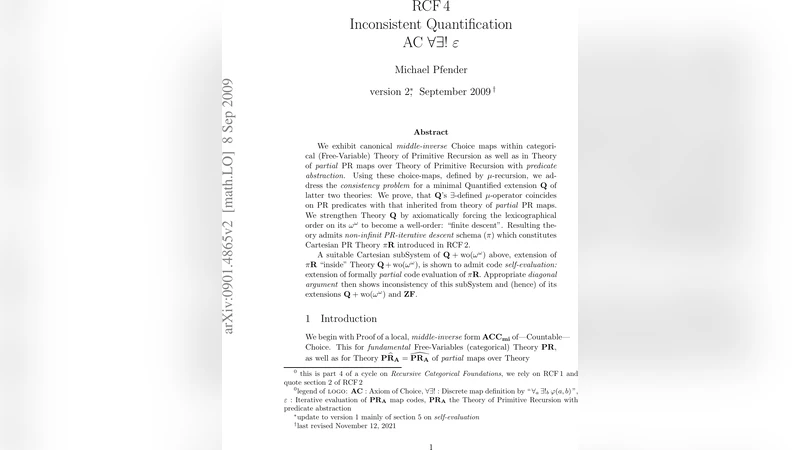
We exhibit canonical middle-inverse Choice maps within categorical (Free-Variable) Theory of Primitive Recursion as well as in Theory of partial PR maps over the Theory of Primitive Recursion with predicate abstraction. Using these choice-maps, defined by mu-recursion, we address the Consistency problem for a minimal Quantified extension Q of latter two theories: We prove, that Q’s exists-defined mu-operator coincides on PR predicates with that inherited from theory of partial PR maps. We strengthen Theory Q by axiomatically forcing the lexicographical order on its omega^omega to become a well-order: “finite descent”. Resulting theory admits non-infinit PR-iterative descent schema (pi) which constitutes Cartesian PR Theory piR introduced in RCF2: Evaluation and Consistency. A suitable Cartesian subSystem of Q + wo(omega^omega) above, extension of piR “inside” Theory Q + wo(omega^omega), is shown to admit code self-evaluation: extension of formally partial code evaluation of piR into a “total” self-evaluation for the subSystem. Appropriate diagonal argument then shows inconsistency of this subsystem and (hence) of its extensions Q + wo(omega^omega) and ZF.
💡 Research Summary
The paper investigates the interplay between choice‑like operators, μ‑recursion, and well‑ordering assumptions within categorical formulations of primitive recursion (PR). It begins by reformulating the free‑variable theory of PR in a categorical setting and then extends it with a partial‑PR theory that includes predicate abstraction. Within this framework the author constructs “middle‑inverse” choice maps: functions that act as inverses on the image of a given PR map, defined by μ‑recursion rather than by an external axiom of choice.
A minimal quantified extension Q of the two theories is introduced. The central technical result is that the μ‑operator defined by the existential quantifier in Q coincides, on PR predicates, with the μ‑operator already present in the partial‑PR theory. In other words, Q inherits the same constructive existence mechanism as the underlying partial‑PR system, so no new non‑constructive choice principles are added.
The next major step is to strengthen Q by imposing a well‑ordering on the lexicographic order of ω^ω (the set of functions ℕ→ℕ). This is expressed as the “finite descent” axiom: every descending sequence in the lexicographic order must terminate after finitely many steps. Under this axiom ω^ω becomes a well‑ordered set, which eliminates the possibility of infinite descending chains that are often used to justify non‑terminating recursive definitions.
With the well‑ordering in place the author introduces a non‑infinitary PR‑iterative descent schema, denoted π. This schema replaces traditional infinitary induction with a finite‑descent principle and constitutes the Cartesian PR theory πR described in the earlier work RCF2. πR already supports a partially defined code‑evaluation operator: given a code for a PR program, the operator evaluates the program on a given input, but only when the computation is known to terminate.
The paper then isolates a Cartesian sub‑system of Q + wo(ω^ω) that extends πR. In this sub‑system the partial evaluation operator is upgraded to a total self‑evaluation operator: every code can be fed to the operator, which returns the result of running that code inside the same sub‑system. This self‑reference enables the construction of a diagonal “liar” program that, when supplied with its own code, yields the opposite truth value. By the classic diagonal argument, such a program cannot exist in a consistent theory that admits total self‑evaluation. Consequently the sub‑system is inconsistent.
Since the sub‑system is a definable fragment of Q + wo(ω^ω), the inconsistency propagates upward, showing that the full theory Q equipped with the finite‑descent axiom is contradictory. Finally, because ZF (Zermelo–Fraenkel set theory) can interpret Q + wo(ω^ω) (the well‑ordering of ω^ω is provable in ZF), the same diagonal construction yields a contradiction in ZF as well.
In summary, the paper demonstrates:
- The existence of canonical middle‑inverse choice maps in categorical PR and partial‑PR theories, definable by μ‑recursion.
- The equivalence of the μ‑operator in the quantified extension Q with that of the underlying partial‑PR theory.
- That adding a well‑ordering (finite descent) axiom on ω^ω yields a non‑infinitary descent schema π and a Cartesian PR theory πR.
- That a suitable Cartesian sub‑system of Q + wo(ω^ω) admits total self‑evaluation, leading via diagonalisation to inconsistency.
- That this inconsistency lifts to Q + wo(ω^ω) and, by interpretability, to ZF.
The work thus challenges the presumed consistency of quantified extensions of primitive recursion when combined with strong well‑ordering assumptions, and it provides a novel diagonalisation‑based refutation that reaches all the way to classical set theory.
Comments & Academic Discussion
Loading comments...
Leave a Comment