Optimal scaling of the random walk Metropolis on elliptically symmetric unimodal targets
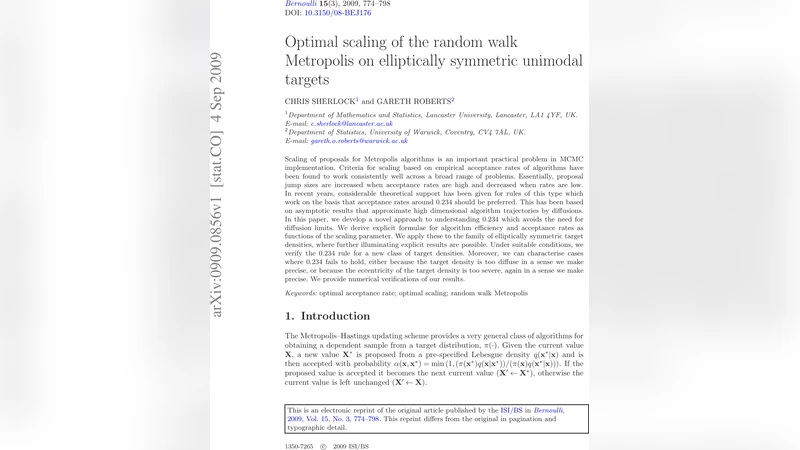
Scaling of proposals for Metropolis algorithms is an important practical problem in MCMC implementation. Criteria for scaling based on empirical acceptance rates of algorithms have been found to work consistently well across a broad range of problems. Essentially, proposal jump sizes are increased when acceptance rates are high and decreased when rates are low. In recent years, considerable theoretical support has been given for rules of this type which work on the basis that acceptance rates around 0.234 should be preferred. This has been based on asymptotic results that approximate high dimensional algorithm trajectories by diffusions. In this paper, we develop a novel approach to understanding 0.234 which avoids the need for diffusion limits. We derive explicit formulae for algorithm efficiency and acceptance rates as functions of the scaling parameter. We apply these to the family of elliptically symmetric target densities, where further illuminating explicit results are possible. Under suitable conditions, we verify the 0.234 rule for a new class of target densities. Moreover, we can characterise cases where 0.234 fails to hold, either because the target density is too diffuse in a sense we make precise, or because the eccentricity of the target density is too severe, again in a sense we make precise. We provide numerical verifications of our results.
💡 Research Summary
**
The paper tackles the long‑standing practical problem of how to choose the proposal scale for the Random‑Walk Metropolis (RWM) algorithm in high‑dimensional settings. While the celebrated “0.234 rule” – that the average acceptance probability should be around 23.4 % – has been widely used, its theoretical justification has traditionally relied on diffusion limits, i.e., approximating the Markov chain by a continuous‑time diffusion as the dimension goes to infinity. This approach is mathematically involved and only applies under fairly restrictive conditions.
The authors propose a completely different route that does not require any diffusion approximation. They focus on a broad class of target densities that are elliptically symmetric and unimodal, i.e. densities of the form
\
Comments & Academic Discussion
Loading comments...
Leave a Comment