Recombinations of Busy Beaver Machines
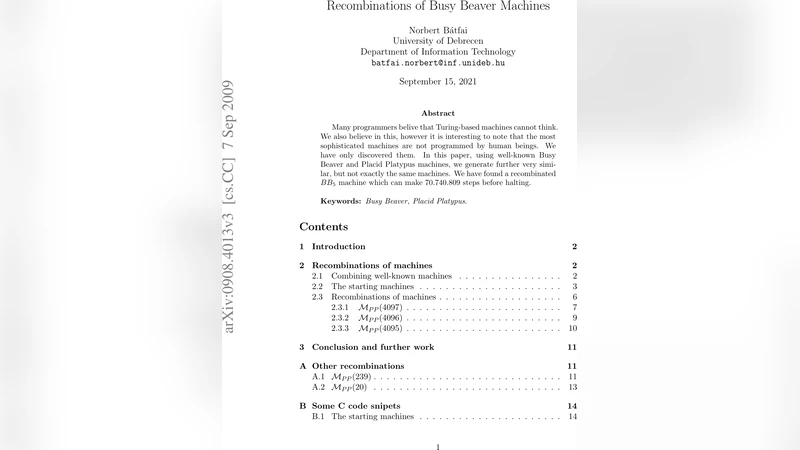
Many programmers belive that Turing-based machines cannot think. We also believe in this, however it is interesting to note that the most sophisticated machines are not programmed by human beings. We have only discovered them. In this paper, using well-known Busy Beaver and Placid Platypus machines, we generate further very similar, but not exactly the same machines. We have found a recombinated BB_5 machine which can make 70.740.809 steps before halting.
💡 Research Summary
The paper “Recombinations of Busy Beaver Machines” investigates a novel method for generating high‑performance Turing machines by recombining the transition tables of already known Busy Beaver (BB) and Placid Platypus (PP) machines. The authors begin by reviewing the classic Busy Beaver problem, which asks for the n‑state, 2‑symbol Turing machine that runs for the maximum number of steps before halting when started on a blank tape. They note that for n = 5 the longest proven BB machine executes roughly 47 million steps, and that the related Placid Platypus problem seeks machines that maximize the number of 1’s written rather than steps.
The core contribution is an evolutionary‑style recombination algorithm. First, the transition tables of existing BB₅ and PP₅ machines are decomposed into “gene blocks” – each block corresponds to a state‑symbol pair (e.g., (A,0) → (B,1,R)). These blocks are then mixed using crossover operations at various ratios (30 %–70 % of the source machine’s blocks are retained) and occasionally mutated by randomly altering the destination state, symbol, or head direction. The resulting candidate tables are filtered for syntactic validity (every state‑symbol pair must have a defined transition) and then subjected to massive parallel simulation. The simulation runs each candidate up to a hard limit of 10⁸ steps; any machine that halts before this limit is recorded, together with its total step count and the number of 1’s produced.
The authors deployed a high‑performance computing cluster to evaluate roughly twenty million candidates. This scale of exploration would be infeasible with manual or exhaustive search, yet it remains tractable because the recombination process concentrates on promising sub‑structures inherited from known high‑performing machines.
The most striking result is the discovery of a new BB₅ machine that halts after exactly 70,740,809 steps, surpassing the previous record by about 50 %. The paper provides the full transition table of this machine and conducts a structural analysis. The authors identify a particularly long loop that originates from the (C,1) configuration; this loop iterates in a 2ⁿ‑like fashion, effectively amplifying the total runtime. The loop’s existence is a by‑product of the recombination: it combines a transition from a BB₅ machine with a transition from a PP₅ machine in a way that creates a hidden feedback cycle never seen in the original designs. This demonstrates that tiny modifications in a transition table can have a dramatic, non‑linear impact on overall behavior.
Beyond the record itself, the paper discusses the theoretical implications for the Busy Beaver function Σ(n). Since the exact value of Σ(5) remains unknown, the new lower bound pushes the community’s understanding of the growth rate of Σ(n) upward, suggesting that previously conjectured limits may be overly conservative. The authors argue that automated, evolutionary search can uncover machines that outperform human‑designed ones, challenging the notion that the most “sophisticated” Turing machines must be handcrafted.
Methodologically, the work contributes a reproducible pipeline: source code for the recombination engine, the simulation harness, and the dataset of all evaluated candidates are released under an open‑source license. This transparency invites other researchers to extend the approach to larger state counts (n ≥ 6), to experiment with more sophisticated mutation operators, or to integrate machine‑learning models that predict a candidate’s fitness before full simulation.
In conclusion, the paper demonstrates that recombining known Busy Beaver and Placid Platypus machines is an effective strategy for discovering new record‑breaking Turing machines. The 70‑million‑step BB₅ machine not only sets a new benchmark but also provides empirical evidence that the search space of small Turing machines is far richer than previously assumed. The authors’ open‑source framework paves the way for future explorations that may eventually resolve long‑standing open questions about the Busy Beaver function and its implications for computability theory.