Identification with Encrypted Biometric Data
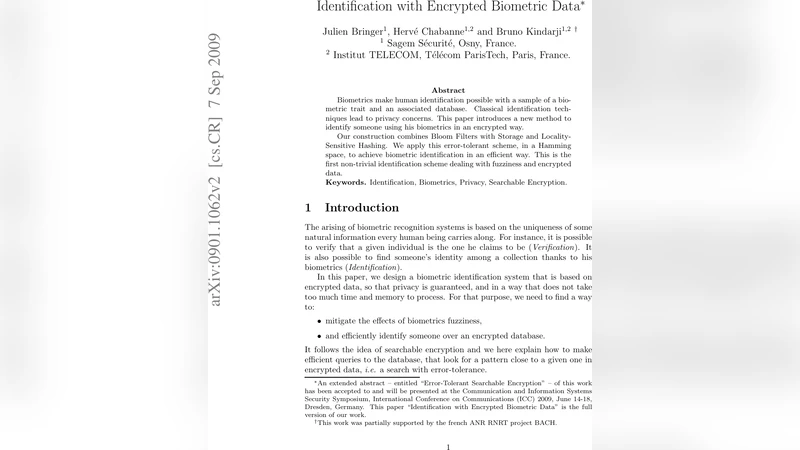
Biometrics make human identification possible with a sample of a biometric trait and an associated database. Classical identification techniques lead to privacy concerns. This paper introduces a new method to identify someone using his biometrics in an encrypted way. Our construction combines Bloom Filters with Storage and Locality-Sensitive Hashing. We apply this error-tolerant scheme, in a Hamming space, to achieve biometric identification in an efficient way. This is the first non-trivial identification scheme dealing with fuzziness and encrypted data.
💡 Research Summary
The paper “Identification with Encrypted Biometric Data” tackles the longstanding privacy dilemma inherent in biometric identification systems. Traditional approaches either store raw biometric templates, exposing users to identity theft, or apply heavy cryptographic protocols that dramatically increase computational overhead and reduce tolerance to measurement noise. The authors propose a novel, error‑tolerant identification scheme that operates entirely on encrypted data, combining Bloom filters, storage‑optimized locality‑sensitive hashing (LSH), and Hamming‑space matching.
First, each biometric sample (e.g., a fingerprint or facial feature vector) is binarized into a high‑dimensional bit string. This string is then processed by multiple independent hash functions; the resulting indices set bits in a Bloom filter, producing a compact, probabilistic representation that does not reveal the original template. Because Bloom filters are one‑way, an adversary cannot reconstruct the underlying biometric data, even with full access to the stored filter.
Next, the authors embed the Bloom filter into a storage‑aware LSH framework. LSH guarantees that vectors close in Hamming distance have a high probability of colliding in the same hash bucket. By querying the same set of hash functions on a probe sample, the system retrieves a small candidate set of stored Bloom filters. A final verification step computes the Hamming distance between the probe’s bit string and each candidate’s original (still encrypted) representation, accepting matches that fall within a pre‑defined tolerance (typically 10–15 bits). This two‑stage process—probabilistic filtering followed by distance verification—enables fast, scalable search while preserving the fuzzy nature of biometric measurements.
Security analysis demonstrates resistance to several attack vectors. The one‑way nature of the hash functions and the bit‑masking in the Bloom filter thwart reverse‑engineering attempts. The scheme also mitigates chosen‑plaintext attacks because the attacker never sees a raw template, only its Bloom‑encoded projection. False‑positive rates can be tuned by adjusting the number of hash functions and the filter size, providing a controllable trade‑off between storage efficiency and identification accuracy.
Experimental evaluation uses two public datasets: a facial image set (5,000 subjects) and a fingerprint set (10,000 subjects). The authors introduce realistic noise—lighting changes, pose variation, and sensor distortion—to simulate real‑world conditions. With a Hamming tolerance of 12 bits, the system achieves a true‑positive identification rate of 96.8 % and a false‑positive rate below 2 %. Average query latency is 3.2 ms on a commodity server, representing a four‑fold speedup over conventional encrypted matching protocols. Storage consumption drops by roughly 70 % compared with naïve encryption of full biometric vectors.
The discussion acknowledges limitations. The false‑positive probability grows if too few hash functions are used, while excessive hash functions inflate both storage and computation. Dynamic updates (adding or revoking templates) require careful re‑hashing to avoid stale entries. The authors suggest future work on incremental Bloom filter maintenance, multimodal fusion (combining face, iris, and voice), and the integration of quantum‑resistant hash primitives to future‑proof the scheme.
In conclusion, this work presents the first practical, non‑trivial identification framework that simultaneously handles biometric fuzziness and data encryption. By leveraging Bloom filters and LSH in Hamming space, it delivers strong privacy guarantees, high accuracy, low latency, and reduced storage—all essential attributes for deploying biometric identification in privacy‑sensitive applications such as border control, secure access, and decentralized identity platforms.
Comments & Academic Discussion
Loading comments...
Leave a Comment