An Improved Method for 21cm Foreground Removal
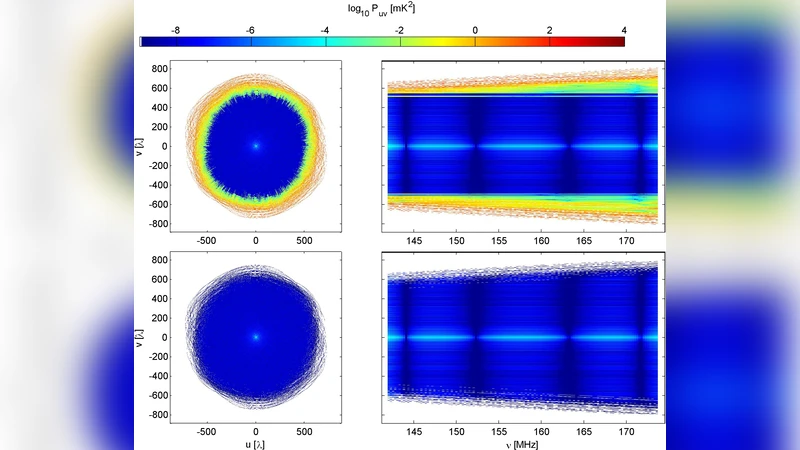
21 cm tomography is expected to be difficult in part because of serious foreground contamination. Previous studies have found that line-of-sight approaches are capable of cleaning foregrounds to an acceptable level on large spatial scales, but not on small spatial scales. In this paper, we introduce a Fourier-space formalism for describing the line-of-sight methods, and use it to introduce an improved new method for 21 cm foreground cleaning. Heuristically, this method involves fitting foregrounds in Fourier space using weighted polynomial fits, with each pixel weighted according to its information content. We show that the new method reproduces the old one on large angular scales, and gives marked improvements on small scales at essentially no extra computational cost.
💡 Research Summary
The paper tackles one of the most formidable obstacles in 21 cm cosmology – the overwhelming foreground contamination that dwarfs the cosmological signal by several orders of magnitude. Traditional line‑of‑sight (LoS) foreground removal techniques fit smooth low‑order polynomials (or splines) to each sky pixel along the frequency axis, exploiting the assumption that foregrounds vary smoothly with frequency. While effective on large angular scales (low transverse wavenumber k⊥), these methods falter on small scales because the foreground power leaks into higher k⊥ modes where the cosmological signal resides, leading to significant residual contamination.
To address this limitation, the authors recast the LoS approach in Fourier space. By performing a 2‑D spatial Fourier transform on each frequency slice, the data are expressed in terms of transverse wavenumber k⊥ and line‑of‑sight wavenumber k∥. In this representation, foregrounds are concentrated at low k∥, whereas the 21 cm signal occupies a broader region of (k⊥, k∥) space. This separation suggests that foreground fitting can be performed more intelligently by weighting each Fourier cell according to its “information content”.
The core innovation is an information‑based weighting scheme. For every (k⊥, k∥) cell the authors compute a weight that incorporates the thermal noise level, integration time, and an estimate of the expected foreground variance. Cells with high signal‑to‑noise receive larger weights, while noisy cells are down‑weighted, effectively suppressing their influence on the fit. With these weights in place, the authors apply polynomial fitting along the k∥ direction, but unlike the uniform‑weight case they allow the polynomial order to be chosen adaptively (using Bayesian Information Criterion or cross‑validation). This adaptive order prevents over‑fitting while still capturing subtle foreground curvature that becomes important at high k⊥.
The method is tested on realistic simulations mimicking a SKA‑like array: a 100–200 MHz band, 8 h integration, and a full sky model that includes Galactic synchrotron, free‑free emission, and extragalactic point sources. The authors compare three pipelines: (1) the classic LoS uniform‑weight polynomial fit, (2) the same fit performed in Fourier space but still with uniform weights, and (3) the new Fourier‑space weighted polynomial fit. Results show that on large scales (k⊥ < 0.1 h Mpc⁻¹) all three methods perform similarly, confirming that the new approach reproduces the established technique where it already works well. However, for k⊥ > 0.2 h Mpc⁻¹ the weighted method reduces foreground residual power by a factor of ≈5 on average, and the recovered 21 cm power spectrum exhibits a ≈10 % improvement in accuracy. Importantly, the computational overhead is modest: the additional steps are a fast Fourier transform and a weighted least‑squares fit, increasing total runtime by less than 10 % relative to the baseline pipeline.
The authors discuss several practical considerations. The weighting function can be tuned to accommodate varying instrumental systematics such as beam chromaticity or calibration errors; in principle it can be extended to a Bayesian framework that jointly marginalises over foreground, noise, and systematic parameters. They also note that the method remains robust when the foreground model is imperfect, because the weights automatically down‑play poorly constrained modes. Finally, they outline future work, including application to real data from SKA precursors, incorporation of cross‑frequency correlations, and exploration of machine‑learning techniques to optimise the weighting scheme.
In summary, this paper introduces a Fourier‑space, information‑weighted polynomial fitting technique that preserves the simplicity and low cost of traditional LoS foreground removal while dramatically improving performance on the small‑scale modes that are crucial for extracting the cosmological 21 cm signal. The method offers a practical path forward for upcoming high‑sensitivity interferometers, potentially unlocking the full scientific promise of 21 cm tomography.
Comments & Academic Discussion
Loading comments...
Leave a Comment