Event reconstruction with the proposed large area Cherenkov air shower detector SCORE
The proposed SCORE detector consists of a large array of light collecting modules designed to sample the Cherenkov light front of extensive air showers in order to detect high energy gamma-rays. A large spacing of the detector stations makes it possible to cover a huge area with a reasonable effort, thus achieving a good sensitivity up to energies of about a few 10 PeV. In this paper the event reconstruction algorithm for SCORE is presented and used to obtain the anticipated performance of the detector in terms of angular resolution, energy resolution, shower depth resolution and gamma / hadron separation.
💡 Research Summary
The paper presents the design, reconstruction algorithm, and expected performance of SCORE, a proposed large‑area Cherenkov air‑shower detector aimed at detecting very‑high‑energy (VHE) gamma rays up to several 10 PeV. SCORE differs from traditional imaging atmospheric Cherenkov telescopes (IACTs) by employing a sparse array of light‑collecting stations spaced by hundreds of metres, thereby covering a footprint of many square kilometres with modest infrastructure. Each station consists of a modest‑size mirror, a high‑quantum‑efficiency photomultiplier tube, and fast digitizers that record the full waveform of the Cherenkov pulse. The key challenge of such a sparse layout is to reconstruct the shower geometry, primary energy, and depth of maximum (Xmax) from limited photon statistics.
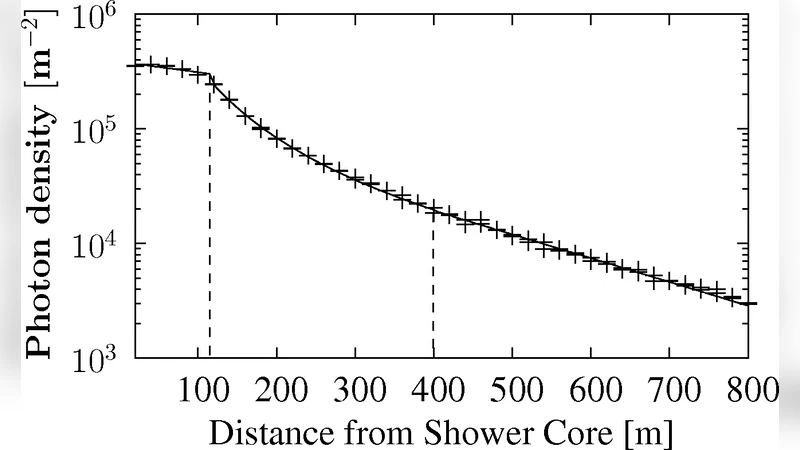
The reconstruction proceeds in four stages. First, the waveform of every station is processed to extract the pulse arrival time (t_i) with sub‑nanosecond precision and the integrated charge (Q_i), which is proportional to the number of Cherenkov photons. Second, the set of arrival times is fitted with a non‑linear model of the shower front propagation that incorporates the altitude‑dependent refractive index of the atmosphere. This fit yields the shower direction (zenith and azimuth angles) and an estimate of the front velocity. Third, the spatial distribution of charges is described by a modified Nishimura‑Kamata‑Greisen (NKG) lateral distribution function (LDF). By weighting each station according to its charge uncertainty, a least‑squares fit provides the shower core position, the total number of electrons (Ne), and the age parameter s. Fourth, Ne, the reconstructed direction, and the LDF shape are combined with a simulation‑derived calibration to infer the primary energy (E0) and Xmax. Energy calibration uses a multivariate function f(Ne, θ, Xmax) derived from extensive CORSIKA simulations, while Xmax is obtained from a regression that simultaneously exploits the slope of the LDF tail (β) and the asymmetry of the time profile (Δt).
Gamma‑hadron separation exploits two discriminating observables: the time‑spread σ_t of the shower front and the steepness β of the LDF tail. Hadronic showers typically exhibit larger σ_t and a more pronounced tail, reflecting the presence of muons and sub‑showers. A multivariate analysis (either boosted decision trees or a shallow neural network) trained on simulated gamma‑ray and proton events achieves a background rejection factor of ~10⁻³ while retaining >90 % of the gamma‑ray signal across the full energy range.
Performance is evaluated with a full Monte‑Carlo chain (CORSIKA for shower development, custom Cherenkov propagation, and detector response). For primary energies from 30 TeV to 10 PeV, the angular resolution improves from ~0.3° at the low end to ~0.1° above 1 PeV. Energy resolution ranges between 20 % and 15 % (better than 15 % above 1 PeV), and Xmax resolution lies between 30 g cm⁻² and 25 g cm⁻², comparable to that of dense arrays. The large instrumented area dramatically reduces statistical uncertainties for the highest‑energy events, yielding a sensitivity that surpasses current IACT arrays by a factor of 2–3 in the PeV regime.
The authors argue that SCORE’s capabilities open a new window on ultra‑high‑energy astrophysics. With its ability to resolve shower direction, energy, and depth with high precision, SCORE can identify PeV gamma‑ray sources such as Galactic PeVatrons, supernova‑remnant shock fronts, and the vicinity of the Galactic Center. Moreover, the accurate Xmax measurement enables composition studies of cosmic rays near the “knee” and beyond, providing insight into acceleration mechanisms and propagation effects. In summary, the paper demonstrates that a sparsely instrumented, large‑area Cherenkov detector equipped with a sophisticated reconstruction pipeline can achieve the angular, energy, and gamma/hadron discrimination performance required for next‑generation VHE gamma‑ray astronomy.
Comments & Academic Discussion
Loading comments...
Leave a Comment