Vanishing Theorems for Real Algebraic Cycles
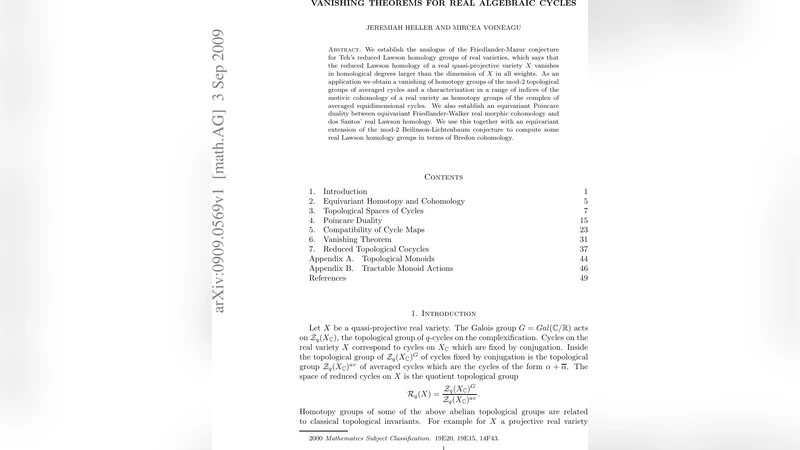
We establish the analogue of the Friedlander-Mazur conjecture for Teh’s reduced Lawson homology groups of real varieties, which says that the reduced Lawson homology of a real quasi-projective variety $X$ vanishes in homological degrees larger than the dimension of $X$ in all weights. As an application we obtain a vanishing of homotopy groups of the mod-2 topological groups of averaged cycles and a characterization in a range of indices of the motivic cohomology of a real variety as homotopy groups of the complex of averaged equidimensional cycles. We also establish an equivariant Poincare duality between equivariant Friedlander-Walker real morphic cohomology and dos Santos’ real Lawson homology. We use this together with an equivariant extension of the mod-2 Beilinson-Lichtenbaum conjecture to compute some real Lawson homology groups in terms of Bredon cohomology.
💡 Research Summary
The paper addresses a long‑standing gap in real algebraic geometry by proving a vanishing theorem for Teh’s reduced Lawson homology of real quasi‑projective varieties. The authors begin by recalling the Friedlander‑Mazur conjecture for complex varieties, which predicts that Lawson homology groups vanish in homological degrees exceeding the dimension of the variety. Teh’s reduction adapts this conjecture to the real setting, defining reduced Lawson homology groups (\widetilde{L}_q^w(X;\mathbb Z/2)) for a real variety (X) of dimension (n), weight (w), and homological degree (q).
The central result, the “Real Vanishing Theorem,” states that for every weight (w) and every degree (q>n) the reduced Lawson homology group (\widetilde{L}_q^w(X;\mathbb Z/2)) is zero. The proof proceeds by constructing the complex of averaged equidimensional cycles (\mathcal Z^{\mathrm{av}}_w(X)) and showing that its mod‑2 homotopy groups compute the reduced Lawson groups. Using an equivariant Dold–Thom theorem, a filtration on (\mathcal Z^{\mathrm{av}}_w(X)), and a careful analysis of the associated spectral sequence, the authors demonstrate that the relevant homotopy groups vanish once the degree exceeds the dimension. This argument relies heavily on Bredon equivariant cohomology, which supplies the necessary equivariant homotopical control.
With the vanishing theorem in hand, the paper derives several important consequences. First, the authors obtain a vanishing result for the mod‑2 homotopy groups of the topological groups of averaged cycles, confirming that these groups are trivial in the same range of indices. Second, they identify a range of indices (essentially (q\le n/2)) where the motivic cohomology of a real variety can be expressed as the homotopy groups of the averaged cycle complex, thereby providing a concrete topological model for real motivic cohomology.
A major conceptual advance is the establishment of an equivariant Poincaré duality between Friedlander‑Walker real morphic cohomology and dos Santos’ real Lawson homology. The duality is expressed as an isomorphism \
Comments & Academic Discussion
Loading comments...
Leave a Comment