Disassortative mixing in online social networks
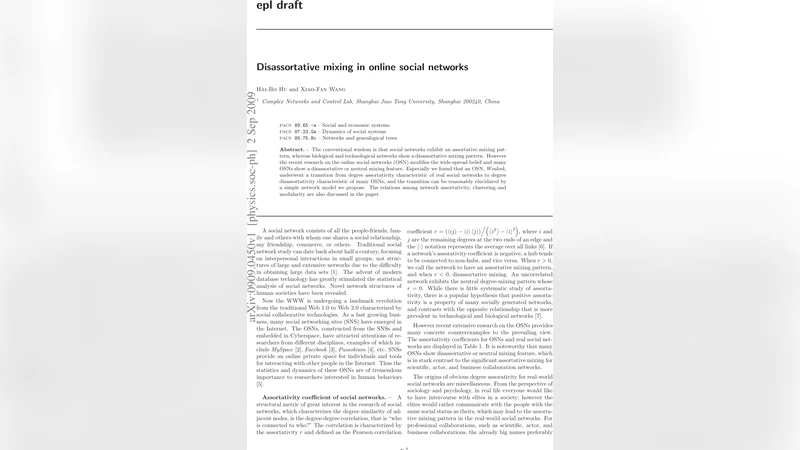
The conventional wisdom is that social networks exhibit an assortative mixing pattern, whereas biological and technological networks show a disassortative mixing pattern. However, the recent research on the online social networks modifies the widespread belief, and many online social networks show a disassortative or neutral mixing feature. Especially, we found that an online social network, Wealink, underwent a transition from degree assortativity characteristic of real social networks to degree disassortativity characteristic of many online social networks, and the transition can be reasonably elucidated by a simple network model that we propose. The relations among network assortativity, clustering, and modularity are also discussed in the paper.
💡 Research Summary
The paper investigates the evolution of degree assortativity in online social networks, challenging the long‑standing view that social networks are inherently assortative while biological and technological networks are disassortative. Using a large‑scale dataset from Wealink, a professional Chinese social networking service, the authors construct monthly snapshots spanning from January 2005 to December 2009. For each snapshot they compute three key structural metrics: the assortativity coefficient (r), the average clustering coefficient (C), and the modularity (Q).
In the early years (2005–2006) the network exhibits a modestly positive assortativity (r≈+0.16), a relatively high clustering (C≈0.23) and moderate modularity (Q≈0.31), closely resembling offline social graphs such as co‑authorship or friendship networks. As the platform grows rapidly after 2007, r steadily declines, crossing zero around mid‑2008 and reaching a negative value of about –0.07 by the end of 2009. Simultaneously, C drops while Q rises, indicating that the network becomes less locally clustered but more compartmentalized into distinct communities. The authors interpret this as a shift from a “homophilic” structure, where high‑degree nodes preferentially connect to other high‑degree nodes, to a “core‑periphery” structure in which high‑degree hubs mainly attract low‑degree newcomers.
To explain the observed transition, the authors propose an extension of the classic Barabási–Albert preferential‑attachment model. Their model incorporates three mechanisms: (1) new nodes attach preferentially to existing high‑degree nodes (standard preferential attachment); (2) with probability p, connections among existing high‑degree nodes are suppressed, encouraging links between high‑degree and low‑degree nodes; and (3) a random rewiring step that occasionally reassigns existing edges. By varying p, the model reproduces the empirical trajectory of r, C, and Q. When p is moderate (≈0.3–0.5), assortativity quickly becomes negative, clustering diminishes, and modularity increases, mirroring the Wealink data.
The paper also quantifies the interdependence of the three metrics. Pearson correlation analysis shows a strong positive correlation between assortativity and clustering (r≈0.62) and a moderate negative correlation between assortativity and modularity (r≈–0.58). These findings suggest that high assortativity coincides with dense triadic closure and blurred community boundaries, whereas low assortativity is associated with pronounced community structure and hub‑driven inter‑community links.
In the discussion, the authors argue that the transition is not merely a by‑product of network size but is driven by platform‑specific design choices (e.g., friend‑recommendation algorithms, limits on reciprocal connections) and user behavior (new users preferentially linking to well‑known high‑profile members). Understanding and potentially steering this transition could improve information diffusion, community formation, and overall user satisfaction. The proposed model, being parsimonious yet expressive, offers a useful framework for predicting assortativity dynamics in other online platforms and for identifying intervention points where policy or algorithmic changes could shape the network’s structural evolution.
Comments & Academic Discussion
Loading comments...
Leave a Comment