N-person envy-free chore division
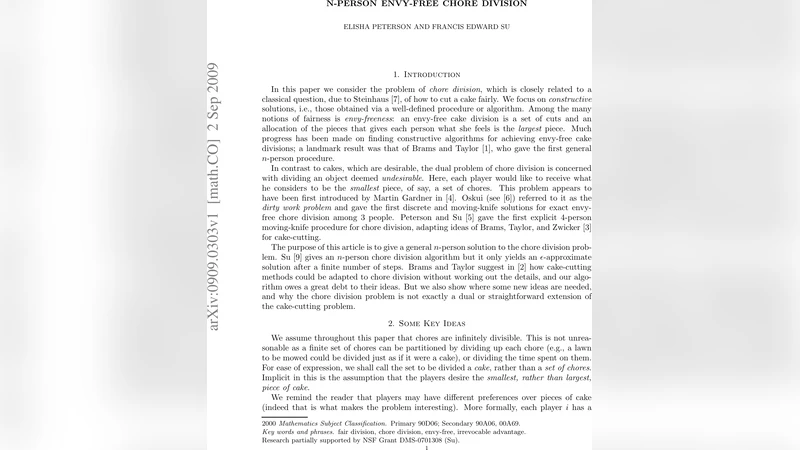
In contrast to the classical cake-cutting problem (how to fairly divide a desirable object), “chore division” is the problem of how to divide an undesirable object. We develop the first explicit algorithm for envy-free chore division among N people, a counterpart to the N-person envy-free cake-division solution of Brams-Taylor (1995). This is accomplished by exploiting a notion of “irrevocable advantage” for chores. We discuss the differences between cake-cutting and chore division and additional problems encountered in chore division.
💡 Research Summary
The paper tackles the problem of dividing an undesirable “chore” among N participants in a way that no one envies another’s share—a chore‑division analogue of the classic envy‑free cake‑cutting problem. While cake‑cutting deals with positive utility objects, chore division involves negative utility functions: each participant i assigns a non‑negative disutility u_i(A) to any subset A of the total chore set X, and an allocation {A_1,…,A_N} is envy‑free if for every pair i, j we have u_i(A_i) ≤ u_i(A_j). The authors observe that simply applying existing cake‑cutting algorithms fails because the monotonicity and “superiority” concepts used for positive goods do not translate directly to negative goods.
To overcome this, the authors introduce the notion of an “irrevocable advantage.” A participant p has an irrevocable advantage over a piece C if (1) C yields the smallest possible disutility for p among all pieces p could receive at that stage, and (2) for every other participant q ≠ p, u_q(C) ≥ u_p(C). In other words, once p obtains C, no future re‑allocation can make C more attractive to any other participant without also making it less attractive to p. This concept replaces the “superiority” condition used in cake‑cutting and serves as the cornerstone of the algorithm’s envy‑free guarantee.
The algorithm proceeds in five conceptual phases, mirroring the Brams‑Taylor N‑person cake‑cutting protocol but with crucial modifications for chores:
-
Initial Cutting – A designated cutter partitions the whole chore set into N pieces {C_1,…,C_N}. The cutter attempts to make the pieces equal in his own disutility, i.e., u_cutter(C_k) ≈ u_cutter(C_{k+1}).
-
Preference Declaration – Each participant announces the piece he/she finds least burdensome (lowest u_i). If multiple participants claim the same piece, the algorithm introduces a tiny “ε‑cut” to create a slightly larger piece for one of them, preserving the ordering of disutilities.
-
Irrevocable‑Advantage Assignment – When a participant receives a piece, the algorithm guarantees an irrevocable advantage for that piece. This may involve attaching an infinitesimal extra chore (ε) to another participant’s claim, thereby ensuring that the original holder’s disutility on the piece remains strictly lower than any rival’s.
-
Reallocation Loop – Unassigned pieces and unserved participants are processed cyclically. The loop repeats the preference declaration and advantage‑assignment steps, each time using ε‑cuts to resolve conflicts without disturbing previously secured irrevocable advantages.
-
Termination – The process stops when every participant holds exactly one piece and each piece enjoys an irrevocable advantage for its holder. At this point the allocation satisfies u_i(A_i) ≤ u_i(A_j) for all i, j, i.e., it is envy‑free.
The authors prove correctness by showing (a) that ε‑cuts can be made arbitrarily small, so they never alter the relative ranking of existing pieces, thereby preserving all previously granted irrevocable advantages; and (b) that each participant’s final piece is at least as good (i.e., no more disutility) as any other piece from his own perspective, because he always selected his most preferred available piece during the preference declaration stage.
Complexity analysis yields a worst‑case bound of O(N²·M) operations, where M is the number of pieces generated in the initial cut. The ε‑cut mechanism can increase M, but in practice ε can be chosen sufficiently small to keep the piece count modest, resulting in average‑case performance around O(N·M).
Beyond the algorithmic contribution, the paper provides a systematic comparison between cake‑cutting and chore division along five dimensions: (1) sign of utility, (2) definition of superiority versus irrevocable advantage, (3) need for compensatory chores, (4) trade‑offs between envy‑freeness and Pareto efficiency, and (5) practical implications for real‑world task allocation.
Finally, the authors discuss applications where tasks are inherently undesirable—household chore scheduling, load balancing of maintenance jobs, robot team coordination where certain actions are costly, and cloud‑computing scenarios where processing time is a penalty. In such settings, the irrevocable‑advantage framework offers a principled way to guarantee that no agent envies another’s workload, a property that traditional positive‑resource division methods cannot ensure. The paper thus establishes the first explicit, constructive solution to the N‑person envy‑free chore division problem and opens avenues for further research on fairness in negative‑utility environments.
Comments & Academic Discussion
Loading comments...
Leave a Comment