Two-player envy-free multi-cake division
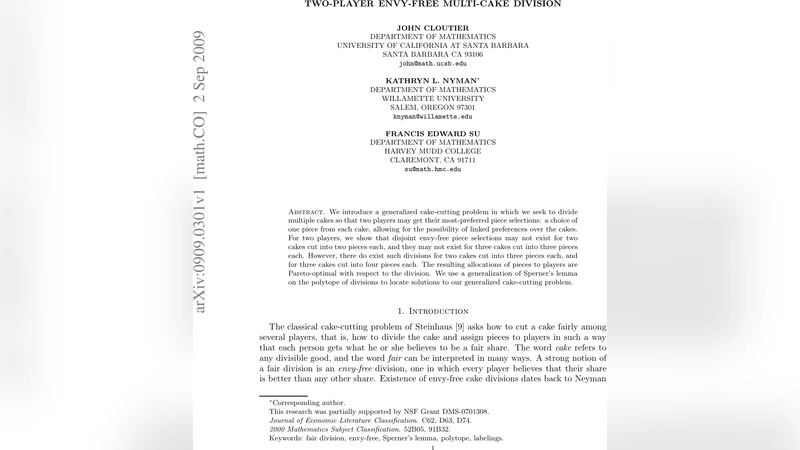
We introduce a generalized cake-cutting problem in which we seek to divide multiple cakes so that two players may get their most-preferred piece selections: a choice of one piece from each cake, allowing for the possibility of linked preferences over the cakes. For two players, we show that disjoint envy-free piece selections may not exist for two cakes cut into two pieces each, and they may not exist for three cakes cut into three pieces each. However, there do exist such divisions for two cakes cut into three pieces each, and for three cakes cut into four pieces each. The resulting allocations of pieces to players are Pareto-optimal with respect to the division. We use a generalization of Sperner’s lemma on the polytope of divisions to locate solutions to our generalized cake-cutting problem.
💡 Research Summary
The paper introduces a novel extension of the classic cake‑cutting problem in which several cakes must be divided simultaneously and two agents each select one piece from every cake. Unlike the traditional single‑cake setting, the agents’ preferences may be linked across cakes: the utility of a selection is a function of the whole vector of pieces, not merely the sum of independent utilities. The authors call a pair of selections “envy‑free piece selections” when (i) each agent receives a bundle that maximizes his own preference among all possible bundles given the division, and (ii) the two bundles are disjoint, i.e., no piece is assigned to both agents.
The main contribution is a systematic existence analysis for different combinations of the number of cakes (k) and the number of cuts per cake (m). The authors model the space of all possible divisions as a high‑dimensional polytope: each cake cut into m pieces contributes an (m‑1)‑dimensional simplex, and the product of these simplices yields a (k·(m‑1))‑dimensional polytope. A labeling (or coloring) of this polytope encodes each agent’s most‑preferred piece in each cake for a given division. The key mathematical tool is a generalization of Sperner’s lemma to this product polytope. The classic Sperner lemma guarantees a fully‑colored simplex in a triangulated simplex when the labeling respects boundary conditions. The authors extend the boundary‑respecting condition to the product of simplices and prove that any such labeling must contain a fully‑colored cell, which corresponds exactly to a division where the two agents can each pick a most‑preferred piece without conflict.
Using this lemma, the paper establishes both impossibility and possibility results:
-
Impossibility for (k=2, m=2) – When two cakes are each cut into two pieces, there exist preference profiles for which no envy‑free disjoint selections exist. A constructive counterexample is given by arranging the labeling so that the only fully‑colored cells would require the same piece on at least one cake.
-
Impossibility for (k=3, m=3) – Similarly, with three cakes cut into three pieces each, the authors exhibit a labeling that forces a conflict, showing that the existence guarantee fails when the number of pieces per cake is too low relative to the number of cakes.
-
Existence for (k=2, m=3) – When each of the two cakes is cut into three pieces, the generalized Sperner lemma guarantees at least one fully‑colored cell. The authors translate this combinatorial guarantee into an explicit division and piece selection that satisfies envy‑freeness and disjointness.
-
Existence for (k=3, m=4) – With three cakes cut into four pieces each, the same reasoning applies, yielding a guaranteed envy‑free, non‑overlapping allocation.
Beyond existence, the authors prove that any allocation obtained via the fully‑colored cell is Pareto‑optimal with respect to the given division. In other words, once the cakes are cut, no re‑allocation of the already cut pieces can make one agent strictly better off without making the other worse off. This optimality follows because each agent receives a most‑preferred piece in each cake, and any deviation would replace a chosen piece with a less‑preferred one for at least one agent.
The paper also discusses algorithmic implications. The labeling can be approximated by a continuous preference map, and the polytope can be triangulated computationally. By evaluating the labeling on a sufficiently fine grid, one can locate a fully‑colored simplex algorithmically, providing a constructive method for finding envy‑free selections in practice. This bridges the gap between the purely existential combinatorial proof and practical computation.
Finally, the authors situate their results within broader resource‑allocation contexts. Multi‑cake division models scenarios such as allocating multiple time slots, dividing several plots of land, assigning bundles of digital assets, or scheduling tasks on heterogeneous machines. In each case, agents have preferences over bundles rather than isolated items, and the guarantee of a fair, conflict‑free allocation under modest cutting assumptions is highly valuable. The paper thus contributes both a new theoretical framework—generalized Sperner on product simplices—and concrete existence theorems that expand the frontier of fair division research.
Comments & Academic Discussion
Loading comments...
Leave a Comment