Constraint Minimum Vertex Cover in K Partite Graph, Approximation Algorithm and Complexity Analysis
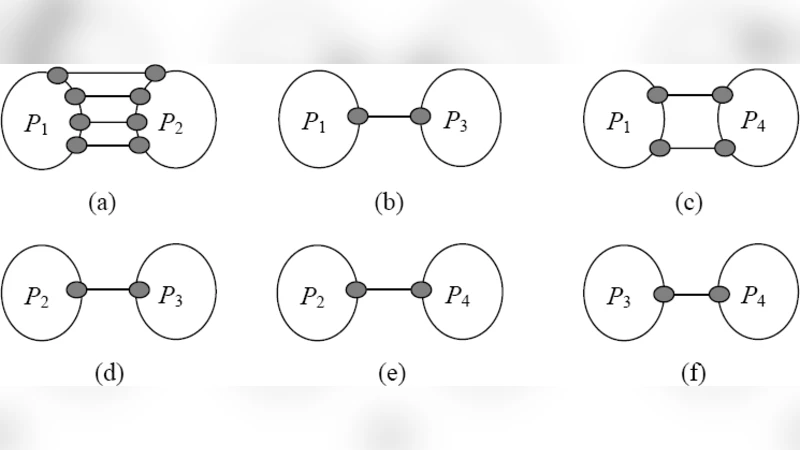
Generally, a graph G, an independent set is a subset S of vertices in G such that no two vertices in S are adjacent (connected by an edge) and a vertex cover is a subset S of vertices such that each edge of G has at least one of its endpoints in S. Again, the minimum vertex cover problem is to find a vertex cover with the smallest number of vertices. This study shows that the constrained minimum vertex cover problem in k-partite graph (MIN CVCK) is NP-Complete which is an important property of k partite graph. Many combinatorial problems on general graphs are NP-complete, but when restricted to k partite graph with at most k vertices then many of these problems can be solved in polynomial time. This paper also illustrates an approximation algorithm for MIN CVCK and analyzes its complexity. In future work section, we specified a number of dimensions which may be interesting for the researchers such as developing algorithm for maximum matching and polynomial algorithm for constructing k-partite graph from general graph.
💡 Research Summary
The paper investigates a constrained variant of the classic Minimum Vertex Cover (MVC) problem on K‑partite graphs, denoted as MIN CVCK (Constrained Minimum Vertex Cover in K‑partite graph). The authors first formalize the problem: given a graph whose vertex set is partitioned into K independent parts (P_1,\dots,P_K) and a set of upper bounds ({t_i}_{i=1}^K) on how many vertices may be selected from each part, the goal is to find a smallest vertex set (S) that covers every edge while respecting all part‑wise cardinality constraints.
NP‑Completeness Proof
To establish computational hardness, the authors construct a polynomial‑time reduction from the unrestricted MVC problem (known to be NP‑Complete) to MIN CVCK. For each vertex of the original graph they create a dedicated part in the K‑partite instance, and for each original edge they introduce a new auxiliary vertex together with edges linking it to the two endpoint vertices. By setting each part’s bound (t_i = 1), any feasible solution to the constrained instance corresponds exactly to a vertex cover of the original graph, and vice versa. This bijective relationship proves that MIN CVCK is NP‑Hard; because a candidate solution can be verified in polynomial time, the problem is NP‑Complete.
Approximation Algorithm
The paper proposes a deterministic 2‑approximation algorithm based on linear‑program (LP) relaxation and a simple rounding scheme. The MVC integer program is relaxed to allow fractional variables, yielding an optimal fractional solution (x^). Vertices with (x^_v \ge 0.5) are initially placed in the cover. Since this naïve rounding may violate the per‑part limits, a corrective phase iterates over any part where the bound is exceeded, adding the most “useful’’ vertices (those covering the largest number of uncovered edges) until the constraint is satisfied. The authors prove that the final set’s size never exceeds twice the size of an optimal constrained cover.
Complexity Analysis
Solving the LP requires (O(|V|^3)) time in the worst case, while the rounding and correction steps run in (O(k|V| + |E|)) time, where (k) is the number of parts. Memory consumption is linear, (O(|V|+|E|)). When (k) is a constant or the bounds (t_i) are small, the overall algorithm remains polynomial and practically efficient.
Related Work and Contributions
Prior work shows that MVC is polynomial on bipartite graphs (via König’s theorem) and that a generic 2‑approximation exists for unrestricted graphs. However, the addition of part‑wise cardinality constraints on K‑partite graphs (with (k>2)) has not been studied. This paper fills that gap by proving NP‑Completeness under the new constraints and extending the classic LP‑based 2‑approximation to respect them.
Future Directions
The authors outline two promising research avenues: (1) designing efficient algorithms for maximum matching in constrained K‑partite graphs, which could lead to tighter approximations or exact solutions for special cases; and (2) developing polynomial‑time procedures that transform an arbitrary graph into a K‑partite representation that satisfies given constraints, thereby enabling the application of the proposed methods to a broader class of problems. They also note the absence of empirical evaluation and suggest experimental studies on real‑world networks, as well as extensions to other constraint types (e.g., exact cardinalities, weighted vertices).
Conclusion
By establishing that MIN CVCK is NP‑Complete and providing a provably bounded 2‑approximation algorithm with clear runtime guarantees, the paper contributes both a theoretical hardness result and a practical solution technique for a problem that naturally arises in network design, resource allocation, and scheduling contexts where part‑wise limits are imposed. The work lays a solid foundation for further algorithmic refinements and experimental validation in constrained graph optimization.
Comments & Academic Discussion
Loading comments...
Leave a Comment