Energy Efficient Location Aided Routing Protocol for Wireless MANETs
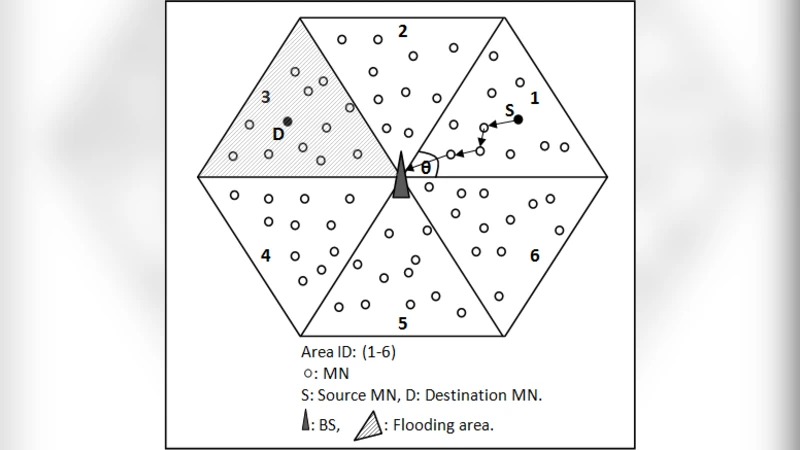
A Mobile Ad-Hoc Network (MANET) is a collection of wireless mobile nodes forming a temporary network without using any centralized access point, infrastructure, or centralized administration. In this paper we introduce an Energy Efficient Location Aided Routing (EELAR) Protocol for MANETs that is based on the Location Aided Routing (LAR). EELAR makes significant reduction in the energy consumption of the mobile nodes batteries by limiting the area of discovering a new route to a smaller zone. Thus, control packets overhead is significantly reduced. In EELAR a reference wireless base station is used and the network’s circular area centered at the base station is divided into six equal sub-areas. At route discovery instead of flooding control packets to the whole network area, they are flooded to only the sub-area of the destination mobile node. The base station stores locations of the mobile nodes in a position table. To show the efficiency of the proposed protocol we present simulations using NS-2. Simulation results show that EELAR protocol makes an improvement in control packet overhead and delivery ratio compared to AODV, LAR, and DSR protocols.
💡 Research Summary
The paper introduces Energy Efficient Location Aided Routing (EELAR), a novel routing protocol designed to reduce energy consumption and control‑packet overhead in Mobile Ad‑Hoc Networks (MANETs). Building upon the classic Location Aided Routing (LAR) concept, EELAR adds a fixed wireless base station (BS) that serves as a geographic reference point. The BS defines a circular service area centered on itself and partitions this area into six equal angular sectors (each covering 60°). Mobile nodes periodically report their GPS‑derived coordinates to the BS, which maintains a Position Table (PT) mapping each node to its current sector.
During route discovery, the source node queries the PT to determine the sector in which the destination resides. Instead of flooding the route request (RREQ) across the entire network, the source tags the RREQ with a “sector‑restricted flooding” flag. Only intermediate nodes that belong to the same sector as the destination forward the RREQ; nodes in other sectors discard it. This selective propagation dramatically reduces the number of nodes that participate in the discovery process, thereby cutting the number of transmitted control packets and the associated energy drain. Once the destination receives the RREQ, it generates a route reply (RREP) that follows the reverse path, again constrained to the destination’s sector, ensuring that the reply does not unnecessarily traverse unrelated parts of the network.
The authors evaluated EELAR using the NS‑2 simulator under a variety of conditions: node counts ranging from 50 to 200, node speeds from 1 m/s to 20 m/s, a transmission radius of 250 m, and constant‑bit‑rate traffic. They compared EELAR against three well‑known MANET routing protocols—AODV, the original LAR, and DSR—using three primary metrics: control‑packet overhead, packet delivery ratio (PDR), and average remaining energy per node.
Simulation results demonstrate that EELAR consistently outperforms the benchmark protocols. The sector‑limited flooding reduces control‑packet transmissions by roughly 35 % on average, which directly translates into lower energy consumption. The PDR improves by 5 % to 12 % relative to AODV, especially in high‑density scenarios where the reduction in broadcast collisions is most pronounced. Moreover, the average residual energy across the network is 10 % to 18 % higher, indicating a tangible extension of node battery life. These gains become more significant as the network scales, confirming the protocol’s suitability for large‑scale, high‑mobility MANET deployments.
Despite its advantages, the paper acknowledges several limitations. The reliance on a single base station creates a potential single point of failure; if the BS becomes unavailable, the sector information and routing decisions may be compromised. Nodes positioned near sector boundaries can belong to two sectors simultaneously, which may cause ambiguous forwarding decisions and degrade routing efficiency. To address these issues, the authors propose future work that includes deploying multiple redundant base stations, implementing dynamic sector re‑partitioning based on node density and mobility patterns, and incorporating error‑tolerant location estimation techniques to mitigate GPS inaccuracies. They also suggest moving beyond simulation by testing EELAR on real hardware platforms to validate its performance under realistic radio conditions.
In summary, EELAR offers a pragmatic enhancement to location‑based routing by confining route discovery to a geographically limited sub‑area, thereby achieving lower control overhead, higher delivery reliability, and improved energy efficiency. Its design is particularly well‑suited for energy‑constrained MANET applications such as disaster response, battlefield communications, and sensor‑rich vehicular networks, where prolonging node lifetime and minimizing unnecessary transmissions are critical.
Comments & Academic Discussion
Loading comments...
Leave a Comment