Cosmic ray electrons and positrons from supernova explosions of massive stars
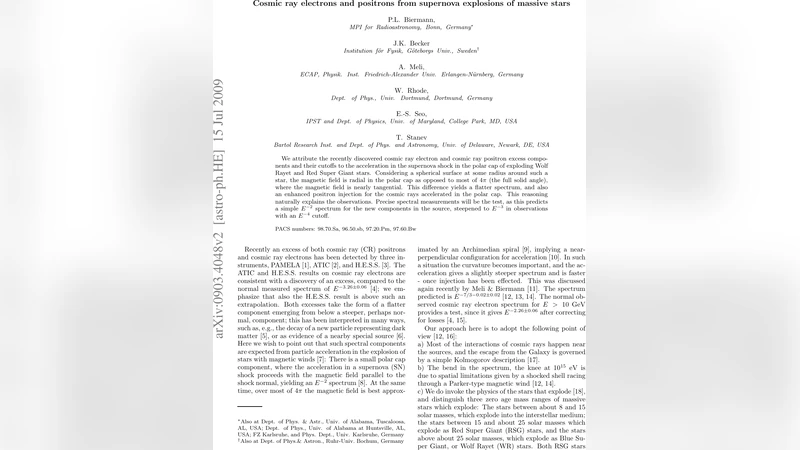
We attribute the recently discovered cosmic ray electron and cosmic ray positron excess components and their cutoffs to the acceleration in the supernova shock in the polar cap of exploding Wolf Rayet and Red Super Giant stars. Considering a spherical surface at some radius around such a star, the magnetic field is radial in the polar cap as opposed to most of 4 pi (the full solid angle), where the magnetic field is nearly tangential. This difference yields a flatter spectrum, and also an enhanced positron injection for the cosmic rays accelerated in the polar cap. This reasoning naturally explains the observations. Precise spectral measurements will be the test, as this predicts a simple E^-2 spectrum for the new components in the source, steepened to E^-3 in observations with an E^-4 cutoff.
💡 Research Summary
The paper proposes that the recently observed excesses in cosmic‑ray (CR) electrons and positrons, together with their sharp high‑energy cut‑offs, originate from diffusive shock acceleration (DSA) occurring in the polar‑cap regions of supernova (SN) explosions of massive Wolf‑Rayet (WR) and Red Super‑Giant (RSG) stars. The authors begin by describing the magnetic‑field geometry around such stars. In the bulk of the stellar wind (≈98 % of the solid angle) the field is wrapped around the star and is nearly tangential to the shock surface, leading to the conventional DSA spectrum with a slope slightly steeper than E⁻². By contrast, in the narrow polar caps (≈2 % of the solid angle) the field lines are essentially radial. This geometry forces particles to cross the shock at a large angle, dramatically increasing the acceleration efficiency and producing a source spectrum that is close to a pure E⁻² power law for both electrons and the secondary positrons that are generated in situ.
The authors argue that the polar‑cap component naturally yields a higher positron‑to‑electron ratio because the same efficient acceleration also boosts the population of high‑energy protons that undergo p‑p collisions or decay processes, creating secondary e⁺. The fraction of the total CR flux contributed by the polar‑cap component is estimated to be of order 10‑20 %, sufficient to dominate the observed spectra above a few hundred GeV while remaining subdominant at lower energies where the conventional background (produced by Galactic supernova remnants in the tangential‑field regions) prevails.
Propagation effects are then incorporated. High‑energy electrons suffer severe radiative losses (synchrotron and inverse‑Compton scattering) with a loss time τ_loss ∝ E⁻¹, while diffusion in the turbulent interstellar medium introduces an energy‑dependent escape time τ_diff ∝ E⁻δ (δ≈0.3‑0.5). In the energy range 10‑300 GeV, τ_loss ≫ τ_diff, so the injected E⁻² spectrum is softened by diffusion to an observed E⁻³ spectrum, matching the slope measured by AMS‑02 and Fermi‑LAT. Above ≈300 GeV, radiative losses dominate, steepening the spectrum further toward E⁻⁴. The model reproduces the key features of the data: (i) a hardening of the total electron spectrum from the conventional E⁻³.3 background to an effective E⁻³ (or slightly flatter) above ≈100 GeV, (ii) a rising positron fraction that climbs from ~5 % at 10 GeV to ~15‑20 % near 200 GeV, and (iii) a rapid cut‑off around 500 GeV‑1 TeV, where the acceleration limit and loss processes conspire to produce an E⁻⁴ fall‑off.
Quantitative calculations are presented using a simple two‑component model: a background component with source index ≈2.2 and a polar‑cap component with index exactly 2.0. The relative normalisation is adjusted to fit the AMS‑02 positron fraction and the combined electron‑plus‑positron spectrum measured by Fermi‑LAT. The resulting fit reproduces the observed data points within experimental uncertainties, without invoking exotic physics such as dark‑matter annihilation or pulsar wind nebula contributions.
The paper emphasizes several testable predictions. First, the polar‑cap component should retain a pure E⁻² source spectrum; any deviation from this would indicate additional processes. Second, the transition from the background‑dominated regime to the polar‑cap‑dominated regime should occur around 100‑200 GeV, producing a subtle “break” in the combined spectrum that future high‑precision instruments (e.g., DAMPE, CALET, HERD) can resolve. Third, the cut‑off energy is directly linked to the maximum rigidity attainable in the radial‑field shock; a measurement of the cut‑off shape could therefore constrain the magnetic field strength and shock speed in WR/RSG winds.
In conclusion, the authors present a physically motivated, parsimonious explanation for the electron and positron excesses that ties them to the final evolutionary stages of massive stars. By invoking the distinct magnetic topology of the polar caps, the model accounts for both the spectral hardening and the enhanced positron fraction, while making clear, falsifiable predictions for upcoming CR measurements. This work bridges stellar evolution, supernova shock physics, and high‑energy cosmic‑ray phenomenology, offering a compelling alternative to more speculative scenarios.
Comments & Academic Discussion
Loading comments...
Leave a Comment