Transmission protocols for instruction streams
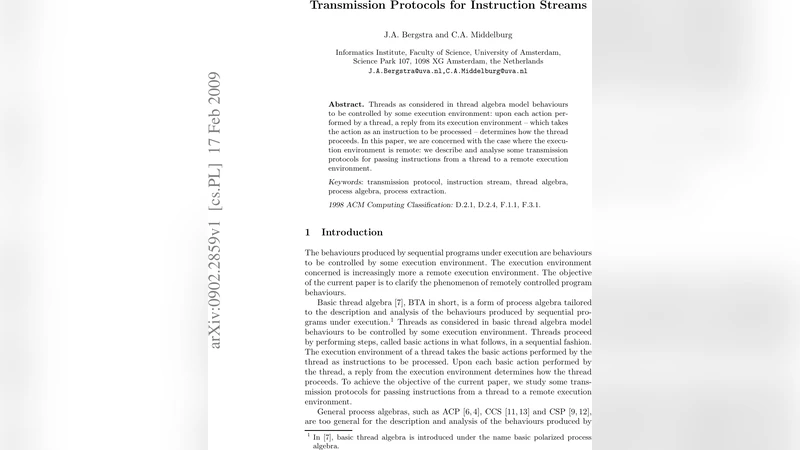
Threads as considered in thread algebra model behaviours to be controlled by some execution environment: upon each action performed by a thread, a reply from its execution environment – which takes the action as an instruction to be processed – determines how the thread proceeds. In this paper, we are concerned with the case where the execution environment is remote: we describe and analyse some transmission protocols for passing instructions from a thread to a remote execution environment.
💡 Research Summary
The paper investigates how to transmit instructions from a thread, modeled in thread algebra (TA), to a remote execution environment. In classical TA, a thread’s actions are immediately answered by a local environment, and the thread’s continuation is determined by the reply (T, F, B, etc.). The authors extend this setting to a distributed scenario where the environment resides on a different machine, introducing explicit transmission protocols that bridge the logical gap between the thread and the remote executor.
Two families of protocols are presented. The first is a synchronous request‑response protocol. The thread packages an action into a command packet, sends it over the network, and blocks until a reply packet arrives. The protocol is simple, preserves the original sequential semantics of TA, and is easy to verify, but its performance is dominated by network latency and round‑trip time.
The second family is an asynchronous pipelined protocol. Here the thread may issue a stream of command packets without waiting for individual replies. Replies are collected in a buffer, possibly out of order, and the thread reassembles them according to identifiers embedded in the packets. This design overlaps communication with remote computation, dramatically increasing throughput when bandwidth is high and loss is low. However, it introduces several complications: (1) ordering guarantees must be restored at the thread side; (2) duplicate or lost packets require retransmission logic and timers; (3) flow control must prevent buffer overflow; and (4) the thread must decide how to handle late or missing replies without violating TA’s semantics.
To reason about correctness, the authors embed both protocols into a process‑algebraic framework. They define a labelled transition system for each protocol, including states for “waiting”, “buffered”, “retransmitting”, and “completed”. Using bisimulation and invariant techniques, they prove safety (no deadlock or livelock) and liveness (every issued command eventually receives a reply) under the assumption that the network eventually delivers packets and that buffer sizes and timer bounds satisfy certain constraints. For the pipelined protocol, they show that if the buffer capacity is at least the maximum number of outstanding commands and the retransmission timeout exceeds the worst‑case round‑trip time, the system remains deadlock‑free.
Performance analysis combines analytical modeling with simulation. The authors derive expressions for expected latency (L) and throughput (T) as functions of bandwidth (B), round‑trip time (RTT), packet loss probability (p), and average remote execution time (E). In the synchronous case, (L \approx RTT + E) and (T \approx 1/(RTT+E)). In the pipelined case, (L) is reduced roughly to (E) (once the pipeline is filled) while (T) approaches (\min(B/E, 1/E)) provided loss is low. Simulations confirm that for loss rates below about 5 % and buffer sizes large enough to hold the in‑flight commands, the pipelined protocol achieves up to a tenfold increase in throughput compared with the synchronous protocol. When loss rises above this threshold, retransmission overhead erodes the advantage, and the synchronous protocol becomes more efficient.
The paper concludes that designing remote execution interfaces requires a balanced view: formal modeling guarantees that the extended TA semantics remain sound, while empirical performance studies guide the choice between simplicity (synchronous) and high throughput (asynchronous pipelining). The authors suggest future extensions such as integrating cryptographic authentication, adaptive flow control that reacts to measured loss, and multi‑environment load balancing, thereby broadening the applicability of their protocols to cloud services, edge computing, and Internet‑of‑Things scenarios.
Comments & Academic Discussion
Loading comments...
Leave a Comment