Lindelof indestructibility, topological games and selection principles
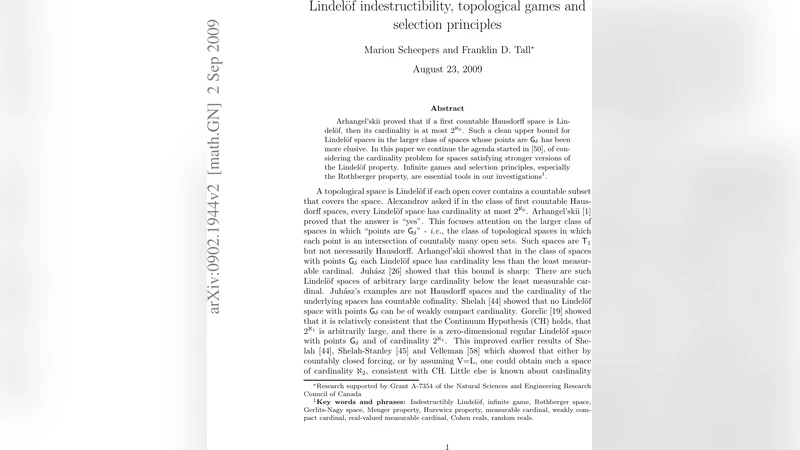
Arhangel’skii proved that if a first countable Hausdorff space is Lindel"of, then its cardinality is at most $2^{\aleph_0}$. Such a clean upper bound for Lindel"of spaces in the larger class of spaces whose points are ${\sf G}{\delta}$ has been more elusive. In this paper we continue the agenda started in F.D. Tall, On the cardinality of Lindel"of spaces with points $G{\delta}$, Topology and its Applications 63 (1995), 21 - 38, of considering the cardinality problem for spaces satisfying stronger versions of the Lindel"of property. Infinite games and selection principles, especially the Rothberger property, are essential tools in our investigations
💡 Research Summary
The paper investigates cardinality bounds for Lindelöf spaces whose points are $G_{\delta}$, extending the classical Arhangel’skii theorem that a first‑countable Hausdorff Lindelöf space has cardinality at most $2^{\aleph_{0}}$. The authors introduce the notion of indestructibly Lindelöf spaces: a space $X$ is indestructibly Lindelöf if it remains Lindelöf after any $\sigma$‑closed forcing extension. This concept captures a robustness property that is particularly useful when dealing with $G_{\delta}$‑points, because such points often behave well under forcing.
To analyze indestructibility, the paper employs two infinite topological games. The first is the classic $G_{1}(\mathcal O,\mathcal O)$ game, where ONE presents an open cover $\mathcal U_{n}$ at round $n$ and TWO selects a single member $U_{n}\in\mathcal U_{n}$. TWO wins if ${U_{n}:n\in\omega}$ covers $X$. The second game, $G_{\mathrm{fin}}(\mathcal O,\mathcal O)$, allows TWO to pick a finite subfamily at each round. The authors show that a winning strategy for TWO in $G_{1}(\mathcal O,\mathcal O)$ is equivalent to the Rothberger selection principle $\mathsf{S}{1}(\mathcal O,\mathcal O)$. Moreover, they prove that if $X$ is Hausdorff, has $G{\delta}$ points, and is indestructibly Lindelöf, then TWO possesses a winning strategy in $G_{1}(\mathcal O,\mathcal O)$, and consequently $X$ satisfies the Rothberger property.
The Rothberger property is known to impose strong cardinal restrictions: any Rothberger space with $G_{\delta}$ points has cardinality at most $2^{\aleph_{0}}$. By combining this with indestructibility, the authors obtain the central theorem: Every Hausdorff space that is indestructibly Lindelöf and whose points are $G_{\delta}$ has cardinality $\le 2^{\aleph_{0}}$. This result recovers Arhangel’skii’s bound without the first‑countability hypothesis and answers a longstanding question raised by Tall (1995) concerning stronger Lindelöf‑type properties.
The paper also situates the Rothberger property within a hierarchy of selection principles—Menger, Hurewicz, $\gamma$‑sets, etc.—and examines which of these are preserved under indestructibility. It is shown that indestructibility alone does not guarantee the Menger property, and the Menger condition is insufficient to derive the $2^{\aleph_{0}}$ bound. Thus Rothberger emerges as the precise selection principle needed for the cardinality restriction in the $G_{\delta}$‑point context.
In addition to ZFC results, the authors explore consistency issues. They demonstrate that under certain cardinal characteristics (e.g., $\mathfrak{b}=\mathfrak{d}=\aleph_{1}$) the notions “indestructibly Lindelöf + $G_{\delta}$ points” and “Rothberger + $G_{\delta}$ points” become equivalent, whereas in ZFC alone the equivalence is independent. This highlights the delicate interplay between set‑theoretic assumptions and topological properties.
The final section outlines open problems: extending indestructibility to other covering properties (normality, paracompactness), investigating the role of different forcing notions, and developing analogous game‑theoretic characterizations for higher‑dimensional selection principles. Overall, the paper provides a comprehensive synthesis of infinite game theory, selection principles, and forcing techniques to advance our understanding of cardinal invariants in generalized Lindelöf spaces.
Comments & Academic Discussion
Loading comments...
Leave a Comment