Real Computation with Least Discrete Advice: A Complexity Theory of Nonuniform Computability
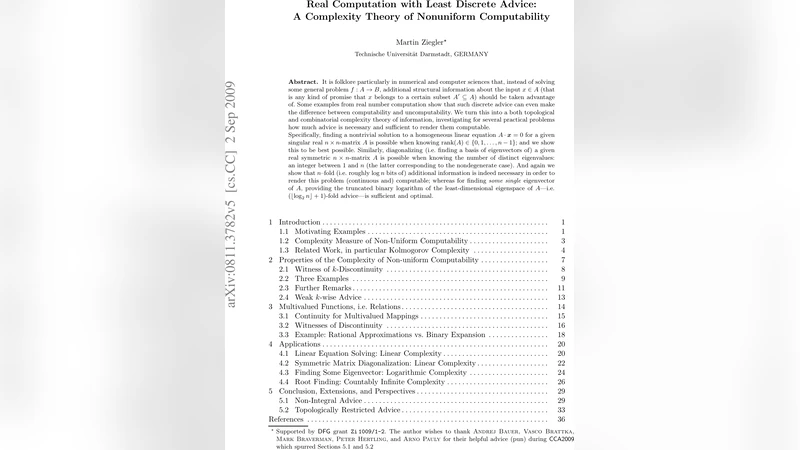
It is folklore particularly in numerical and computer sciences that, instead of solving some general problem f:A->B, additional structural information about the input x in A (that is any kind of promise that x belongs to a certain subset A’ of A) should be taken advantage of. Some examples from real number computation show that such discrete advice can even make the difference between computability and uncomputability. We turn this into a both topological and combinatorial complexity theory of information, investigating for several practical problems how much advice is necessary and sufficient to render them computable. Specifically, finding a nontrivial solution to a homogeneous linear equation A*x=0 for a given singular real NxN-matrix A is possible when knowing rank(A)=0,1,…,N-1; and we show this to be best possible. Similarly, diagonalizing (i.e. finding a BASIS of eigenvectors of) a given real symmetric NxN-matrix is possible when knowing the number of distinct eigenvalues: an integer between 1 and N (the latter corresponding to the nondegenerate case). And again we show that N-fold (i.e. roughly log N bits of) additional information is indeed necessary in order to render this problem (continuous and) computable; whereas for finding SOME SINGLE eigenvector of A, providing the truncated binary logarithm of the least-dimensional eigenspace of A–i.e. Theta(log N)-fold advice–is sufficient and optimal.
💡 Research Summary
The paper develops a systematic theory of “non‑uniform computability” for real‑valued problems by quantifying the minimal discrete advice required to turn otherwise uncomputable tasks into computable ones. Starting from the well‑known Main Theorem of Recursive Analysis, which states that any computable real function must be continuous, the author introduces the notion of k‑wise advice: the input space is partitioned into at most k pieces, each equipped with its own continuous realizer. The smallest such k is defined as the advice complexity C_c(f), and it is shown that the topological discontinuity measure C_t(f) never exceeds C_c(f).
The framework is applied to several concrete problems. For a singular n×n real matrix A, knowing its rank r∈{0,…,n−1} suffices to compute a non‑trivial solution of Ax=0, and the paper proves that without this rank information the problem remains discontinuous and thus non‑computable. Hence the advice complexity is Θ(log n) bits (i.e., n‑fold advice). For diagonalizing a symmetric matrix, the number k of distinct eigenvalues is enough to obtain a full orthogonal eigenbasis; the author shows that exactly n‑fold advice (again Θ(log n) bits) is both necessary and sufficient. In contrast, finding a single eigenvector only requires the binary logarithm of the dimension of the smallest eigenspace, i.e., ⌊log₂ d⌋+1 bits of advice, and this bound is proved optimal.
Further examples include identifying extreme points of a convex hull, where knowing only the total number of extreme points already reduces the advice requirement to (N−1)‑fold, and root‑finding problems that exhibit countably infinite advice complexity. The paper also relates advice complexity to Kolmogorov complexity, demonstrates independence from classical measurability hierarchies (Borel, Wadge), and constructs functions that are 2‑computable but not measurable, Δ₂‑measurable but not k‑continuous for any finite k, and even continuous yet non‑computable relative to any oracle.
In the concluding sections the author discusses extensions to non‑integer advice, topologically restricted advice, and potential applications in numerical analysis, computational geometry, and optimization. The work thus provides a robust, quantitative bridge between discrete information and continuous computation, opening a new avenue for analyzing the intrinsic difficulty of real‑number algorithms.
Comments & Academic Discussion
Loading comments...
Leave a Comment