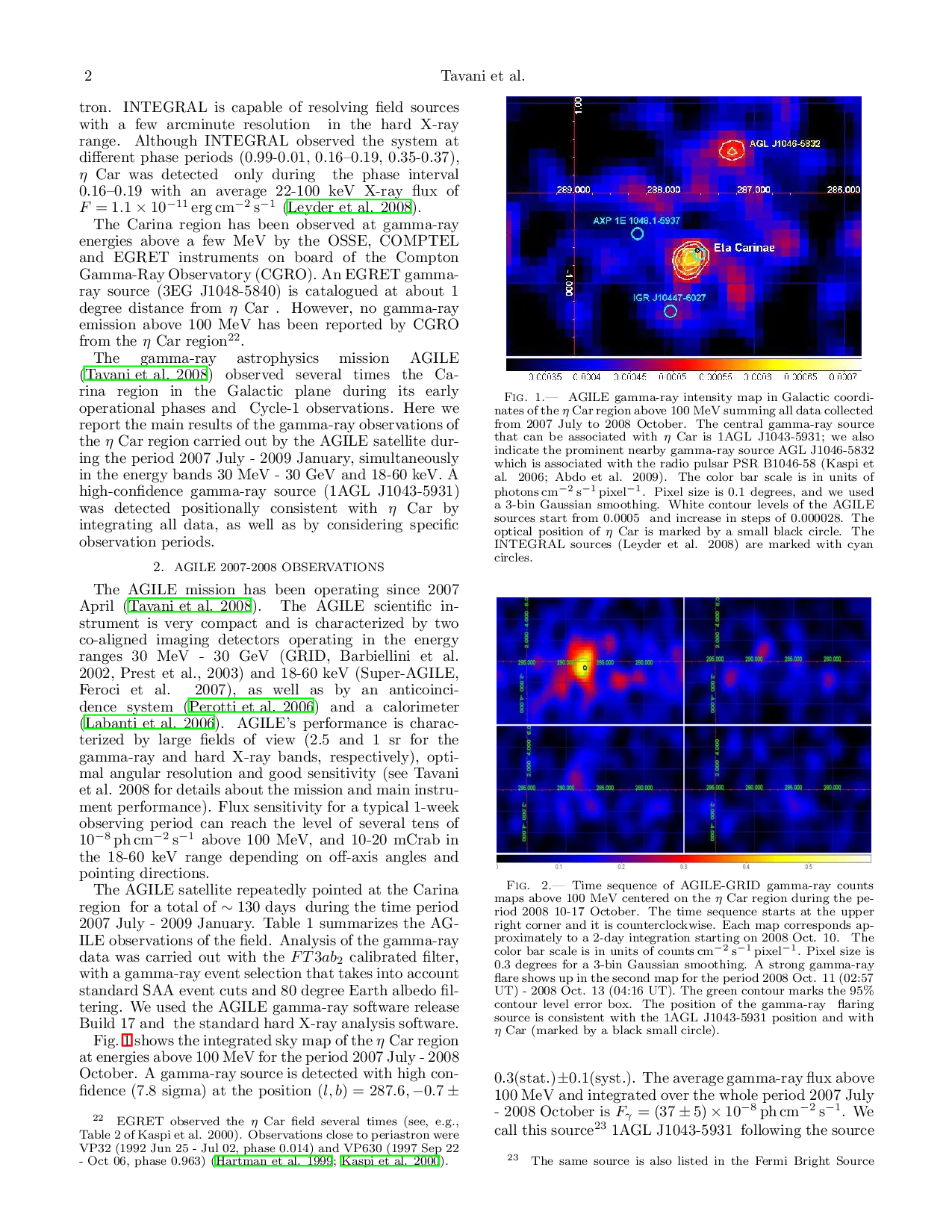
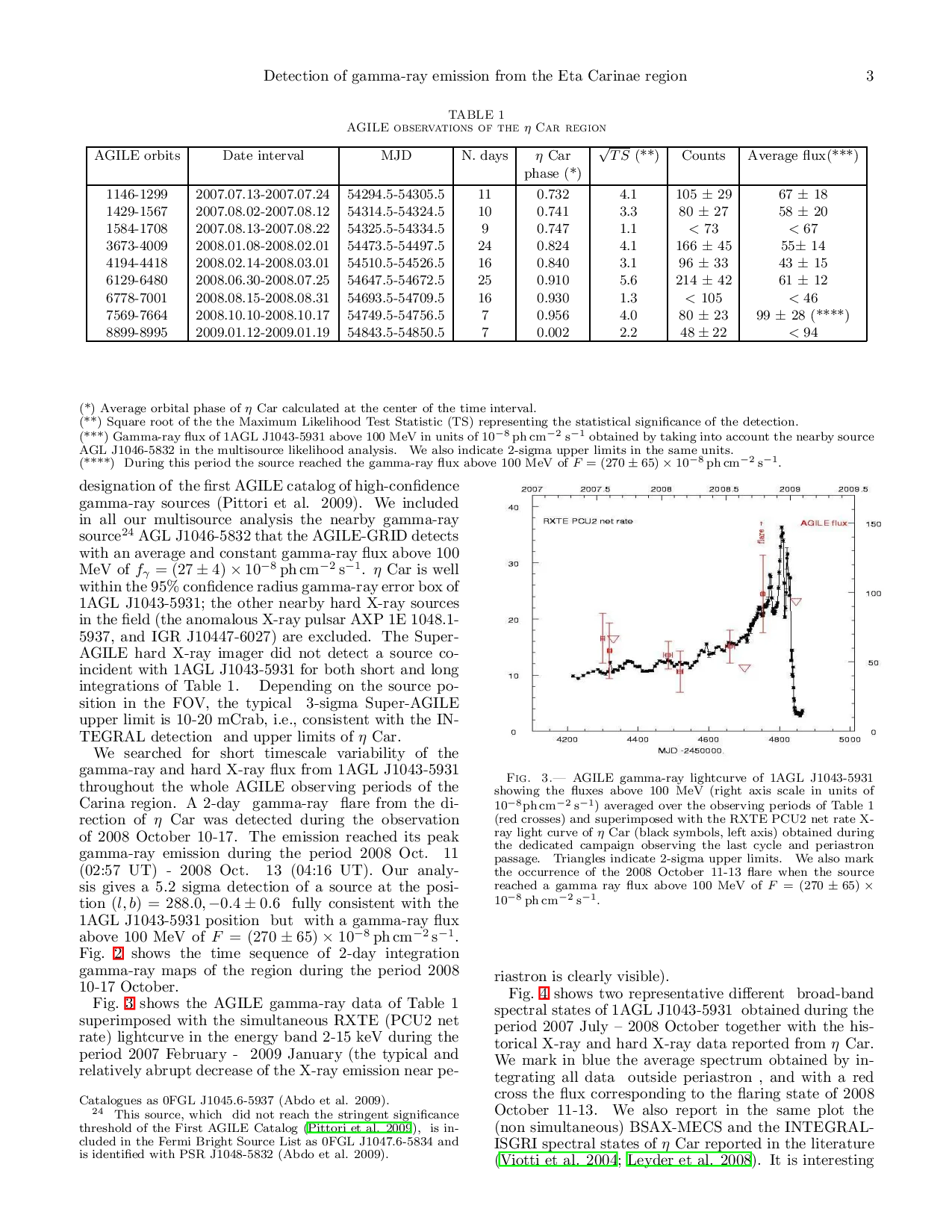
We present the results of extensive observations by the gamma-ray AGILE satellite of the Galactic region hosting the Carina nebula and the remarkable colliding wind binary Eta Carinae (Eta Car) during the period 2007 July to 2009 January. We detect a gamma-ray source (1AGL J1043-5931) consistent with the position of Eta Car. If 1AGL J1043-5931 is associated with the Eta Car system our data provide the long sought first detection above 100 MeV of a colliding wind binary. The average gamma-ray flux above 100 MeV and integrated over the pre-periastron period 2007 July to 2008 October is F = (37 +/- 5) x 10-8 ph cm-2 s-1 corresponding to an average gamma-ray luminosity of L = 3.4 x 10^34 erg s-1 for a distance of 2.3 kpc. We also report a 2-day gamma-ray flaring episode of 1AGL J1043-5931 on 2008 Oct. 11-13 possibly related to a transient acceleration and radiation episode of the strongly variable shock in the system.
Deep Dive into Detection of Gamma-ray Emission from the Eta-Carinae Region.
We present the results of extensive observations by the gamma-ray AGILE satellite of the Galactic region hosting the Carina nebula and the remarkable colliding wind binary Eta Carinae (Eta Car) during the period 2007 July to 2009 January. We detect a gamma-ray source (1AGL J1043-5931) consistent with the position of Eta Car. If 1AGL J1043-5931 is associated with the Eta Car system our data provide the long sought first detection above 100 MeV of a colliding wind binary. The average gamma-ray flux above 100 MeV and integrated over the pre-periastron period 2007 July to 2008 October is F = (37 +/- 5) x 10-8 ph cm-2 s-1 corresponding to an average gamma-ray luminosity of L = 3.4 x 10^34 erg s-1 for a distance of 2.3 kpc. We also report a 2-day gamma-ray flaring episode of 1AGL J1043-5931 on 2008 Oct. 11-13 possibly related to a transient acceleration and radiation episode of the strongly variable shock in the system.
η Car is a very massive (∼ 100 solar masses) star known for its strong mass outflow eruptions, and is one of the most interesting objects of our Galaxy (e.g., Davidson & Humphrey 1997). Radial velocity variations of spectroscopic lines accumulated over the years provide a strong evidence that η Car is a binary system (e.g., Damineli et al. 2008a,b) where the primary star is a luminous blue variable (LBV) star orbiting in a very eccentric binary (e ∼ 0.9) with a companion star believed to be an O star of ∼ 30 solar masses. The orbital period is 5.53 years (∼2023 days) (e.g., Damineli et al., 2008a): the system has been monitored in the radio, mm, IR, optical and X-ray bands for at least three cycles. Both stars emit dense and high-velocity gaseous winds, and the binary system is ideal to study the interaction of colliding winds and to test theories of particle acceleration and radiation under extreme conditions. The mass outflow rates and wind speeds of the two stars inferred from the wealth of all available data are Ṁ1 ≃ 2 × 10 -4 M ⊙ yr -1 , Ṁ2 ≃ 2 × 10 -5 M ⊙ yr -1 , v 1 ≃ 600 km s -1 , v 2 ≃ 3000 km s -1 (Pittard et al. 2005). Eta Car is then interesting among other colliding wind binaries since the observable X-ray emission in the 2-10 keV band is almost entirely produced by the shocked fast wind of the secondary star, with little if any contribution from the slow shocked wind of Eta Car itself. The system is known for its variability and occasional erratic eruptions detected in the IR and optical bands, as well as for its distinct asymmetric pattern of optical line and X-ray emission during its orbital period (Corcoran et al. 2001).
η Car has been repeatedly observed in the energy ranges 1-10 keV and 20-100 keV by different observatories. It is certainly the only source showing a nonthermal X-ray spectrum within a region centered on η Car with a 1 degree diameter (the anomalous X-ray pulsar AXP 1E 1048.1-5937 is about 0.6 degrees away). Whereas the 1-10 keV spectrum is dominated by a quasithermal and variable component (Corcoran et al. 2001;Corcoran 2005;Viotti et al. 2002), the hard X-ray observations show non-thermal emission that appears to vary along the orbit (Viotti et al. 2004;Leyder et al. 2008). The η Car source was detected with high significance by BSAX-PDS and INTEGRAL-ISGRI far from perias-tron. INTEGRAL is capable of resolving field sources with a few arcminute resolution in the hard X-ray range. Although INTEGRAL observed the system at different phase periods (0.99-0.01, 0.16-0.19, 0.35-0.37), η Car was detected only during the phase interval 0.16-0.19 with an average 22-100 keV X-ray flux of F = 1.1 × 10 -11 erg cm -2 s -1 (Leyder et al. 2008).
The Carina region has been observed at gamma-ray energies above a few MeV by the OSSE, COMPTEL and EGRET instruments on board of the Compton Gamma-Ray Observatory (CGRO). An EGRET gammaray source (3EG J1048-5840) is catalogued at about 1 degree distance from η Car . However, no gamma-ray emission above 100 MeV has been reported by CGRO from the η Car region 22 .
The gamma-ray astrophysics mission AGILE (Tavani et al. 2008) observed several times the Carina region in the Galactic plane during its early operational phases and Cycle-1 observations. Here we report the main results of the gamma-ray observations of the η Car region carried out by the AGILE satellite during the period 2007 July -2009 January, simultaneously in the energy bands 30 MeV -30 GeV and 18-60 keV. A high-confidence gamma-ray source (1AGL J1043-5931) was detected positionally consistent with η Car by integrating all data, as well as by considering specific observation periods.
The AGILE mission has been operating since 2007 April (Tavani et al. 2008). The AGILE scientific instrument is very compact and is characterized by two co-aligned imaging detectors operating in the energy ranges 30 MeV -30 GeV (GRID, Barbiellini et al. 2002, Prest et al., 2003) and 18-60 keV (Super-AGILE, Feroci et al. 2007), as well as by an anticoincidence system (Perotti et al. 2006) and a calorimeter (Labanti et al. 2006). AGILE’s performance is characterized by large fields of view (2.5 and 1 sr for the gamma-ray and hard X-ray bands, respectively), optimal angular resolution and good sensitivity (see Tavani et al. 2008 for details about the mission and main instrument performance). Flux sensitivity for a typical 1-week observing period can reach the level of several tens of 10 -8 ph cm -2 s -1 above 100 MeV, and 10-20 mCrab in the 18-60 keV range depending on off-axis angles and pointing directions.
The AGILE satellite repeatedly pointed at the Carina region for a total of ∼ 130 days during the time period 2007 July -2009 January. Table 1 summarizes the AG-ILE observations of the field. Analysis of the gamma-ray data was carried out with the F T 3ab 2 calibrated filter, with a gamma-ray event selection that takes into account standard SAA event cuts and 80 degree Earth albedo filtering. We used
…(Full text truncated)…
This content is AI-processed based on ArXiv data.