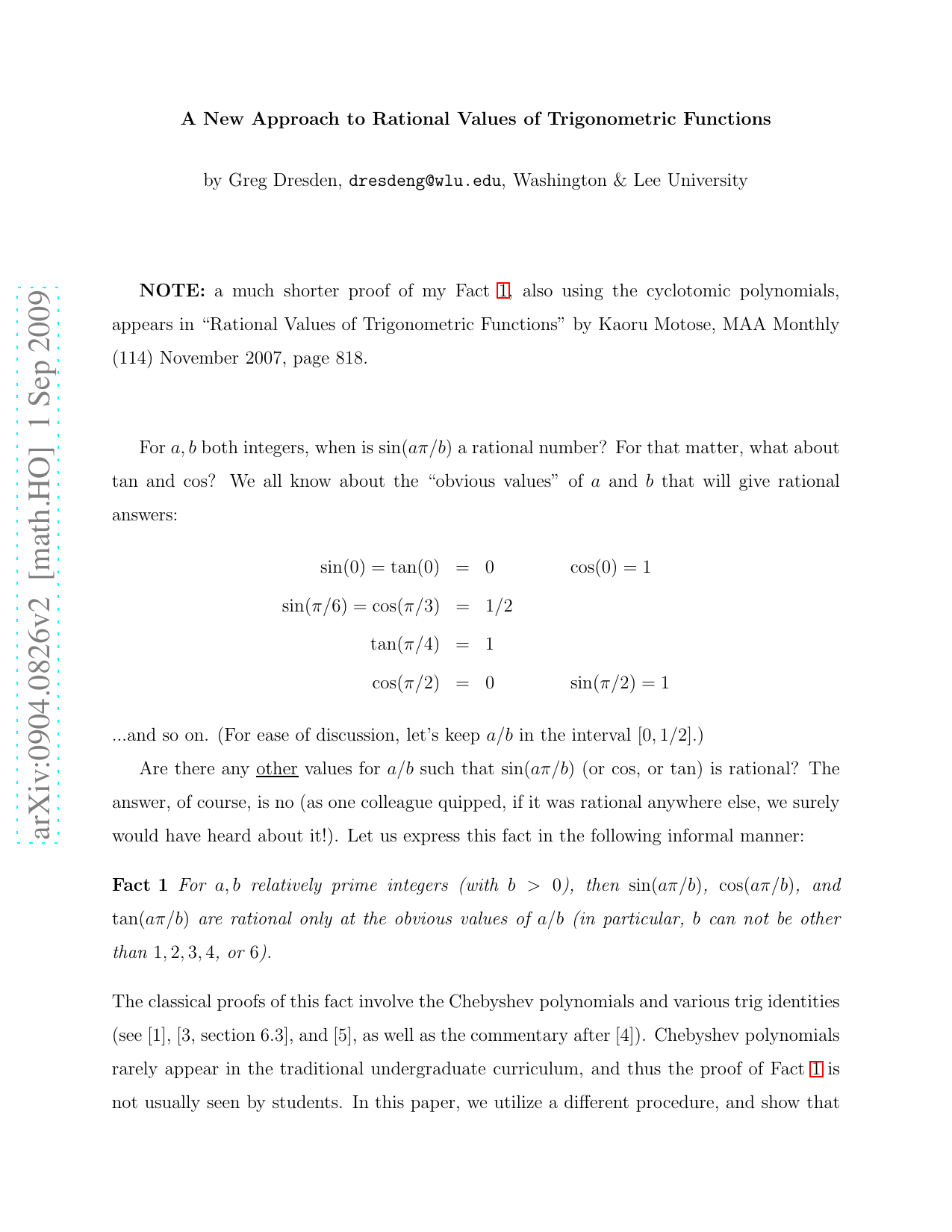
It is well known that sin(a\pi/b), cos(a\pi/b), etc., are only rational numbers for a few select integers a and b. We show that this is equivalent to the fact that only for d = 1,2,3,4, and 6 is the primitive dth root of unity of degree 2 over Q.
Deep Dive into A New Approach to Rational Values of Trigonometric Functions.
It is well known that sin(a\pi/b), cos(a\pi/b), etc., are only rational numbers for a few select integers a and b. We show that this is equivalent to the fact that only for d = 1,2,3,4, and 6 is the primitive dth root of unity of degree 2 over Q.
The classical proofs of this fact involve the Chebyshev polynomials and various trig identities (see [1], [3, section 6.3], and [5], as well as the commentary after [4]). Chebyshev polynomials rarely appear in the traditional undergraduate curriculum, and thus the proof of Fact 1 is not usually seen by students. In this paper, we utilize a different procedure, and show that Fact 1 is in fact equivalent to the following well-known statement, familiar to most algebra students:
Fact 2 For c, d relatively prime integers (with d > 0), the primitive dth root of unity e 2πic/d has degree ≤ 2 over Q iff d = 1, 2, 3, 4, or 6.
We point out that this topic is well suited for an abstract algebra class, and provides a delightful application of the theory of field extensions. The method outlined here is relatively also the complex number i sin(2πc/d). These can’t both be degree 2 over Q, as the field K, being only of degree 2, can’t contain both a real degree-2 subfield and a complex degree-2 subfield. Thus, either sin(2πc/d) = 0 or cos(2πc/d) ∈ Q. By Fact 1, the first case gives d = 1 or 2, and the second gives d = 1, 2, 3, 4, or 6.
Second, suppose Fact 2 is true. Choose a rational number a/b in reduced form such that tan(aπ/b) equals some rational number r, and let v = 1 + ri (see Figure 1, below). Now, v is in Q(i), but since it’s not of length 1, it clearly is not a root of unity and so we can’t use Fact 2. So, it would be reasonable to consider
, which clearly has length 1 and argument aπ/b, and thus is a root of unity. Unfortunately, this complex number is in the possibly degree-4 field Q( √ 1 + r 2 , i) so we still can’t apply Fact 2! Instead, we look at
which is clearly in the quadratic number field Q(i). Thus, by Fact 2 (and since a, b are relatively prime) we have that b = 1, 2, 3, 4, or 6; a simple calculation shows that tangent is rational only at the obvious values.
We now proceed to show the same holds for cosine (once we have this, the rationality of sine follows from the identity sin(θ) = cos(π/2 -θ). In a similar manner to our work earlier, we choose a rational number a/b in reduced form such that cos(aπ/b) = s (for s some rational number), and let w = s + i √ 1 -s 2 (see Figure 2, above). Now, |w| = 1 and arg(w) = aπ/b, so w = e iaπ/b and is in Q(i √ 1 -s 2 ), a (complex) quadratic number field.
Thus, we can apply Fact 2 to note that b must be 1, 2, 3, 4, or 6, and again, calculations give us the desired obvious values.
This completes our proof of the equivalence of the two facts, but it does not mark the end of this intriguing area of study. For example, we note that the roots of unity of degree all simple radicals of degree 2 over Q. The interested reader might want to generalize Facts 1 and 2 to include this correspondence (as well as others of arbitrary degree). Indeed, this might well lead to an alternate proof of the well-known statement that the trig functions are algebraic at all rational multiples of π.
references
This content is AI-processed based on ArXiv data.